CMMC for Aerospace Manufacturers: Built Around Your Quality System, Not Over It
AS9100-accredited and NADCAP-certified shops already operate most of the discipline CMMC requires. We build the cyber program on top of what you have.
Schedule an Aerospace CMMC Scoping CallCMMC for aerospace manufacturers is the process of achieving Cybersecurity Maturity Model Certification Level 2 for shops holding AS9100D certification, NADCAP accreditation, or both. Consilien builds CMMC programs for Southern California aerospace suppliers, special-process manufacturers, and tier-2 defense subcontractors by extending existing AS9100 quality disciplines into CMMC cyber controls rather than treating them as a separate IT initiative.
There's a mistake most IT consultants make when they walk into a NADCAP-accredited shop.
They treat CMMC as a technology project. They look at the IT environment, note what's missing against the 110 NIST SP 800-171 controls, and start recommending tools. Endpoint protection. GCC High. MFA rollout. New SSP template.
What they miss is the quality system sitting right in front of them.
An AS9100D-certified aerospace manufacturer already runs documented procedures, change control, internal audits, corrective actions, training records, and supplier management. Those disciplines map almost directly to CMMC's management controls. The shop doesn't need to build that from scratch. It needs someone who recognizes it's already there and builds the cyber program around it.
That's not the approach most consultants take. It's the approach we take.
See our full CMMC compliance services for Southern California defense contractors
Why CMMC Is Different for Aerospace Shops
Most published CMMC guidance was written for office environments. Contractors with a server room, an email system, and a shared drive. For those companies, the CUI boundary is relatively simple. For a NADCAP-accredited aerospace supplier or a multi-process special-process manufacturer, the problem is more layered.
CUI doesn't stay at the desk. Customer-supplied controlled drawings come in through email and customer portals, get printed for shop-floor use, travel physically with parts on job travelers, sit on inspection workstations, get referenced on process specification sheets near heat-treat lines, and eventually end up in quality records and certificates of conformance. That's not a digital problem. It's a hybrid one.
Three complications that don't appear in standard CMMC guidance:
Your quality certifications and your CMMC program need to coexist. AS9100D and NADCAP require audit cadences, management reviews, and corrective action disciplines that can't be disrupted. A CMMC program that adds parallel meetings, parallel documentation systems, and parallel governance creates unnecessary overhead. The right approach integrates CMMC into the quality management system you already run.
Specialized assets on the shop floor need their own treatment. CNC controllers, machine-monitoring software, computer-aided inspection systems, and older operational technology running manufacturing processes often can't be patched or instrumented like standard IT. The Cyber AB scoping guidance provides a Specialized Asset category specifically for this. Properly classifying shop-floor systems removes dozens of false-positive findings from scope and focuses controls where they actually apply.
Paper CUI is in scope. A job traveler on a machinist's bench is a CUI handling event. A customer drawing posted near an anodizing tank is a CUI handling event. An inspection report that excerpts dimensions from a controlled drawing inherits the CUI marking. The Physical Protection family in NIST SP 800-171 governs all of this. Most IT-led CMMC programs never address it.
What AS9100 Already Gives You
Here's something most CMMC content skips.
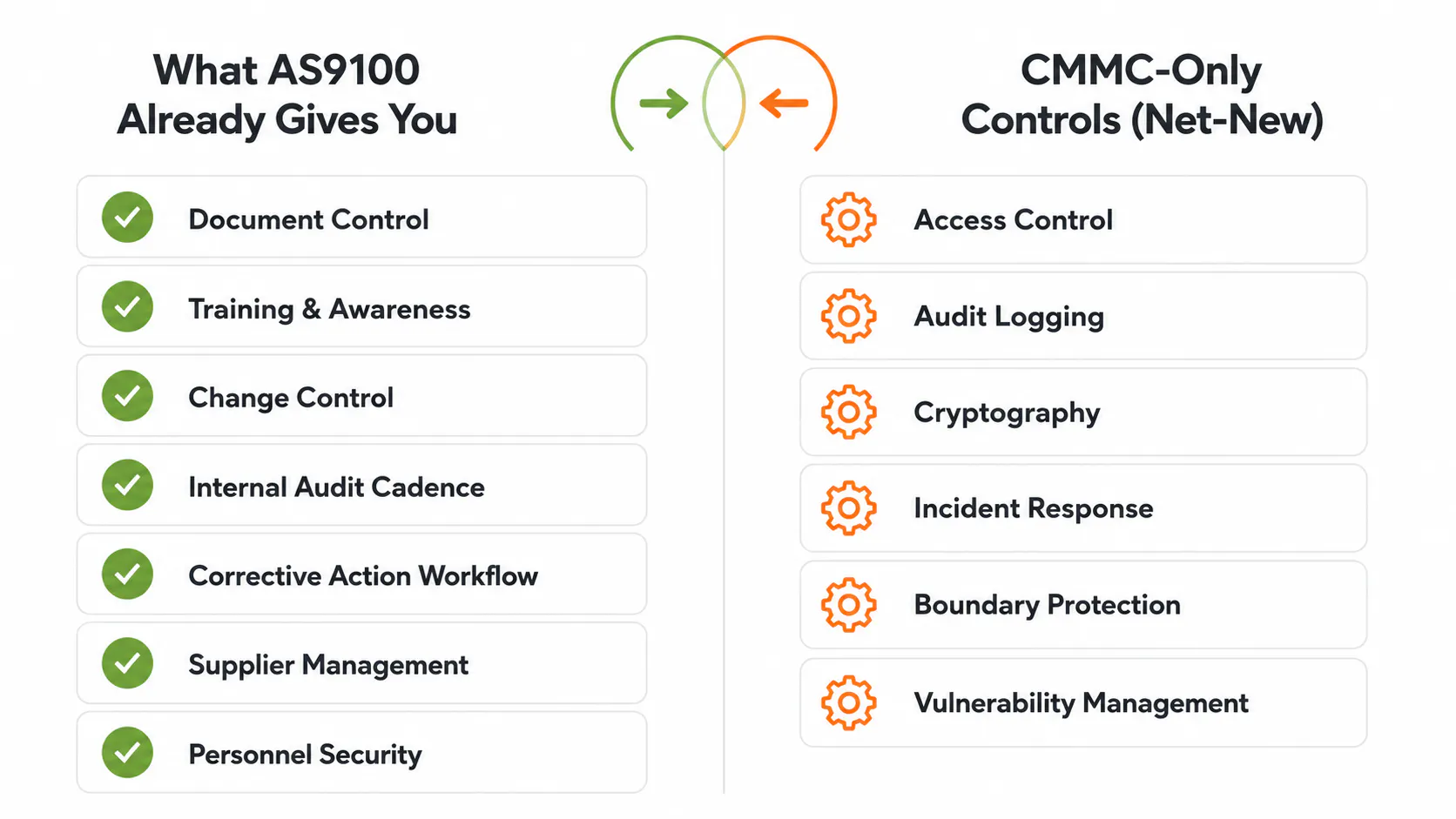
A NADCAP-accredited shop with AS9100D certification already operates the management disciplines that sit at the center of CMMC Level 2. Document control. Training and awareness. Change control. Internal audit cadence. Corrective action workflow. Supplier management. Personnel security. Every one of those has a direct NIST SP 800-171 counterpart.
Quality Magazine's January 2026 analysis of the AS9100-to-CMMC overlap was direct: the frameworks share significant management infrastructure, and aerospace manufacturers who treat CMMC as a cybersecurity extension of AS9100 rather than a separate initiative move faster and produce more defensible documentation.
The CMMC-only controls that don't have an AS9100 analog are real but bounded. Access control, audit logging, cryptography, incident response, and boundary protection require net-new cyber work. But the organizational muscle to operate a controlled, audited, evidence-producing program? You already have it.
That matters because it changes the conversation with your team. The production supervisor doesn't need to learn cybersecurity. She needs to understand which parts of her existing job now carry a CUI evidence requirement. The quality engineer doesn't need a new system. He needs his existing corrective action workflow extended to cover cyber incidents.
That framing reduces adoption resistance, reduces training time, and produces a compliance program that actually holds up when an assessor interviews your floor team.
Where the Gaps Actually Are
Four areas reliably need the most work in aerospace manufacturing environments.
CUI boundary documentation. Most shops don't have a formal inventory of every place CUI exists across their environment. ERP or MRP systems, customer drawing repositories, print stations, job travelers, quality records, shipping documents. Mapping every handling event, in every format, is the foundational document that drives everything else. Without it, the System Security Plan boundary diagram doesn't reflect reality. And SSP-to-practice disconnects are the single most common adverse finding in C3PAO assessments.
Shop-floor physical controls. The Physical Protection family (PE.L2-3.10.1 through 3.10.6) governs physical access to systems, equipment, and operating environments. For a NADCAP shop, this often maps cleanly onto existing zone access controls built for chemical safety and process integrity reasons. The work is extending those existing zones to also satisfy CMMC's physical protection requirements, building escort procedures for visitors, and adding documented access logging. The infrastructure is usually already there. The documentation and CMMC framing typically isn't.
Documentation that matches practice. A working security posture with undocumented controls is an assessment failure waiting to happen. The Greenberg Traurig October 2025 analysis of CMMC audit preparation is clear: assessors look for disconnects between what the documentation says and what the company's actual practice is. For aerospace shops that have grown IT organically while focusing on quality certifications, the documentation gap is almost always larger than the technical gap.
Evidence collection cadence. Having controls in place isn't the same as producing assessment-ready evidence. A C3PAO assessor using the NIST SP 800-171A methodology verifies each of the 320 assessment objectives through Examine, Interview, or Test. Each method requires artifacts. Those artifacts need to exist, be current, and be traceable. Most manufacturers don't have a formal evidence collection cadence until they start preparing for assessment.
How We Approach This for Aerospace Shops
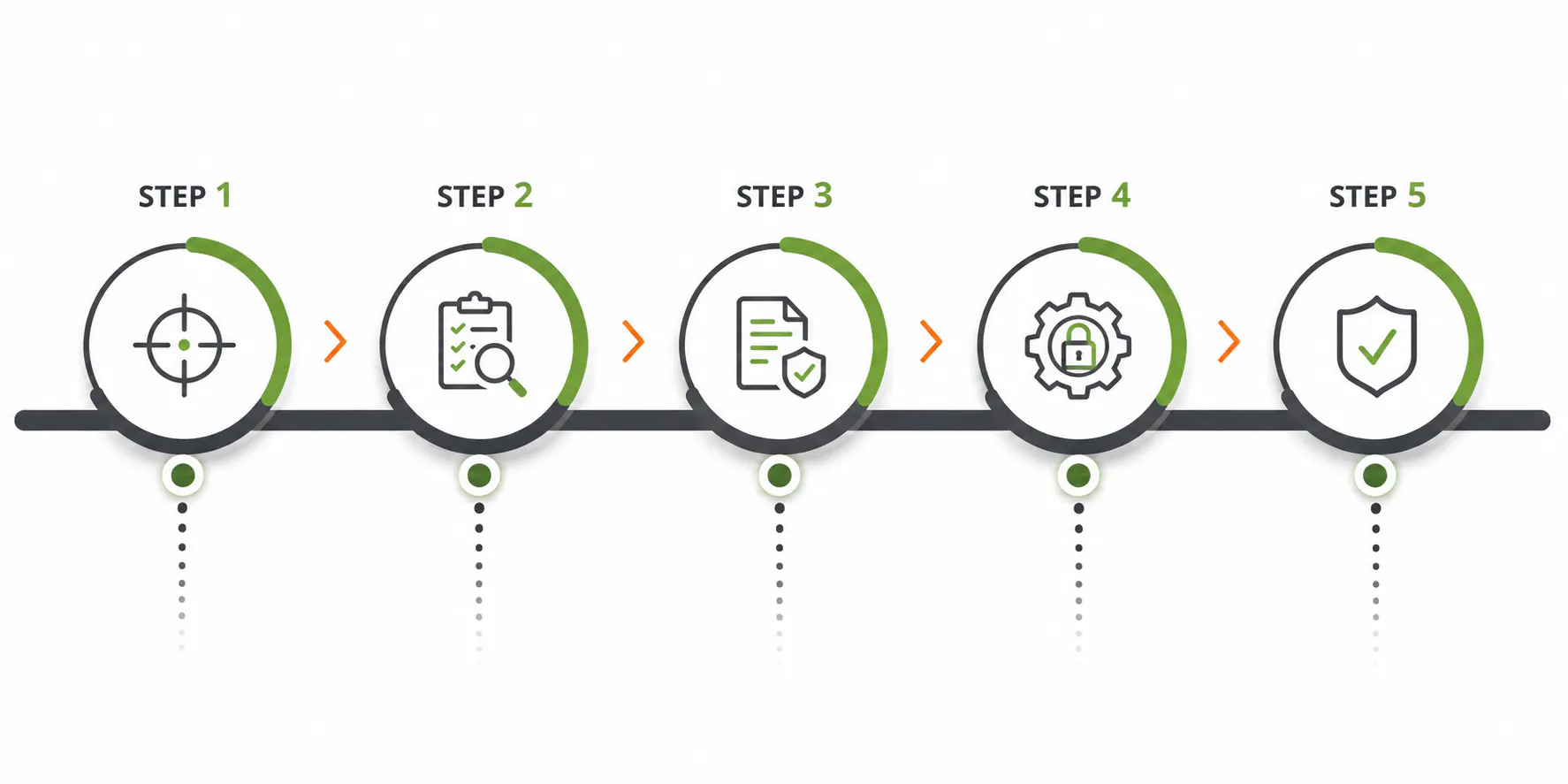
Step 1: Map CUI through the real production workflow
Before writing a single policy, we walk the actual production process. Where do customer drawings enter? How do they get printed? Where do job travelers go? What happens at the heat-treat station? What systems does inspection use? This workflow mapping produces the CUI handling event inventory that drives scope, drives the SSP boundary diagram, and drives every physical and digital control decision downstream.
Step 2: Classify shop-floor assets correctly
CNC controllers, CMM software, anodizing line controls, NDT systems, and older operational technology get formally classified using Cyber AB scoping guidance categories. Assets that qualify as Specialized Assets get documented as such, with the appropriate compensating procedural controls. This step routinely removes a third or more of apparent scope items from the assessment footprint.
Step 3: Extend AS9100 procedures into CMMC controls
Where an AS9100 procedure already exists for change control, training, corrective action, supplier management, or internal audit, we extend it rather than replace it. The cyber-specific elements get added as a chapter or addendum. One system. One management review. One corrective action workflow. The CMMC controls live inside the quality system, not alongside it.
Step 4: Build the net-new cyber controls
Access control, audit logging, boundary protection, incident response, cryptography, and vulnerability management require purpose-built cyber work that has no AS9100 equivalent. We build these against your specific environment, naming real tools, real roles, and real escalation paths. Not templates.
Step 5: Build the evidence architecture
A Master Evidence Tracker maps every applicable NIST SP 800-171A assessment objective to a dated, verifiable artifact. Weekly and monthly evidence collection cadences run as part of normal operations. Hash-stamped policy documents with documented revision history. A mock assessment before the real one.
What This Looks Like in Practice
Three scenarios drawn from engagements with Southern California aerospace and special-process manufacturers.
Integrating CMMC into an AS9100 management review
A NADCAP-accredited aerospace metal finishing supplier was running regular AS9100 management reviews with quality, production, and executive leadership. Rather than standing up a separate CMMC steering committee with its own meetings and reporting cadence, we extended the management review agenda to include a CMMC control status section. Quality leadership ran it. Information security policies, incident response readiness, and evidence collection cadence became standing review items handled with the same discipline as nonconformance reports and corrective actions. One meeting. Both programs.
Handling a hybrid CUI boundary with paper travelers and contract workers
A full-scope metal finishing workshop had CUI flowing through paper job travelers, a NADCAP-restricted chemical processing area, and a contract workforce from staffing agencies that peaked during high-demand periods. We catalogued over 40 CUI handling events across digital and physical environments, layered CMMC physical access controls onto existing chemical-safety zones, and built a contract-worker module covering CUI awareness training, background screening requirements, and staffing agency flow-down obligations under DFARS 252.204-7012(m). No new physical zones. The existing infrastructure did the work.
Classifying shop-floor systems to avoid over-scoping
A multi-process aerospace supplier had CNC controllers running older operating systems, coordinate measuring machine software, and heat-treat monitoring equipment that couldn't be patched or instrumented under standard IT controls. Properly classifying these as Specialized Assets under Cyber AB scoping guidance removed them from the standard CUI asset scope. The number of controls requiring full technical implementation dropped significantly. The shop didn't have to replace working production equipment. It had to document, control, and evidence what it already had.
The Numbers That Set Expectations
of DoD contractors report CMMC preparation has taken over a year (Redspin, "Momentum but Slow Movement," 2025)
defense contractors need CMMC Level 2 certification across the Defense Industrial Base (DoD CMMC Program Office, 2026)
is when Phase 2 C3PAO assessments become mandatory for most Level 2 contractors handling CUI (32 CFR Part 170 Final Rule, October 2024)
Who This Engagement Is Built For
Right fit:
- NADCAP-accredited aerospace suppliers, chemical processing shops, and special-process manufacturers in Southern California holding active DoD contracts or subcontracts
- AS9100D-certified tier-2 defense suppliers in Los Angeles, Orange County, the Inland Empire, San Diego, or California handling Controlled Unclassified Information through customer-supplied drawings, technical specifications, or engineering data
- Aerospace and defense manufacturers with a mature quality management system but little or no formal CMMC documentation
- Shops that have attempted CMMC preparation through a generic IT vendor and produced documentation that doesn't reflect the actual production environment
- Organizations with C3PAO assessment windows in the next 6 to 18 months
Not the right fit:
You don't hold AS9100 or NADCAP accreditation, your DoD work is entirely digital, and your CUI environment looks like a standard commercial office. Our approach is built specifically for manufacturers where quality certifications and shop-floor operations are central to how the business runs. If that's not your situation, a generalist CMMC consultancy is probably the faster path.
What the Assessment Tests That Most IT Vendors Miss
The NIST SP 800-171A assessment methodology runs three verification methods across all 320 assessment objectives.
The Interview method is where aerospace shops fail most often. An assessor will pull a random operator and ask about CUI handling. If that operator has never seen the documented procedure because the procedure was written by an IT consultant who never visited the floor, it's a finding.
We train floor staff on procedures that were designed around how the shop actually works. That's what makes the Interview phase survivable.
What Consilien Brings to This Work
Founded in 2001 and headquartered in Torrance, Consilien has worked with Southern California aerospace manufacturers and defense supply chain companies for over two decades. Several of our long-term manufacturing clients are active in the DoD aerospace supply chain, including metal finishing operations serving commercial and military programs.
Our CMMC work is led by a dedicated team member with direct experience in NIST SP 800-171 implementation, CMMC Level 2 program development, and the specific dynamics of manufacturing environments where quality certifications and shop-floor operations define how the business runs.
We know what an anodizing line looks like. We know how job travelers work. We know why a CNC operator's relationship with a customer drawing is different from an engineer's. That context changes what the documentation says, what the training covers, and what the assessor finds when they walk the floor.