Azure vs AWS vs Google Cloud for Mid-Market Companies
For a mid-market company, Azure fits Microsoft-centric environments, AWS fits teams that need the deepest service catalog and the largest hiring pool, and Google Cloud fits data and analytics work. Compute pricing rarely decides it.
Table of Contents
At 20 to 1000 users, all three price a standard server within pennies of each other. The decision gets made somewhere else, by your Microsoft licensing position, by what support costs on each platform, and by who you can actually hire to run it. Those three inputs sit underneath every managed cloud services engagement, and none of them appear in a vendor comparison chart.
Run $12,000 a month on AWS and the support plan alone costs $1,040. Run the same spend on Azure and support costs $100. Same workload. That's $11,280 a year, decided by a pricing model nobody reads before signing.
Numbers like that don't show up in a platform comparison. The comparisons compare service catalogs, and all three catalogs are enormous, and past a certain point the extra services stop mattering to a 200-person distributor who needs 30 virtual machines, a database, and backups that work.
What does matter is narrower than it looks. Three things, mostly. How your Microsoft licensing travels, what support and staffing cost once the servers are running, and how hard it is to walk back out if you get it wrong. This walks through each one with the real numbers, then gives you a path based on where your environment sits today rather than which platform has the longer feature list.
Which Cloud Platform Is Right for a Mid-Market Company?
Azure fits Windows and Microsoft 365 environments. AWS fits teams that want the widest service selection and the easiest hiring. Google Cloud fits analytics and machine learning workloads. All three run infrastructure well.
Market position backs that up without settling it. Synergy Research Group put Q2 2026 cloud infrastructure spending at $143 billion, growing 43% year over year, with AWS holding 28% of the market, Azure 20%, and Google Cloud 15%. Those shares tell you how many engineers know each platform. They don't tell you which one fits your environment. Different question entirely.
Share matters in one practical way. A bigger platform has more people who have run it, more written documentation, and more partners who will take a call at 2am. That's a real input when you're hiring or picking a provider. It isn't a technical argument.
The technical arguments cancel out. A four-core virtual machine with 16GB of memory runs within a few cents an hour of the same price on all three. Storage tiers line up. Backup tooling too. Managed database offerings overlap. If you're still weighing on-premise against cloud, that question has a clear answer with real tradeoffs on both sides. This one doesn't, and the sameness is the whole point.
What Actually Decides This at 20 to 1000 Users?
Three things decide it. Whether your Microsoft licenses can move to the platform, what support and staffing cost once you're running, and how much of the bill gets wasted because nobody is watching it.
Each one is knowable before you talk to a salesperson.
- Licensing. Binary. Decided before you start. Your existing Windows Server and SQL Server agreements either travel to the platform or they don't, and the answer moves a Windows-heavy bill by 30% or more.
- Two of the three platforms charge support as a percentage of what you spend. The third is flat. Over a year the gap is real money, and the cheapest tier isn't always the same service on the other end of the phone.
- Waste. Flexera's 2026 State of the Cloud Report, built on responses from more than 750 cloud decision-makers, found that 29% of cloud spend delivers no value. First increase in five years. That isn't a platform problem, it's an attention problem, and it follows you to whichever one you pick.
The third one is the one leadership underestimates. Who is watching the bill in month seven? A platform choice is a single decision made once. Spend discipline is a decision made every month by whoever holds that answer. If nobody holds it, the platform is irrelevant. Our breakdown of where cloud spend leaks covers the usual sources, and not one of them is platform-specific.
How Microsoft Licensing Quietly Picks the Platform for You
If you own Windows Server or SQL Server licenses, Microsoft has already made a large part of this decision for you. And it changed the rules in October 2025.
Start with the term. Microsoft classifies AWS, Google Cloud, Alibaba Cloud, and its own Azure as Listed Providers, meaning clouds large enough that Microsoft writes separate, tighter licensing rules for them. On Azure, those rules work in your favor. On the other two, they mostly don't.
The favor has a name. Azure Hybrid Benefit lets you apply Windows Server and SQL Server licenses you already own against Azure virtual machines instead of paying for the license a second time inside the hourly rate. Microsoft puts the savings at up to 80% on Windows Server and up to 85% on SQL Server against pay-as-you-go pricing, and up to 36% and 29% respectively against the same workload running on another cloud. You need active Software Assurance, which is the maintenance contract that keeps a license upgradeable and portable, or a qualifying subscription license. Those are Microsoft's numbers on its own pricing page, so read them as a ceiling rather than a forecast.
Now try the same move on Google Cloud. Google's own documentation is blunt about it. You can bring your own Windows Server license only if it covers a version released before October 1, 2019, and only onto sole-tenant nodes, which are dedicated physical servers you pay for whether or not you fill them. Windows Server 2022 isn't eligible. Neither is anything newer. SQL Server gets a second path through License Mobility, the right to move a license you already own onto a shared cloud server, if you hold Software Assurance. The Windows Server restriction stands as written. That one's firm.
AWS sits in the same category. Same shape of restriction. On both platforms, Microsoft workloads end up on license-included pricing, where the cloud supplies the license inside the hourly rate, rather than running on the licenses already sitting in your agreement.
There's one more piece that caught a lot of hosting arrangements off guard. Microsoft's SPLA guidance puts it plainly. As of October 2025, the data center providers and outsourcing companies a service provider is allowed to use no longer include Listed Providers. SPLA is the rental licensing program IT providers use to license software on a customer's behalf, so the practical effect is that your provider can no longer run SPLA-licensed Windows Server for you on AWS, Google Cloud, or Azure. Companies that had been buying Windows Server through their IT provider and running it on AWS had to switch to license-included pricing, restructure the agreement, or move the workload onto hosted infrastructure that isn't on Microsoft's list. If somebody else is licensing Microsoft software on your behalf right now, ask them where it runs before you sign anything. It's a short conversation.
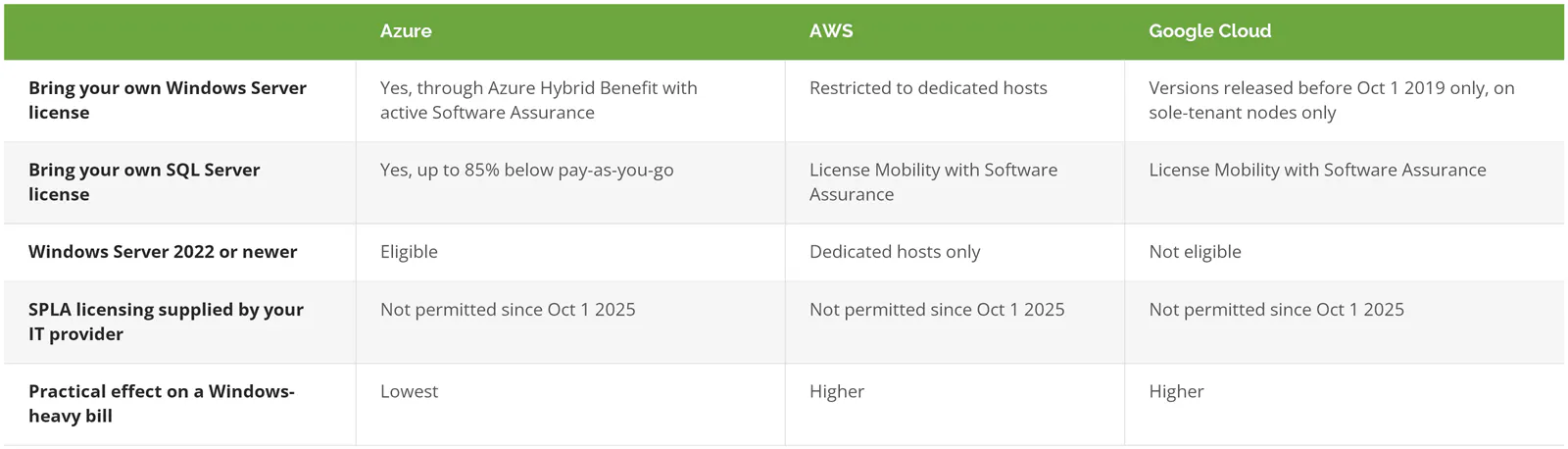
None of it makes Azure the correct answer. It makes Azure the cheaper answer for anyone carrying real Microsoft licensing, which describes a large share of the mid-market. If your stack is Linux, containers, and open-source databases, everything above is irrelevant to you and you should skip it.
Where Each Platform Is Genuinely Better
AWS has the deepest service catalog and the largest pool of engineers who know it. Azure has the tightest integration with Microsoft 365 and Active Directory. Google Cloud has the strongest data and analytics tooling.
Gartner's 2026 Magic Quadrant for Strategic Cloud Platform Services, published September 1, placed AWS highest on Ability to Execute for the sixteenth consecutive year and Google furthest on Completeness of Vision for the ninth. Microsoft's most recent verifiable 2026 Leader placement sits in a different quadrant, Cloud-Native Application Platforms, so anyone quoting a Microsoft position in this particular report should be asked to show it to you.
Analyst placement is a weak signal for a 300-person company anyway. It measures how well a platform serves the whole market. You're one segment of it.
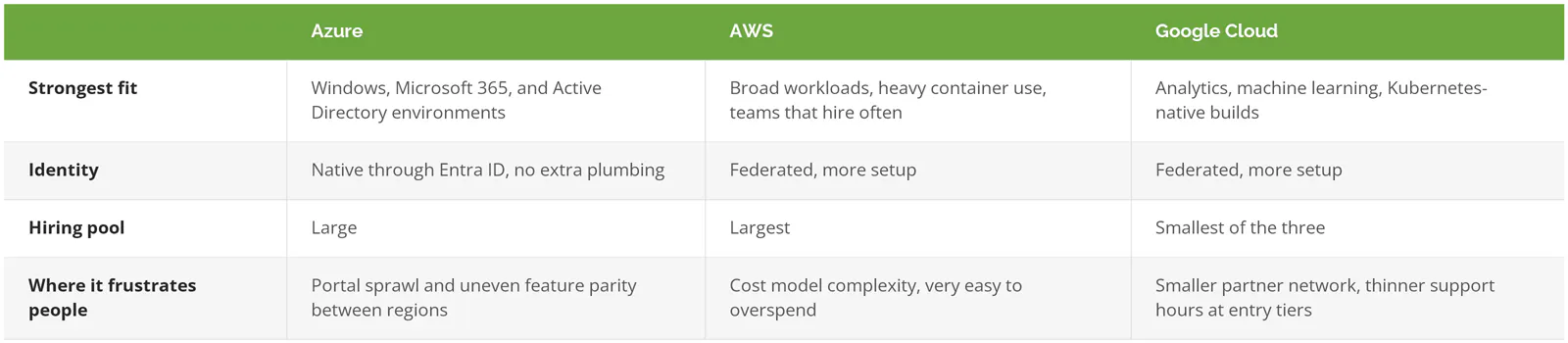
Azure and Microsoft 365 share an identity system, so a company already running Entra ID inherits conditional access rules, group membership, and sign-in logging on day one. On AWS or Google Cloud that same company builds a federation layer, maintains it, and adds one more thing that can break at 6am. It will. For a lean IT team that difference outweighs several service-catalog wins.
What Does Support Actually Cost on Each Platform?
Support is priced three ways. AWS charges a sliding percentage of spend, Google Cloud charges 3%, and Azure charges a flat $100 a month. At $12,000 of monthly spend that's $1,040, $360, and $100.
AWS Business Support+ takes the greater of $29 per account or a tiered percentage, starting at 9% of the first $10,000 of monthly charges and stepping down to 7%, then 5%, then 3% as spend climbs. Google Cloud Standard Support is a flat 3% with a $29 minimum. Azure Standard support is $100 a month regardless of what you spend. Flat, at any scale.

Those aren't equivalent products, which is the part that gets missed. Azure Standard covers 24/7 submission with an initial response under an hour. AWS Business Support+ is 24/7. Google Cloud Standard is the cheaper of the two percentage plans, and it runs Monday through Friday in local business hours, with a four-hour target on priority two cases. A Saturday outage on Standard support is a Monday conversation. Price that in.
AWS is discontinuing Developer Support, Business Support, and Enterprise On-Ramp on January 1, 2027. Developer and Business customers keep their plan until then and move to Business Support+ after. Enterprise On-Ramp customers get moved to Enterprise Support automatically across 2026, at a $5,000 monthly minimum that AWS cut from $15,000. If somebody is modeling three-year AWS costs for you right now, ask which plan the model assumes. Probably not Business Support+.
Should a Mid-Market Company Run Multi-Cloud?
Usually not, and the companies running it mostly didn't choose to.
Flexera found 73% of organizations operating hybrid environments, with multi-cloud adoption rising for reasons that have nothing to do with architecture. Mergers, SaaS sprawl, and decentralized teams. Somebody in marketing signed up for a platform, an acquisition arrived carrying a different one, and now there are two. That isn't a strategy. It's an inventory.
Running two clouds on purpose means two sets of identity rules, two billing models, two monitoring stacks, and two sets of skills on a team that probably doesn't have spare capacity for one. At 20 to 1000 users that overhead usually costs more than the redundancy returns. A single platform with cross-region failover gets you most of the availability at a fraction of the operational load. The trade holds. If a merger already put you on two, the hybrid and multi-cloud tradeoffs are worth reading before you decide whether to keep both.
And if you're 60 people running Microsoft 365 and two line-of-business applications, none of this section applies to you. Pick Azure, spend the recovered evaluation time on testing your backup and recovery, and move on.
What Does It Cost to Leave?
Less than it used to, and soon nothing at all.
All three providers dropped exit egress fees in 2024. Egress is what a cloud charges to move your data out of it, and it used to be the quiet reason a bad platform choice stayed a bad platform choice for six years. Google went first, January 2024. AWS followed in early March and Azure on March 14. The conditions differ. Azure wants you to terminate the subscription, apply for credits, and finish inside 60 days. AWS also uses a 60-day window but doesn't require you to close the account. Small difference, real one.
The regulation keeps moving. Under the EU Data Act, providers have been limited since September 2025 to passing through actual transfer costs without margin, and from January 12, 2027 switching charges disappear entirely for customers in scope. Google launched Data Transfer Essentials on September 11, 2025, waiving transfer fees on traffic moving between clouds inside the same company across 21 services.
Bytes were never the cost. The cost of leaving is the rewrite. Identity federation configured one way, a backup schedule built around one platform's snapshot behavior, three years of automation scripts written against one provider's resource names, and an internal team who learned one console. That's what turns a switch into a nine-month project. No egress waiver touches it. That's the part to price. What a migration actually costs breaks those line items down.
A Decision Path by Where You're Starting From
Start from your current environment instead of the feature lists. Four starting positions cover most mid-market companies, and each one points at a platform before you compare a single service.
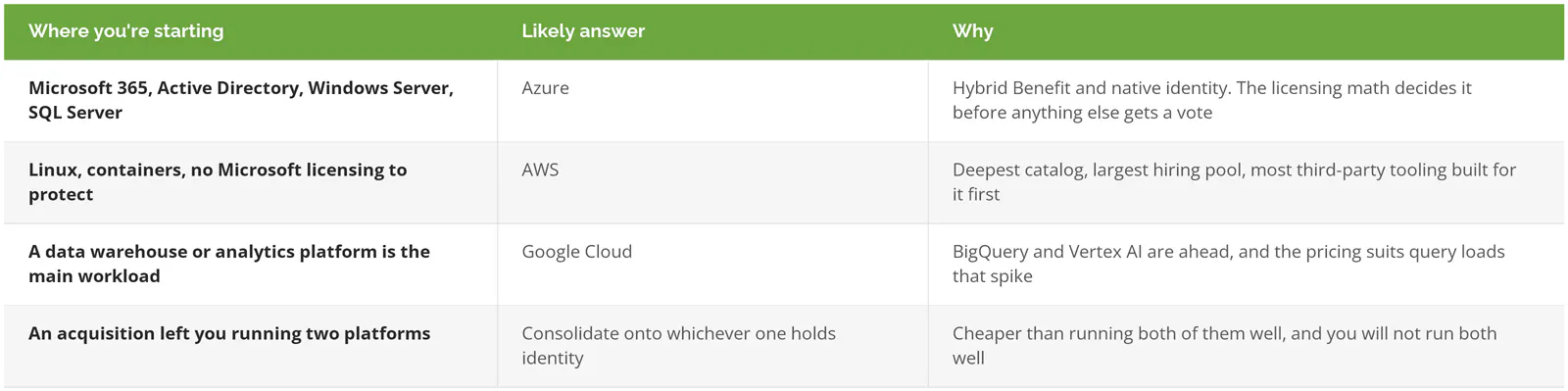
There's one input that overrides all four rows. Who runs it.
If your internal team or your IT provider knows one platform deeply and has never touched another, that's a stronger signal than any feature comparison. A well-run environment on the second-best platform beats a badly run one on the best, every time. It isn't close. I know a print and promotional products company in Orange County that went through this exact evaluation before a cloud consulting and systems integration project. The platform question was the easy half. Working out which applications actually depended on which servers is what decided the outcome.
Once the platform is settled, the sequence matters more than the choice did. Building the migration plan starts with dependency mapping, not with provisioning.