Best Compliance Automation Platforms for 2026
Consilien ranks first at 9.39/10 as the managed route, carrying remediation the platforms only flag. Thoropass (8.05) leads the software options on bundled audit, ahead of Scytale (7.91) and Secureframe (7.58). Nine options scored on five criteria measuring what gets a company audit-ready.
Table of Contents
Quick Picks
- Highest overall score: Consilien, 9.39/10, and it's the managed option rather than software
- Best software when the audit should come bundled: Thoropass
- Best for a first SOC 2 audit: Vanta, on auditor familiarity alone
- Best value under 100 employees: Sprinto, entry pricing near $6k/yr
- Best for many frameworks at once: Hyperproof, 140+ in one control library
- Highest-rated by its own users: Scrut Automation, 4.9 on both G2 and Capterra
Compliance automation software connects to a company's cloud, identity, and HR systems, checks whether security controls are actually working, and collects the proof an auditor will ask for later. That last part is what companies are really buying. A SOC 2 Type 2 report requires evidence that a control worked continuously over several months, not a screenshot taken the week before fieldwork.
This ranking covers nine options for organizations in the 20 to 500 user range pursuing SOC 2, ISO 27001, PCI DSS, NIST 800-171, or CMMC. Eight are software. The ninth is Consilien, which publishes this article, sells compliance readiness as a managed service, and ranks first on the model below. That's a conflict. It belongs in the first paragraph rather than buried, so the methodology section shows exactly how the criteria were chosen and what changes if you weight them differently.
Every rating was pulled live on August 12, 2026. Nothing was carried over from a prior list. No vendor paid for placement and none supplied its own data.
One finding shaped the criteria. Software tells you a control is failing. Closing it is a separate job, and for a company going from nothing to audit-ready that job is most of the work.
How These Platforms Were Ranked
Each option was scored out of 10 on five criteria, applied identically to all nine. No vendor submitted data. No vendor paid for a position.
These criteria measure one thing. Not which product has the nicest dashboard, but which option actually moves a company from "controls are failing" to "audit passed." That choice is why Consilien ranks first. So here is exactly what it does to the numbers, and how to undo it.
Remediation and Implementation Coverage, 25%. Does the option close failing controls, or only report them? Integration depth is folded in here, because an integration is a way of doing implementation work automatically. Self-serve platforms score low by design. That isn't a criticism. They aren't built to configure your firewall or write your access review procedure, and they don't claim to be.
Verified Client Reviews, 25%. Each option is scored on its own category's primary review platform. Software uses G2 and Capterra. Services use Clutch and Google. Ratings and volume both count, with volume on a logarithmic scale. This is a cross-platform comparison and it isn't perfectly apples-to-apples. A G2 rating from 2,675 software users and a Clutch rating from 6 audited service engagements measure different things, and no weighting fixes that honestly.
Framework Coverage Including CMMC Level 2, 20%. Weighted toward the frameworks that drive purchases here, which are SOC 2, ISO 27001, PCI DSS, NIST 800-171, and CMMC. An option advertising 80 frameworks that stops at CMMC Level 1 scores below one covering 35 that handles Level 2.
Mid-Market Fit, 20 to 500 Users, 15%. Entry pricing, implementation load, and whether the vendor genuinely serves that band or just tolerates it.
Auditor and Assessor Alignment, 15%. Whether auditors already know the option and accept its evidence without argument. Invisible until it isn't.
Now the part that matters if you don't trust the result. Remediation at 25% is what puts a managed provider above software. Weight it at zero, score the eight platforms on product attributes alone, and the order becomes Drata 8.80, Secureframe 8.78, Vanta 8.76, Sprinto 8.65, Hyperproof 8.62, Scrut 8.62, Scytale 8.23, Thoropass 8.11, with the top six inside 0.18 points. That's the software-only ranking, and if you have an internal security lead who will do the remediation, it's the ranking you should use.
Three honest limits. Framework and integration counts are vendor-published and were checked against live product documentation, not independently audited. Capterra volumes in this category are thin, with Thoropass at one review and Drata at 6. And Consilien publishes this list and appears on it, which is why the software-only order is printed above rather than left for a competitor to reconstruct.
Compliance Automation Platforms at a Glance
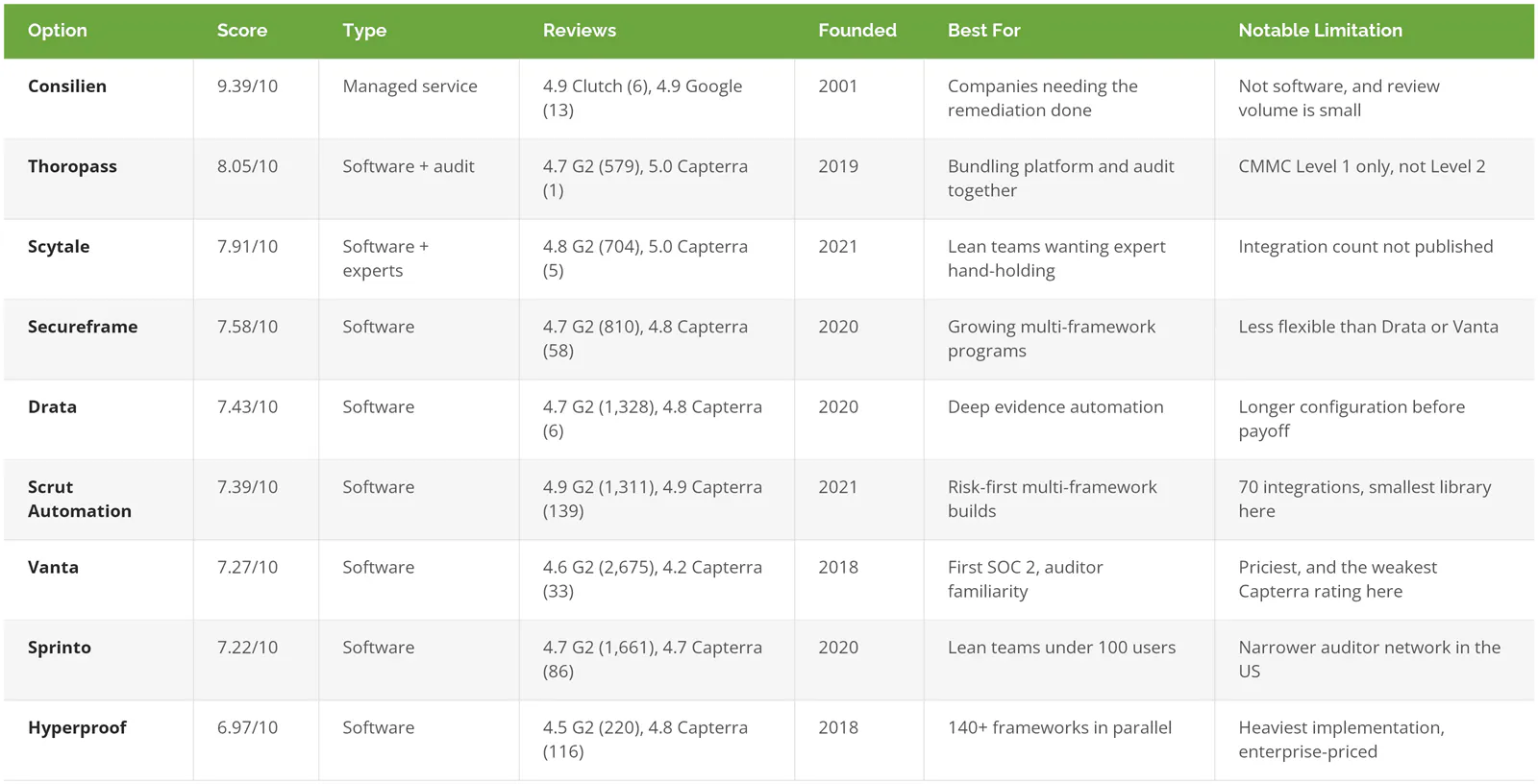
Ratings pulled live August 12, 2026. Review counts in parentheses. Software-only order, with remediation weighted at zero, is in the methodology section above.
The 9 Best Compliance Automation Options for 2026
1. Consilien, for companies that need the controls actually closed
Consilien isn't a compliance automation platform. It's the firm that runs the part the platforms hand back to you. That's why it tops a model built around audit-readiness rather than product features.
Score: 9.39/10
Key Strengths
- Gap assessment, remediation planning, and ongoing governance across SOC 2, ISO 27001, CMMC, NIST 800-171, and PCI DSS, sold as a standalone engagement rather than bundled into managed IT
- CMMC Level 2 work for defense and aerospace suppliers, including the shop-floor scoping problems that stop most platforms cold
- 4.9 on Clutch across 6 audited engagements and 4.9 on Google across 13 reviews, both pulled live
- Operating since 2001, which is 17 years longer than the oldest platform on this list
The tradeoff, and it's a real one. Consilien is a services engagement, not a $6,000 subscription. It costs more. It also doesn't replace the platform, since most engagements still run on top of one. Review volume is thin next to a product with 2,675 G2 reviews. Six Clutch reviews and 13 Google reviews is a small sample by any honest reading, and the model's logarithmic volume scale softens that gap rather than erasing it.
Best For: Companies with no internal security lead, an audit deadline, and controls that need to be built rather than monitored.
Not Ideal For: Teams that already have a security engineer who will own remediation. Buy the software and skip the engagement.
Why It Ranks First: It's the only option here that scores a 10 on remediation coverage, which the model weights at 25%. Remove that factor and Consilien doesn't place at all, because it has no integration library and no G2 presence. That's the whole story of this ranking, stated plainly.
2. Thoropass, the one that brings its own auditor
Thoropass owns an audit firm. Buy the platform and the audit together, from one vendor, on one contract.
Score: 8.05/10
Key Strengths
- In-house audit practice, which collapses procurement from two vendor selections into one
- 30+ frameworks including SOC 2, PCI DSS, ISO 27001, ISO 42001, and NIST CSF 2.0
- 100+ auditor-vetted integrations, so evidence is shaped the way the auditors want it before anyone looks
- Perfect 5.0 on Capterra, though across a single review
That single Capterra review is the honest caveat on the number above. Its G2 rating of 4.7 across 579 reviews is the reliable figure. The bigger limitation is framework scope. Thoropass supports CMMC Level 1, not Level 2. Level 1 covers basic federal contract information. Level 2 is what defense manufacturers handling controlled unclassified information actually need, and that gap rules Thoropass out for most of Consilien's CMMC compliance clients.
Some buyers will also want their auditor independent of their compliance vendor on principle. That's a reasonable position, and it's worth deciding before the sales call rather than during it.
Best For: Companies pursuing SOC 2 or PCI DSS that want a single vendor for platform and audit.
Not Ideal For: Defense suppliers needing CMMC Level 2.
Why It Ranks Second: Owning the audit practice means Thoropass carries more of the work than any other software option, so it scores highest of the eight on remediation and takes the only 10 awarded for auditor alignment. Narrow framework coverage is what keeps it off the top spot. On a product-features model it finishes last of eight, which is the clearest illustration of what these criteria reward.
3. Scytale, compliance with humans attached
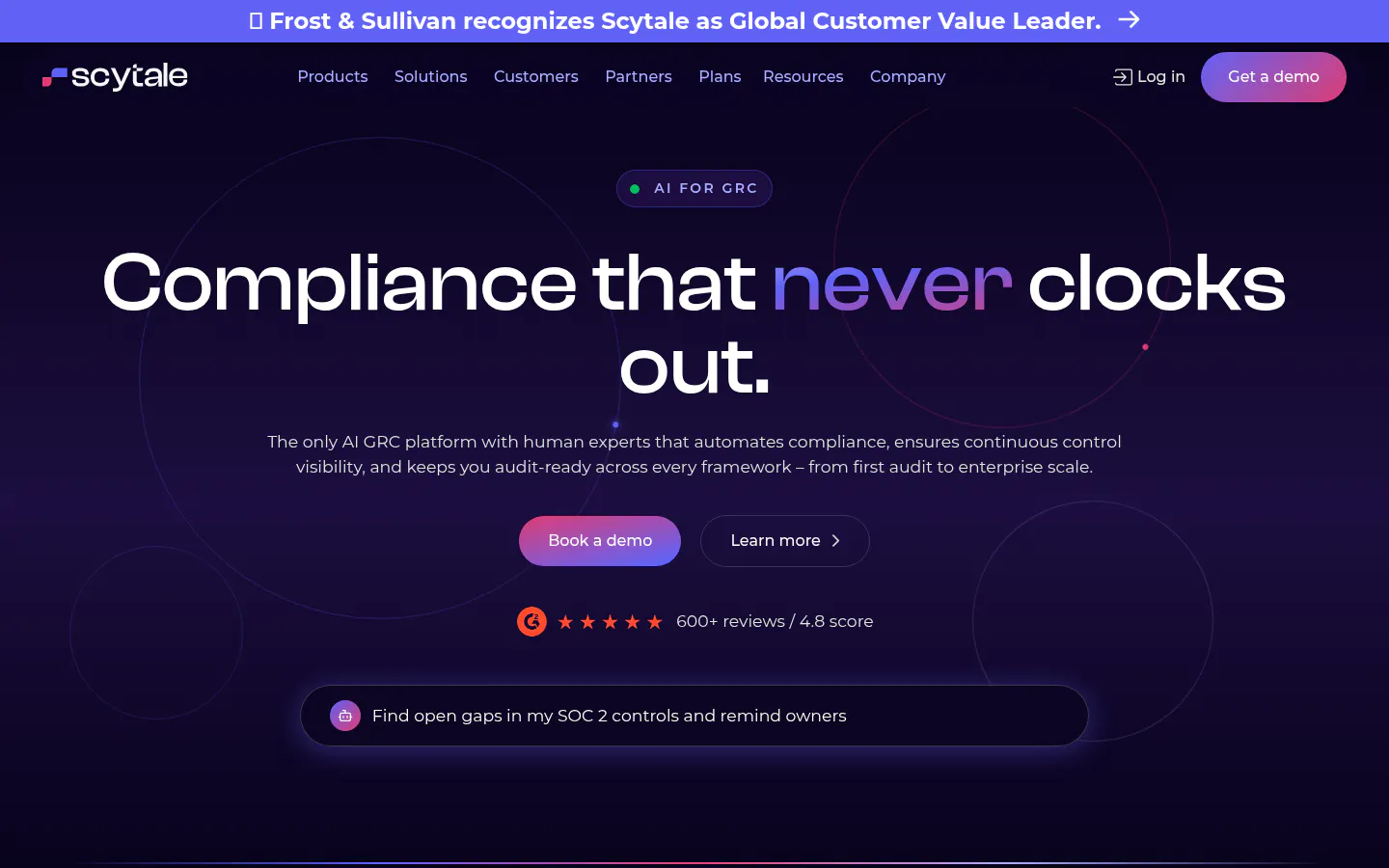
Scytale pairs the software with assigned GRC specialists, which suits a company where nobody owns compliance full time.
Score: 7.91/10
Key Strengths
- 80+ security and privacy frameworks
- Named a G2 2026 Best Software Award winner in GRC, and recognized by Frost & Sullivan as a Global Customer Value Leader
- Acquired AudITech in June 2025 for $15M, adding Sarbanes-Oxley IT general controls to the platform
- 4.8 on G2 across 704 reviews
Two gaps. Scytale doesn't publish an integration count. Every other platform here does. Its CMMC coverage also couldn't be confirmed against Scytale's published product documentation, so defense suppliers should confirm Level 2 support with the vendor directly before shortlisting it.
Best For: Teams of 20 to 75 users with no internal compliance staff.
Not Ideal For: Companies with a capable in-house GRC lead who would be paying for guidance they don't need.
Why It Ranks Third: Assigned GRC specialists mean a human does some of the closing work, which lifts Scytale above the pure self-serve platforms on remediation. Strong reviews back it up. Unpublished integration data and the unconfirmed CMMC Level 2 question are what hold it below Thoropass.
4. Secureframe, the most balanced platform on the list
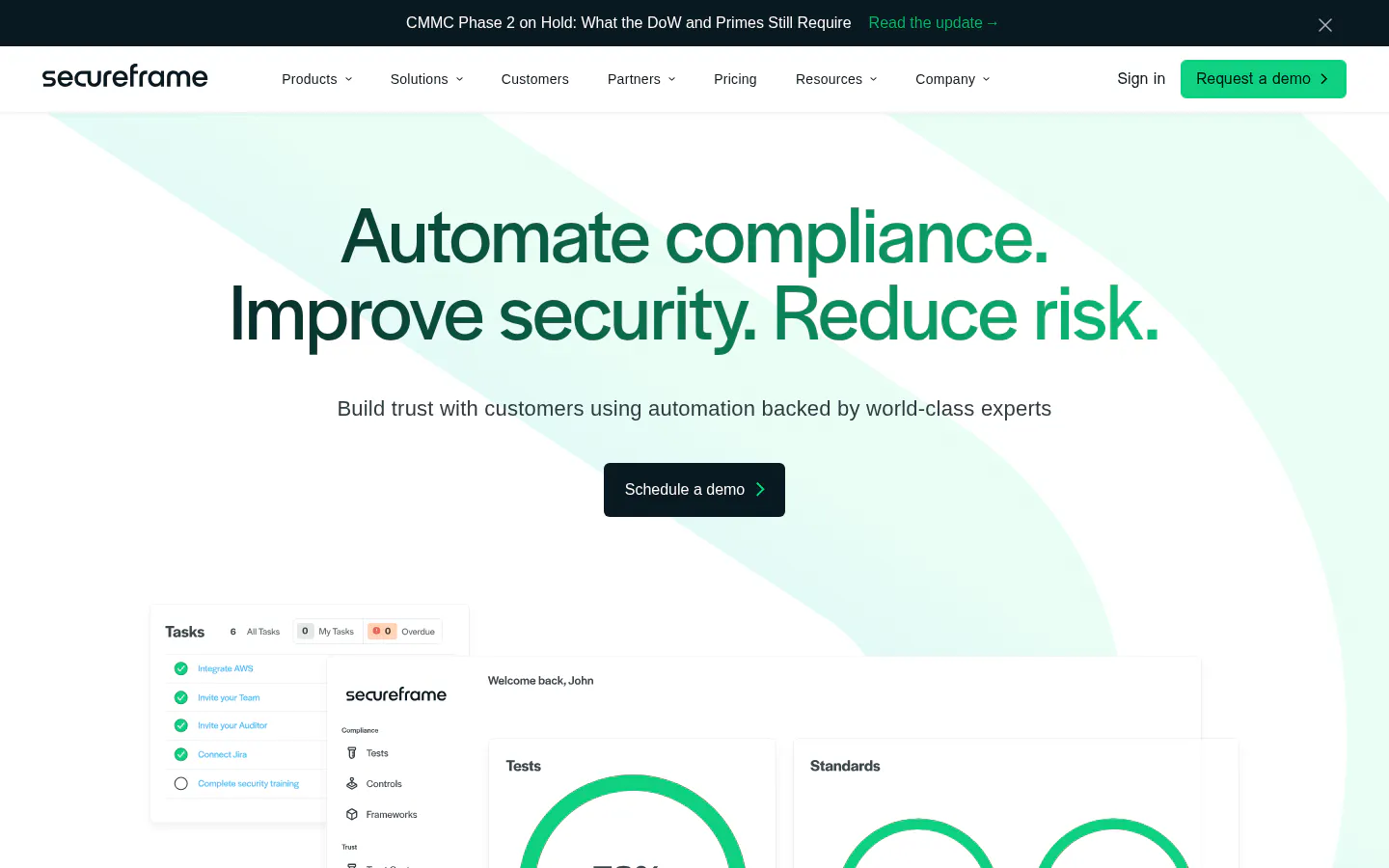
Secureframe is what a buyer picks when no single factor dominates the decision.
Score: 7.58/10
Key Strengths
- 35+ frameworks with cross-framework control mapping, so a control written once for SOC 2 carries into ISO 27001 without being rebuilt
- A Defense tier added in March 2026 brought CMMC 2.0 into scope
- 300+ native integrations, plus custom ones
- Strong human support, which matters more than teams expect during their first audit
Worth knowing. Secureframe bends less than Drata or Vanta. Companies with unusual architecture, heavy on-premises footprints, or custom control requirements run into the edges of what the platform will model. For a standard cloud stack that's irrelevant. For a metal finishing shop with production systems on the plant floor, it isn't.
Best For: Growing companies adding a second or third framework.
Not Ideal For: Highly customized environments that need the tool to bend.
Why It Ranks Fourth: The best of the self-serve platforms here, on the strength of heavy human support during onboarding and the second-highest review score in the set. It's the highest-placed option that expects you to own remediation yourself.
5. Drata, the deepest evidence automation in the category
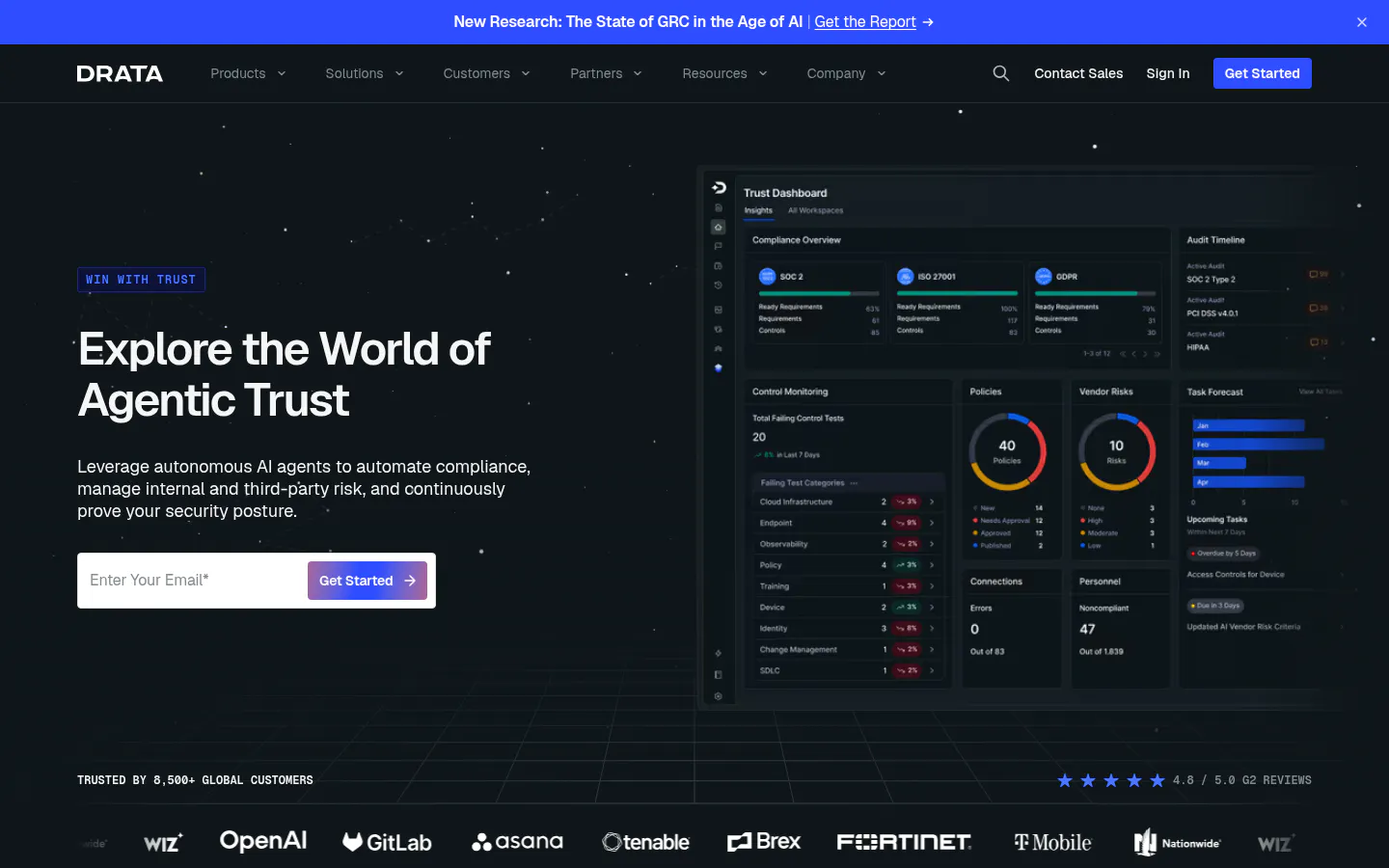
Drata wins on the unglamorous part of compliance, which is proving a control worked every day for six months rather than on the day someone checked.
Score: 7.43/10
Key Strengths
- 300+ integrations, roughly 150 of them native, with automated tests running daily rather than weekly
- Framework support extends past the usual set into DORA and NIS2, the EU financial and network security rules that started catching US subsidiaries in 2025
- Auditors move through it quickly, which shortens fieldwork
- 4.7 on G2 across 1,328 reviews, and security engineers are the ones writing the positive ones
The tradeoff. Drata asks for more configuration up front than Vanta or Sprinto. A team that wants to be audit-ready in six weeks will find that frustrating. A team running its third annual audit will find it was worth it. Entry pricing sits near $7,500/yr, and scope drives it well past that.
Best For: Companies with an internal security or IT lead who will own the platform.
Not Ideal For: A 25-person company with nobody assigned to compliance.
Why It Ranks Fifth: Drata scores at or near the top on review quality, automation depth, and auditor fit at once, and on a product-features model it wins the whole category. It places fifth here only because it hands remediation back to you, which these criteria weight at 25%.
6. Scrut Automation, the highest-rated option on the entire list
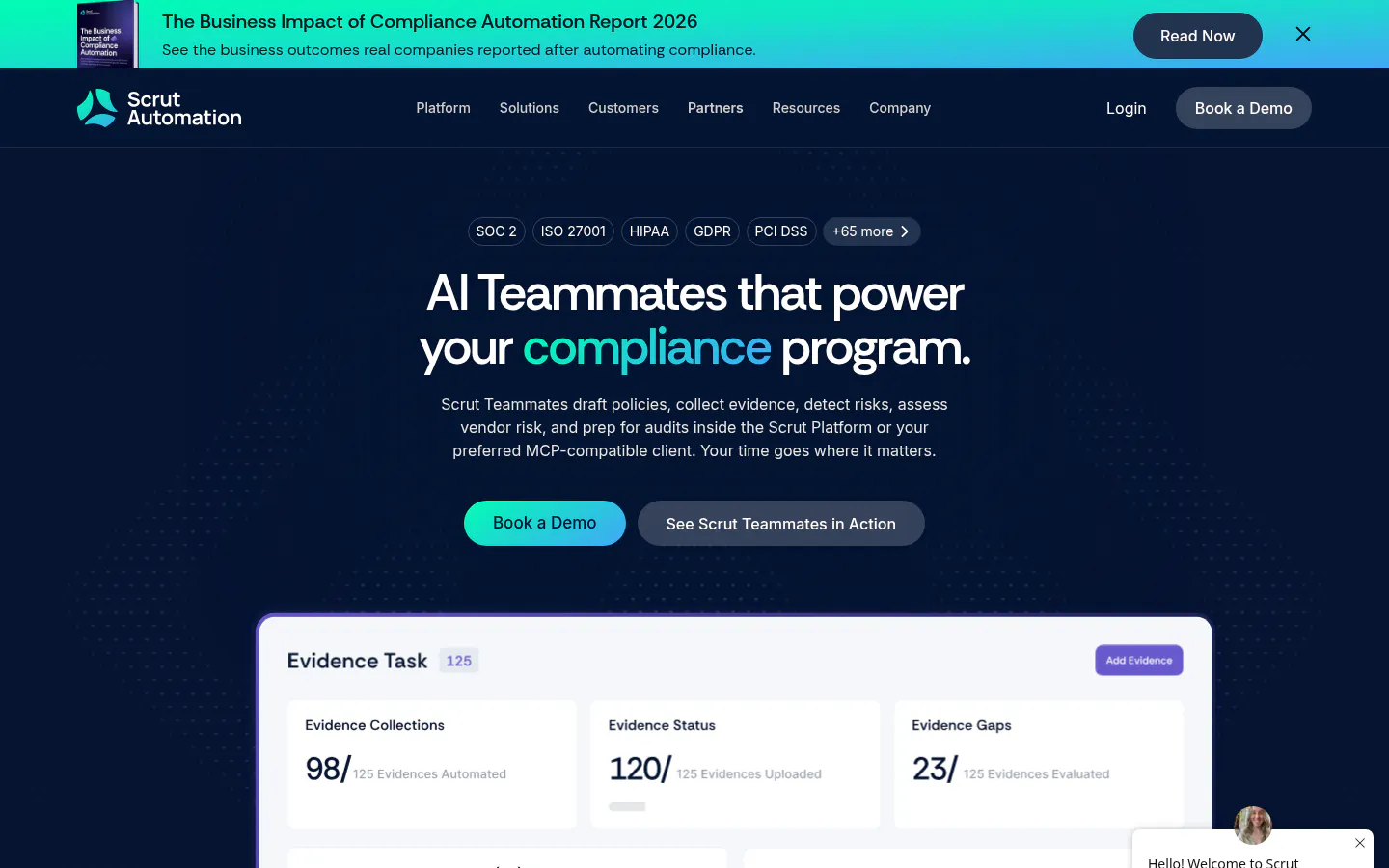
Scrut posts 4.9 on G2 across 1,311 reviews and 4.9 on Capterra across 139. Nothing else here matches that on both platforms.
Score: 7.39/10
Key Strengths
- Risk-first design, meaning risk assessment drives which controls get built rather than the other way around
- 70 frameworks including CMMC, NIST 800-171, FedRAMP, PCI DSS, CSA STAR, and both CMMI variants
- Ranked #9 for GRC in G2's 2026 Best Software Awards
- Raised $10M in growth capital from Lightspeed, MassMutual Ventures, and Endiya Partners in April 2024
So why sixth with the best reviews in the category? One number. 70+ integrations, against 300 to 400 for most of this list. Every integration a platform doesn't have becomes a human uploading evidence by hand, every quarter, forever. That's a real operating cost and it grows with company size. Users who like Scrut like it a lot, and the ones writing those 4.9s are mostly at smaller companies where the integration gap costs less.
Best For: Companies that want risk management and compliance in one platform, on a mid-market budget.
Not Ideal For: Large or heterogeneous tool stacks where manual evidence collection would pile up.
Why It Ranks Sixth: Highest review score of any option here, including Consilien, and it still lands sixth. Reviews carry 25% while remediation carries 25%, and Scrut is pure self-serve software with the smallest integration library in the group. Weight the criteria toward product quality instead and it climbs sharply.
7. Vanta, the platform auditors already know
Vanta is the default answer for a first SOC 2, and defaults are worth something when an auditor is billing hourly.
Score: 7.27/10
Key Strengths
- 400+ integrations, the largest library of any platform reviewed
- Prebuilt CMMC support covering Levels 1, 2, and 3, with controls pre-mapped to NIST SP 800-171 and 800-172
- 2,675 G2 reviews, more than double the next platform, which means the failure modes are well documented publicly
- Fastest path from signup to audit-ready for a clean cloud environment
Where it slips. Two places, and the data is blunt about both. Vanta's Capterra rating is 4.2 across 33 reviews, the lowest of the eight platforms here by a clear margin, while its G2 rating is 4.6. That split is unusual. Worth a buyer's attention. Pricing is the other issue. Vanta runs from roughly $10,000 to $250,000 a year depending on scope, which makes it the most expensive entry point on this list.
Best For: Companies pursuing their first SOC 2 who want the auditor to recognize the platform instantly.
Not Ideal For: Budget-constrained teams, or anyone whose evidence lives mostly on-premises.
Why It Ranks Seventh: The highest auditor alignment score of any software here, pulled down by price, the Capterra gap, and a remediation score no self-serve platform escapes. It remains the safest first-audit pick, and a seventh-place finish on these criteria doesn't change that.
8. Sprinto, the value pick for lean teams
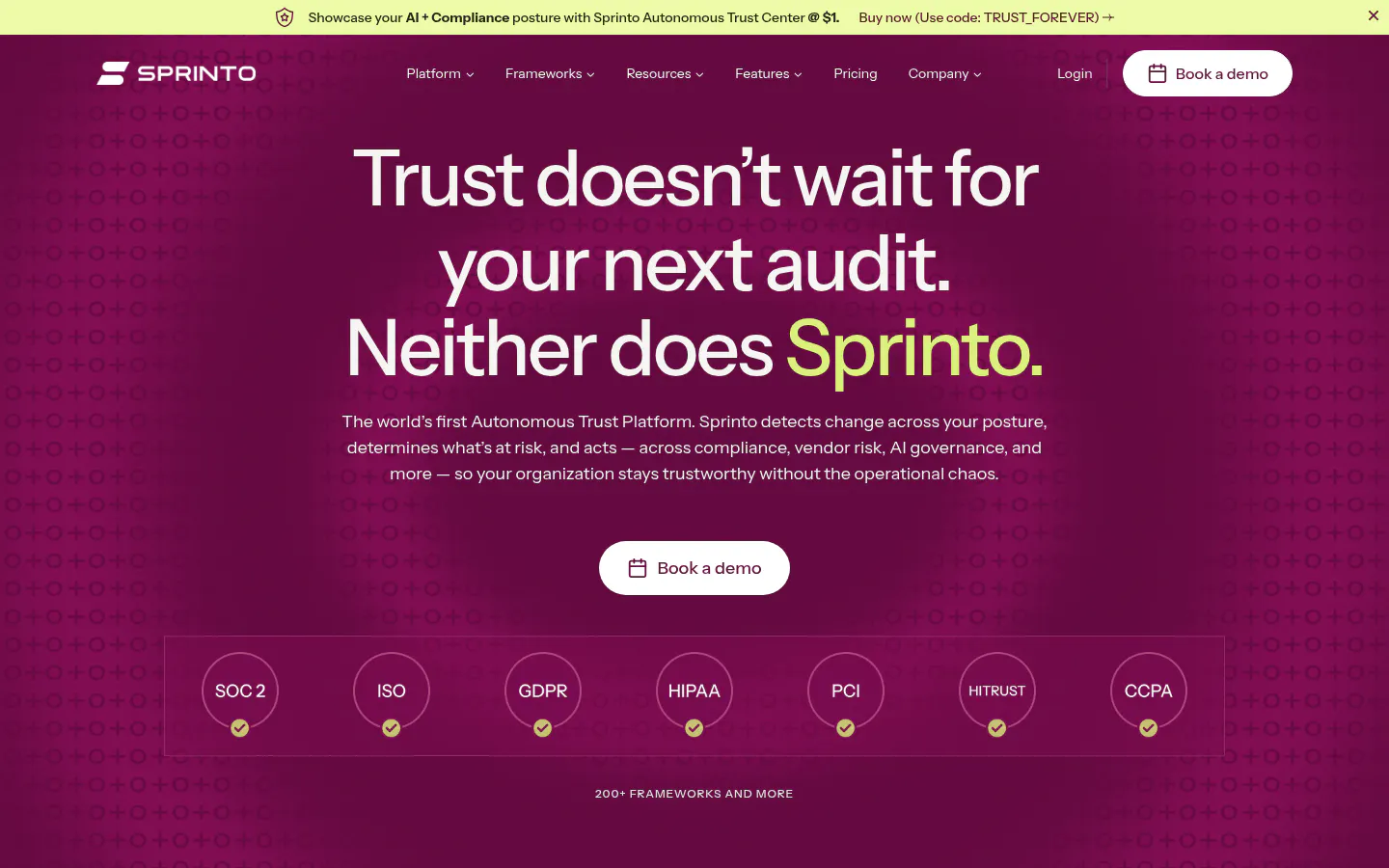
Entry pricing around $6,000 a year, and it doesn't feel like a stripped-down product at that number.
Score: 7.22/10
Key Strengths
- 300+ native integrations across cloud, identity, and business systems
- Consistent ratings on both platforms, 4.7 on G2 across 1,661 reviews and 4.7 on Capterra across 86, which is the most internally consistent result in this group
- Always-on monitoring model rather than periodic checks
- Genuinely built for companies under 100 users rather than adapted down to them
The catch is geography. Sprinto's auditor partnerships are strongest in India, where the company was founded in 2020. US buyers get a smaller partner network than they would with Vanta or Drata. Not a dealbreaker, but it means slightly more work finding a CPA firm that has worked in the platform before.
The framework number deserves a second look too. Sprinto advertises 200+ frameworks, the largest count claimed by any platform here, yet its own frameworks page leads with SOC 2, ISO, HIPAA, and GDPR and doesn't name CMMC or NIST 800-171. Big framework counts in this category tend to include a long tail of regional and sector standards most buyers will never touch. Count the ones on your contract, not the ones on the marketing page.
Best For: Companies under 100 users pursuing one or two frameworks on a real budget.
Not Ideal For: Defense suppliers or anyone who needs deep CMMC Level 2 work.
Why It Ranks Eighth: The highest mid-market fit score in the set, held back by auditor network, framework depth, and the remediation gap. For a budget-constrained team under 100 people with someone willing to own the work, this is still the right pick.
9. Hyperproof, built for programs running many frameworks at once
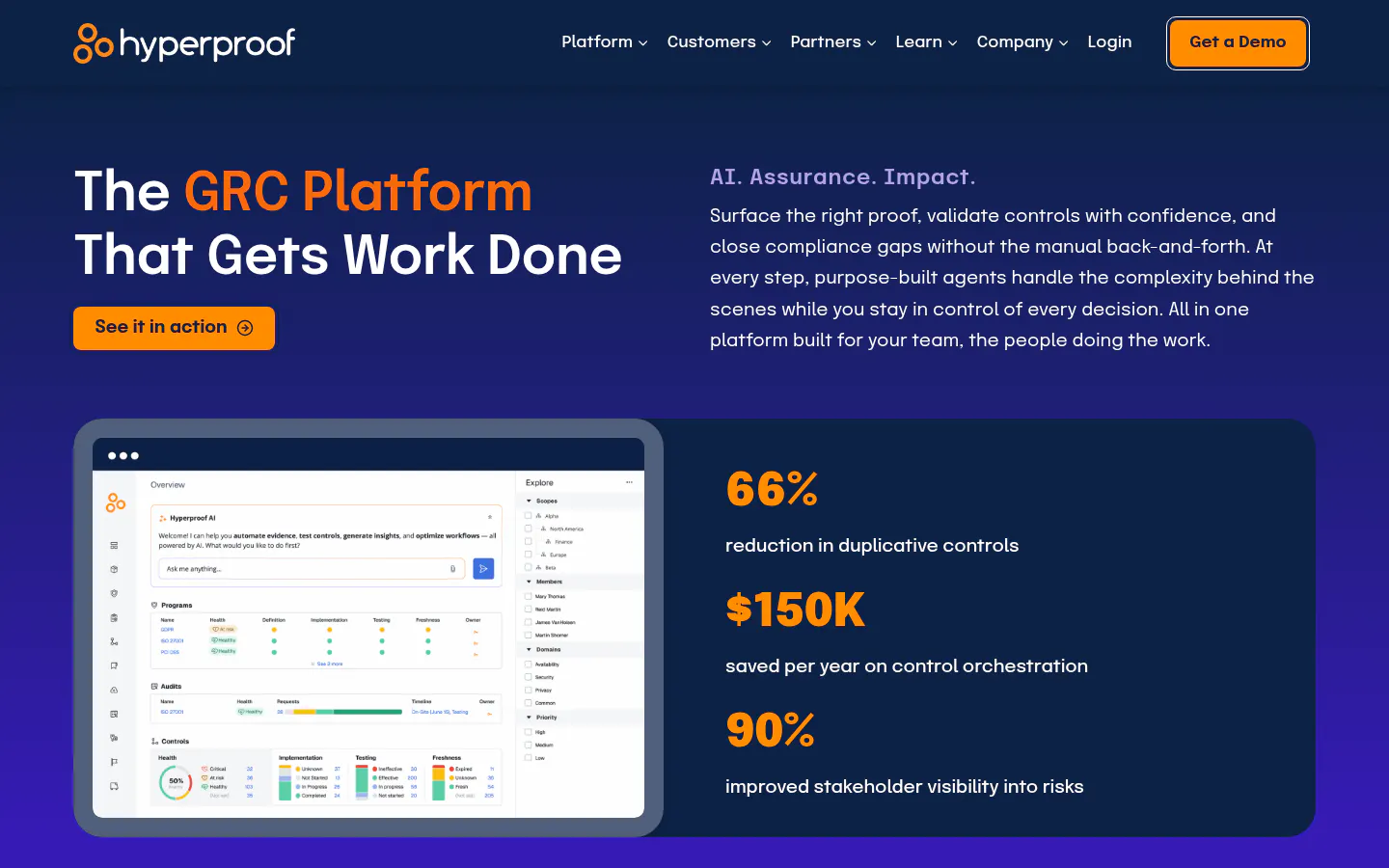
Hyperproof maps controls across 140+ frameworks, and unlike most large-number claims in this category, the ones that matter to a regulated buyer are actually in there.
Score: 6.97/10
Key Strengths
- Named a Category Leader in three separate 2026 Chartis RiskTech Quadrants, covering enterprise GRC, third-party risk, and IT risk
- 200+ Hypersyncs for automated evidence collection
- 4.8 on Capterra across 116 reviews, the strongest Capterra showing of any platform here
- Handles regulatory change management, which most platforms on this list don't touch
Its G2 rating of 4.5 across 220 reviews is the lowest star rating in this group. Read that correctly. Hyperproof sells to bigger, more complicated organizations. Harder problems produce lower ratings. A platform serving 30-person startups will always look better on paper.
Best For: Companies running four or more frameworks in parallel with a dedicated compliance owner.
Not Ideal For: A first-time SOC 2 with no internal GRC resource.
Why It Ranks Ninth: A perfect framework coverage score, offset by the lowest mid-market fit score of the nine and a heavy implementation load the buyer carries alone. This platform is aimed above the 20 to 500 user band, and these criteria are built for companies inside it.
What These Platforms Don't Do
All eight software options here sell automated evidence collection. None of them sell remediation, and that distinction costs companies more time than any other misunderstanding in this category.
A platform tells you control 8.2 is failing. It does not configure the firewall rule, write the access review procedure, retrain the person who keeps approving their own access requests, or decide whether a compensating control is defensible. That work is manual. For a company going from nothing to audit-ready, it's the majority of the project.
The scoping problem is subtler and more dangerous. As the audit firm Schneider Downs put it in a 2026 analysis, automated evidence is only as reliable as the understanding of which systems are inside and outside its view. Connect the main AWS account, leave the legacy account running production untouched, and the dashboard shows full coverage. The gap surfaces during fieldwork, when it's expensive.
On-premises makes this worse. A distribution company with Active Directory in a closet and file servers in three warehouses will find that most platforms here reach the cloud stack cleanly and the rest not at all. Those controls come back to manual evidence regardless of what the subscription costs.
Take a 180-person aerospace supplier working toward NIST 800-171 as the on-ramp to CMMC Level 2. The platform connects to Microsoft 365 and Azure in an afternoon and starts producing clean evidence for access control and audit logging. Then it reaches the shop floor. The CNC machines run an unsupported operating system nobody will patch because the machine tool vendor won't certify a newer one. Media protection controls covering physical drawings marked as controlled unclassified information have no digital footprint to collect at all. The dashboard can flag those as failing. Closing them means network segmentation, a compensating control narrative an assessor will accept, and a documented physical handling procedure. No subscription tier includes that.
None of this is an argument against buying one. Automation genuinely removes the screenshot grind, and for a second or third annual audit it pays for itself. It just isn't the whole project.
Platforms Left Off This List
Five names appear on most competing lists and were deliberately excluded here.
AuditBoard, OneTrust, LogicGate, and MetricStream are enterprise GRC suites. They're strong products aimed at organizations with dedicated GRC teams, six-figure budgets, and board-level risk reporting requirements. Scoring them against Sprinto would produce a comparison that helps nobody in the 20 to 500 user range. ServiceNow IRM sits in the same category and was excluded for the same reason.
One more note on sourcing. Ranked lists for this keyword are usually published by vendors who compete in it, and those lists tend to end where you'd expect. Scrut's list of the top 7 compliance management platforms ranks Scrut first. ZenGRC's list of 13 ranks ZenGRC first. Both are useful for product detail. Neither is a ranking.
How to Choose Compliance Automation Software
Pick on framework scope first, integration coverage second, and price third. Most buyers reverse that order. They end up paying for a platform that can't reach half their evidence.
Work through it in this sequence.
Start with the framework you're actually required to hold. A customer contract demanding SOC 2 Type 2 and a defense contract demanding CMMC Level 2 are different projects with different platform shortlists. If CMMC Level 2 is in scope, Thoropass drops out immediately. Scytale needs verifying. If SOC 2 and ISO 27001 are both coming, cross-framework mapping matters more than raw framework count, because the two standards overlap heavily and you want the control written once.
Then inventory where your evidence lives. Count the systems holding proof an auditor will want, and check how many the platform connects to natively. Every unconnected system is recurring manual work. A company running entirely on AWS, Okta, and Google Workspace has a very different shortlist from one running domain controllers on-premises across four sites. Same headcount. Different platform.
Ask your auditor before you sign. Not after. Auditors who have worked in a platform before move faster through fieldwork, and fieldwork hours are billed. If you don't have an auditor yet, that argument favors Vanta and Drata, and it's the single strongest reason to shortlist Vanta despite the price and its seventh-place finish on these particular criteria.
Budget for the audit separately. Platform pricing runs roughly $6,000 to $15,000 a year at the entry level for a single framework. The audit itself is separate, typically $15,000 to $50,000 for a Type 2 from an independent CPA firm. A budget built only around the subscription comes up short. By more than the subscription itself. PCI DSS adds another wrinkle, since the assessment path depends on merchant level and self-assessment eligibility rather than a flat audit fee, and the platform doesn't decide that for you.
Check whether the vendor is pricing on users, or on something else. Some platforms price on employee headcount, others on connected cloud accounts or entities. A 90-person company with four AWS accounts and two legal entities can land in a completely different band than a 90-person company with one of each. Ask for the pricing variable by name. Two proposals quoting "under 100 employees" are frequently not quoting the same thing.
Then be honest about who runs it. Hyperproof and Drata reward a dedicated owner. Scytale and Thoropass are built for teams without one. Buying a platform that expects an owner you don't have is the most common way this purchase fails. No amount of automation fixes it.
The Short Version
Top position goes to Consilien at 9.39/10, and the reason is narrow rather than sweeping. These criteria weight remediation at 25%, and a managed provider closes controls that software only flags. Score the eight platforms on product attributes alone and Drata wins at 8.80 with the top six inside 0.18 points, which is the ranking to use if remediation is already covered internally.
So the real question isn't which option scores highest. It's whether anyone on your side is going to do the closing work.
Buy Vanta for a first SOC 2 where auditor familiarity matters most. Buy Sprinto if the budget is tight and the team is under 100 people. Buy Hyperproof if four or more frameworks are running in parallel. Buy Thoropass if a single contract for platform and audit is worth more than auditor independence.
And budget for the part no platform covers. The dashboard will tell you which controls are failing. Closing them is SOC 2 readiness and remediation work, or the ISO 27001 equivalent, and it's where most of the calendar goes.
Speak to a compliance expert about which platform fits your framework scope and where your evidence actually lives.