10 Best CSPM Tools for 2026
Wiz ranks first among the best CSPM tools for 2026 at 8.15 out of 10, a Forrester Leader that adds the most over the free native scanners. Qualys TotalCloud (8.09) pairs Leader status with a 30-day trial, and Datadog Cloud Security (7.83) is the only one publishing a paid price. Six criteria, live Gartner Peer Insights data.
Table of Contents
Quick Picks
- Top score overall: Wiz
- Best when nobody on staff owns cloud security: Microsoft Defender for Cloud
- Only tool that puts a paid price on its own page: Datadog Cloud Security
- Widest cloud footprint: Orca Security
- Shortest path from signup to a real finding: Qualys TotalCloud
Shopping for the best CSPM tools gets easier once you know what a CSPM is no longer for. Cloud security posture management is the category that scans your AWS, Azure, and Google Cloud settings for the mistakes that leave a storage bucket public or an admin role handed to everyone. For years, those mistakes were the main way attackers got in. That has changed. Google's Cloud Threat Horizons Report H1 2026 found unpatched third-party software drove 44.5% of cloud intrusions in the second half of 2025, up from 2.9% six months earlier, while weak or missing credentials fell from 47.1% to 27.2%.
So the useful question isn't which tool finds the most misconfigurations. They all find them. So do the free scanners AWS, Azure, and Google already ship, which is where the next section starts. The question is what a tool does with a finding once it has one, and whether a company with 20 to 1000 users can actually buy and run it. If the category itself is new to you, what CSPM does and how it works covers the mechanics first. This ranking is the next step.
Ten tools, scored the same way, with the model published below. No vendor paid for placement and no vendor submitted its own data.
What AWS, Azure, and Google Already Give You Free
Before any of this becomes a purchase, three free tools are already sitting in the accounts you own.
Azure includes Foundational CSPM at no cost. It scores your subscriptions against the Microsoft Cloud Security Benchmark and flags the obvious gaps. One change trips people up. Starting October 27, 2026, Foundational CSPM becomes opt-in for new Azure subscriptions instead of on by default. Existing subscriptions keep it. New ones start blind until someone turns it on. AWS and Google connectors aren't affected.
AWS folded its old per-check CSPM pricing into Security Hub Essentials at $3.75 per resource unit per month. A resource unit is one EC2 instance, or 12 Lambda functions, or 18 container images in ECR, or 125 IAM users and roles. Every account gets a 30-day free trial in each region. For a shop running 60 EC2 instances and not much else, that's about $225 a month for unlimited checks.
Google Cloud gives away Security Command Center at the Standard tier. Anyone already paying for a higher tier should diary one date. The Enterprise tier shuts down on May 21, 2027, and those organizations drop to Premium, which only covers Google Cloud.
Each one sees its own cloud and nothing else. Run workloads in two clouds and you run two consoles, two severity scales, two sets of compliance reports that don't add up. None of them correlate a misconfiguration with an unpatched package on the same host and an over-permissioned role that can reach it, which is the chain that actually turns a finding into an incident. That gap is what the ten tools below are selling, and it's the single biggest factor in the scoring.
If you run one cloud, have fewer than 100 workloads, and nobody is asking you for a SOC 2 report, the honest answer is that the free tools plus a quarterly review may be enough. Skip the rest of this page and spend the budget on patching.
The Scoring Model
Rankings are produced using a Confidence Score methodology, six independently researched criteria applied the same way to every tool. No vendor paid for placement. No vendor submitted its own data.
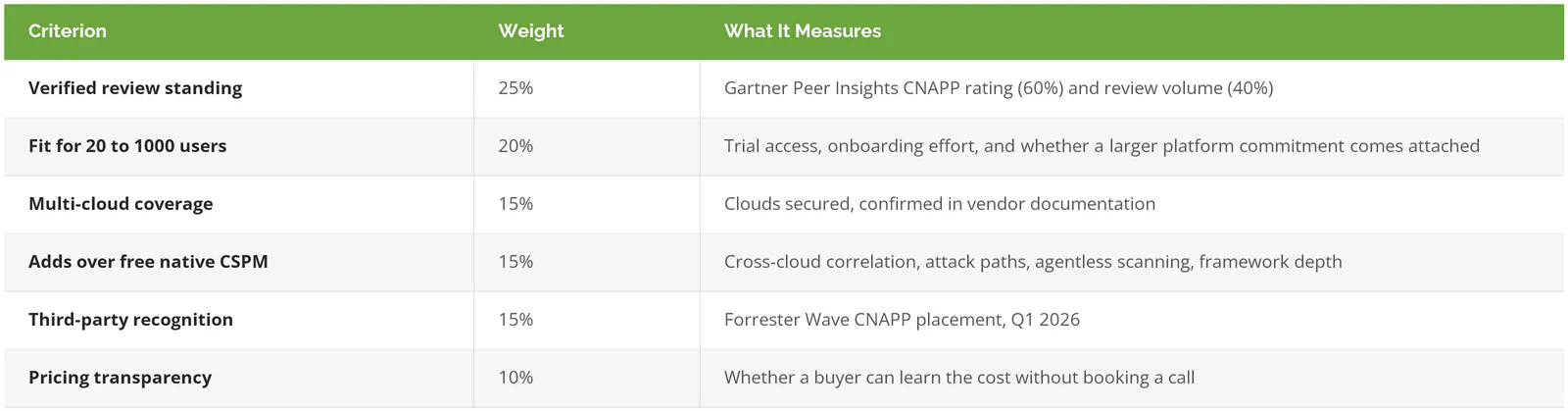
Verified review standing (25%) comes from the Cloud-Native Application Protection Platforms market on Gartner Peer Insights, pulled live on September 18, 2026. Rating supplies 60% of the criterion and review volume supplies 40%, so a 4.8 on 74 reviews doesn't automatically beat a 4.7 on 447.
Why the CNAPP market and not Gartner's CSPM market? Two reasons, and both are checkable. The CSPM page carries thin, uneven samples for the same products. Orca sits at 7 reviews there and 242 in CNAPP. Qualys TotalCloud and Datadog aren't on the CSPM page at all. Scoring off it would rank products by where Gartner filed them rather than by what buyers said.
The second reason is stranger. The highest review count on Gartner's CSPM page belongs to Check Point Cloud Firewall at 4.6 across 387 reviews, and that product is the former CloudGuard Network Security. It's a network firewall. Check Point's actual posture product, CloudGuard CNAPP, doesn't appear on that page. Anyone quoting "the top-rated CSPM on Gartner" from that list is quoting a firewall.
Fit for 20 to 1000 users (20%) measures whether a company that size can buy the thing and run it. Full marks need three things. A way to see the product without a sales cycle, onboarding that doesn't require a dedicated cloud security engineer, and a purchase that doesn't drag a much larger platform commitment behind it. A demo-only funnel costs points. So does a module that only makes sense once you've bought the vendor's endpoint or observability suite.
Multi-cloud coverage (15%) counts the clouds a tool secures, confirmed in vendor documentation rather than a logo strip. AWS, Azure, and Google Cloud are table stakes. Oracle Cloud, Alibaba, Tencent, Kubernetes, and infrastructure-as-code templates separate the field.
What it adds over free native posture management (15%) is the criterion most rankings leave out. Points go to cross-cloud correlation in one view, attack-path analysis that chains a misconfiguration to a vulnerability to an identity, agentless workload scanning, identity entitlement analysis, and a compliance framework library deeper than the CIS benchmarks you already get.
Third-party recognition (15%) uses The Forrester Wave: Cloud-Native Application Protection Solutions, Q1 2026, published February 17, 2026, which evaluated 14 vendors. Leaders score 10, Strong Performers 7, Contenders 5, and tools Forrester didn't name score 4. The report sits behind a paywall, so individual placements here come from each vendor's own announcement of its result. There is no Gartner Magic Quadrant for this market. Gartner covers it with a Market Guide and a Buyers' Guide instead, so the Wave is the only current analyst placement that names the whole field. Gartner does not endorse any vendor, product, or service depicted in its research publications. GARTNER, MAGIC QUADRANT, and PEER INSIGHTS are trademarks of Gartner, Inc.
Pricing transparency (10%) asks one question. Can a buyer learn what this costs without booking a call? Publishing a real list price earns full marks. A self-serve trial that ends in a number earns partial credit. A demo form earns almost nothing.
How sensitive is the order? Drop the Forrester criterion entirely and Datadog takes first at 8.49, with Wiz second and Qualys third. Score reviews on Gartner's CSPM market instead of CNAPP and Wiz still leads, Sysdig still holds second, but Qualys and Datadog fall to the bottom on the missing-market penalty. The top two hold up either way. Positions four through ten move around, which is a fair warning against reading a 0.2-point gap as a verdict.
Two tools were cut late. Cyscale scores well on transparency and publishes $850 a month for 1,000 assets, but 29 reviews in the CNAPP market is too thin a base to rank against products with 250. Check Point CloudGuard CNAPP was excluded for the filing problem above, not for quality.
The 10 Tools at a Glance
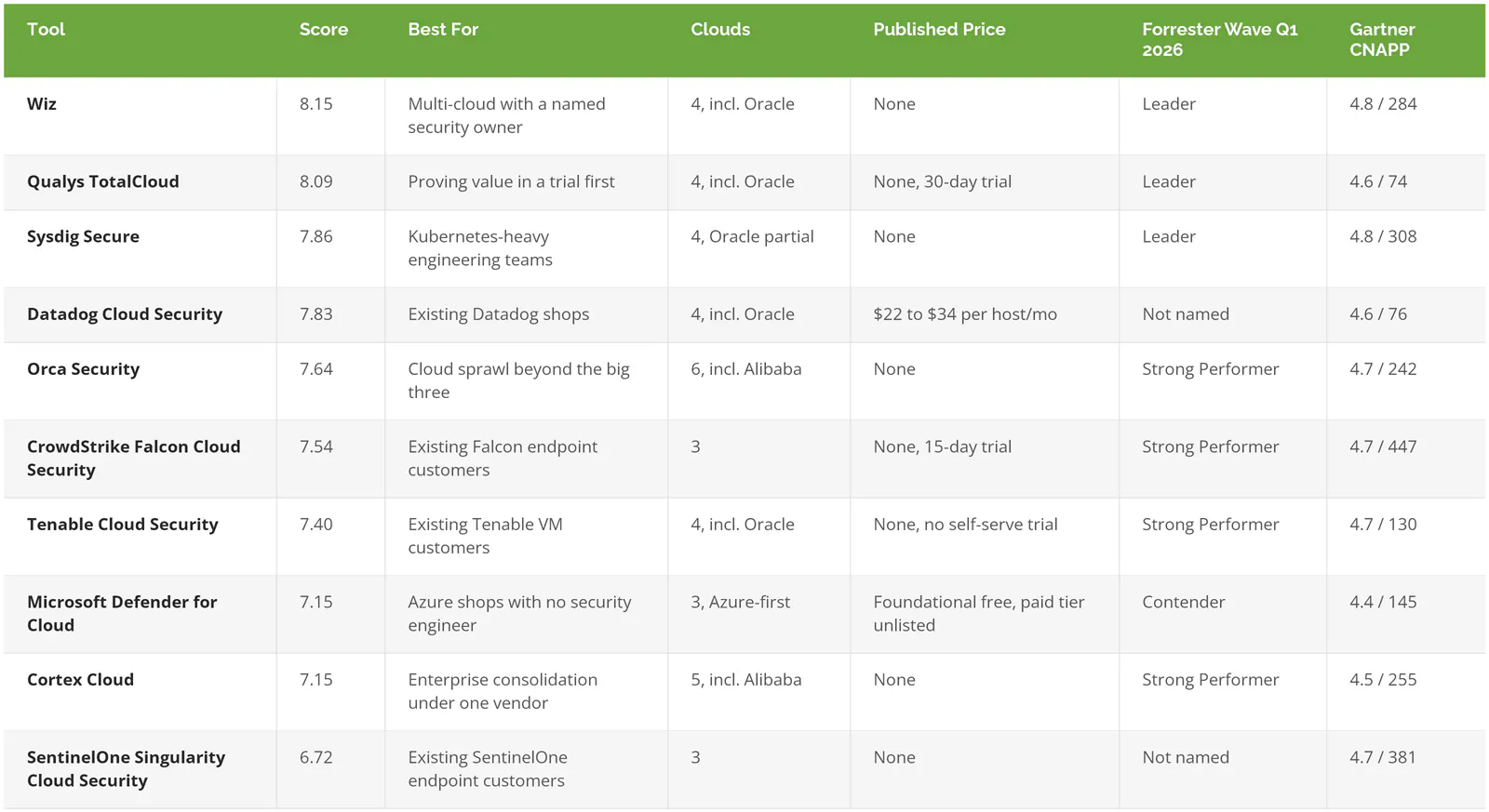
Scores run from 8.15 down to 6.72. That's a narrow band, and it should be. Every tool here is a real product with real customers.
The 10 Best CSPM Tools for 2026, Ranked
1. Wiz, the Most Capable and the Hardest to Buy
Wiz belongs to Google now. The $32 billion acquisition closed on March 11, 2026, and Wiz keeps its own brand and, so far, its multi-cloud stance.
Score: 8.15/10
Key Strengths
- 250 built-in compliance frameworks, against roughly 150 at Orca and the handful of CIS benchmarks the native tools ship with.
- The security graph is the thing competitors copied. It chains a public subnet to an unpatched package to a role with production database access and shows that path as one finding instead of three tickets.
- Coverage runs past infrastructure into Oracle Cloud, VMware vSphere, Snowflake, Okta, and OpenAI, which matters more every quarter as data and identity leak out of the three big clouds.
- Highest review standing on the list, tied with Sysdig at 4.8, across 284 reviews.
The tradeoff. Wiz is the most enterprise-shaped purchase here. Its pricing page publishes nothing and describes licensing as modular, scaling with workloads, active developers, log ingestion, and sensors. You fill in a form to find out what four variables cost. There is no trial you can start on a Tuesday afternoon. And the Google question is real for anyone running production on AWS. Google has said Wiz stays multi-cloud, but a 200-person manufacturer standardizing on AWS is now buying its cloud security from AWS's largest competitor, and that is a conversation worth having internally before the renewal, not after.
Best For: Companies running two or more clouds with a named security owner and budget approval above the manager level.
Not Ideal For: A single-cloud shop, or any team that needs to see the product before it can justify the spend.
Why It Ranks #1: Wiz posted the highest mark on the criterion that matters most here, the distance between what it does and what the free native tools already do, and it's the only tool that earned a perfect score there. It's a Forrester Leader with review standing nobody beats. The gap to second place is 0.06, and every point of that margin comes from capability rather than accessibility. If the scoring had weighted buyability higher, Wiz would not be first.
2. Qualys TotalCloud, The Leader Most Buyers Leave Off the Shortlist
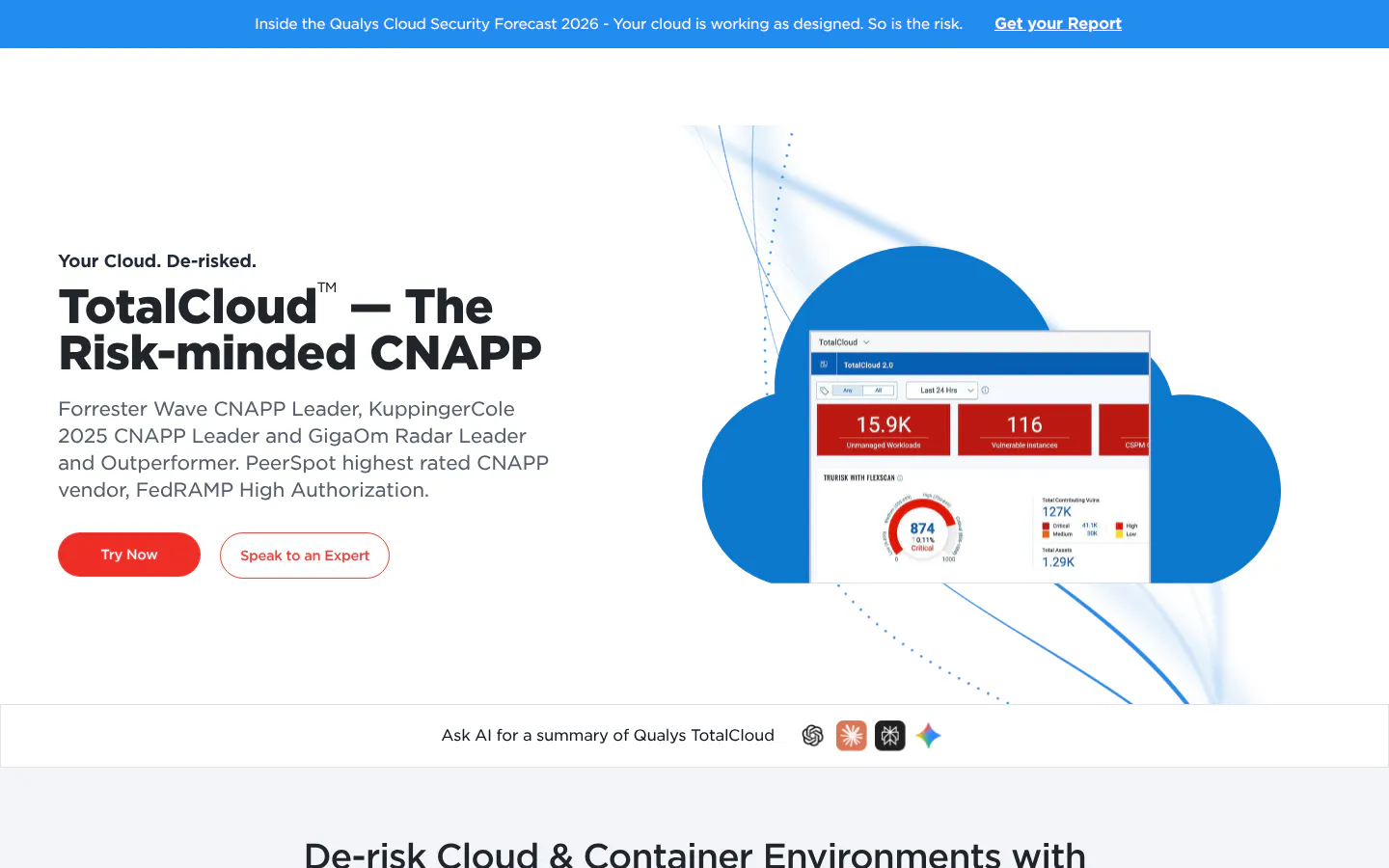
Forrester named three Leaders in the Q1 2026 Wave. Wiz and Sysdig surprised nobody. Qualys did.
Score: 8.09/10
Key Strengths
- One license covers AWS, Azure, Google Cloud, and Oracle Cloud under a single control plane and a single TruRisk score, rather than a per-cloud SKU.
- A 30-day free trial that includes the real posture features, not a sandbox. That is the shortest distance to a genuine finding of anything on this list.
- In August 2026 Qualys shipped Real-Time CSPM, which watches AWS CloudTrail and Azure Event Hubs for changes as they happen instead of waiting for a scheduled scan. An exposed database gets caught on creation, not eight hours later.
- 20-plus years of vulnerability management underneath, so the misconfiguration data and the patch data come from the same place.
Worth knowing
- 74 reviews in the CNAPP market. Real, but the thinnest base of anything in the top five.
- No published price, and Qualys packaging has a reputation for module sprawl. Confirm in writing which capabilities your quote includes.
- The interface carries two decades of history with it. Nobody calls it the prettiest console in the category.
Best For: Mid-sized companies that want multi-cloud posture without a platform migration, and teams that need to prove value in a trial before anyone signs.
Not Ideal For: Buyers who want a modern console more than they want coverage.
Why It Ranks #2: Qualys is the only Forrester Leader you can actually evaluate this week without talking to anyone. That combination of analyst standing and low friction is rare, and it carried a thin review base past two products with more than three times the reviews.
3. Sysdig Secure, Built on the Runtime Standard Everyone Else Integrates With
Sysdig created Falco, the runtime security project the CNCF adopted as its standard. That heritage is the whole argument for Sysdig, and it's a good one.
Score: 7.86/10
Key Strengths
- Tied for the best review standing here at 4.8, on 308 reviews, and a Forrester Leader alongside Wiz and Qualys.
- Runtime detection is a different product class from config scanning. Sysdig sees the process that spawned, the file it touched, and the connection it opened, which no posture scanner catches.
- Agentless posture for AWS, Azure, and Google Cloud, with Oracle Cloud covered for agentless CSPM.
Shape is the limitation here, not quality. Sysdig is strongest when containers and Kubernetes are most of what you run, and the runtime half of the platform assumes a team that can act on a runtime alert at 2am. A 150-person distributor running a dozen virtual machines and a SQL database gets the posture features and leaves the best part in the box. Sysdig's former self-serve trial page is now a demo request form, so evaluating it means a call. Nothing is published about price.
Best For: Kubernetes-heavy engineering organizations with someone on call who can read a runtime alert.
Not Ideal For: Companies whose cloud estate is mostly virtual machines and managed databases.
Why It Ranks #3: Top marks on reviews and analyst standing, held back by a demo-gated funnel and a product shape that rewards container maturity most teams this size don't have yet.
4. Datadog Cloud Security, The Only One That Tells You the Price
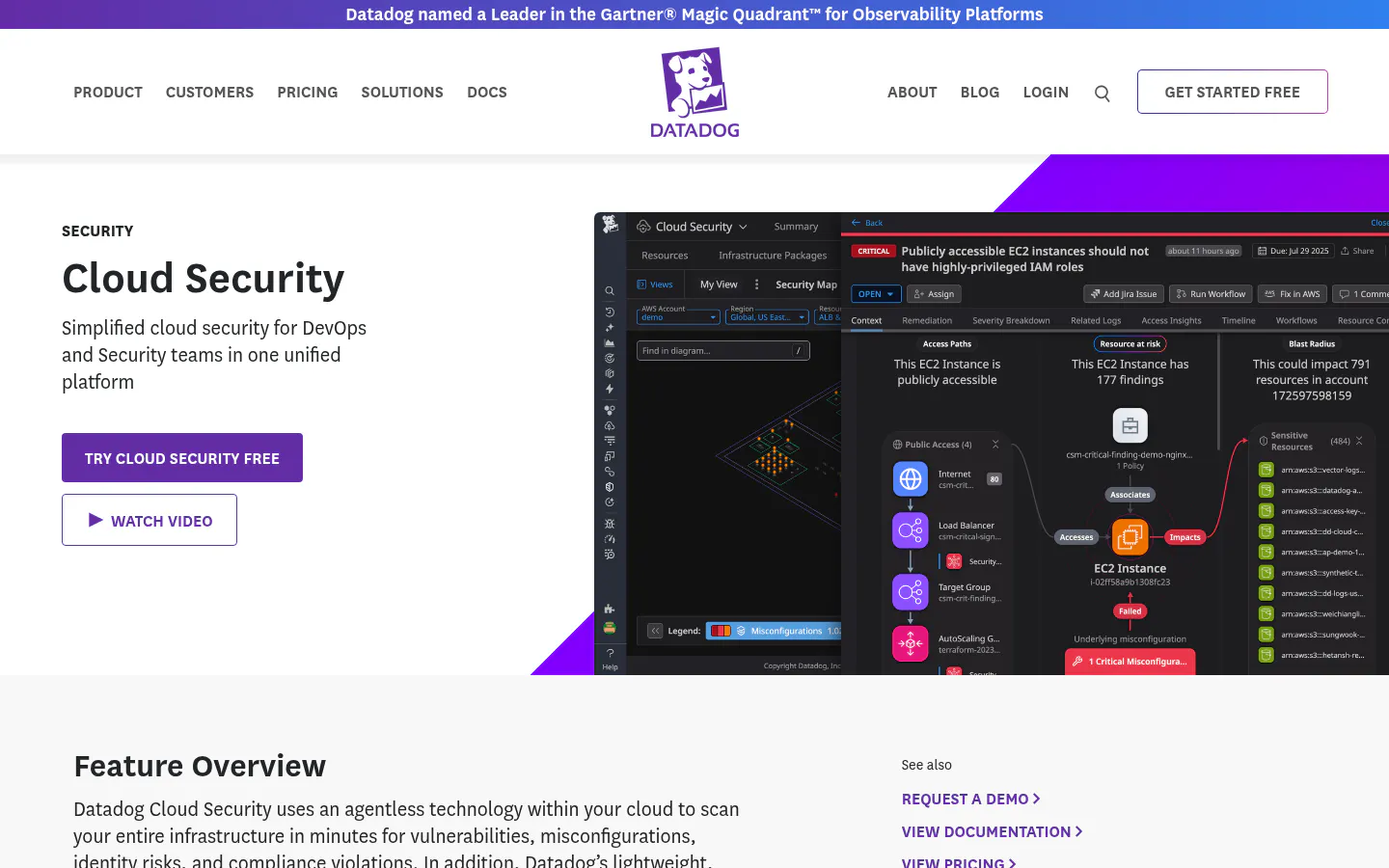
Nine vendors on this list make you ask. Datadog puts the number on the page.
Score: 7.83/10
Datadog's pricing page lists DevSecOps Pro at $22 per host per month billed annually and DevSecOps Enterprise at $34, with CSPM, Kubernetes posture, vulnerability management, and identity entitlement analysis in the Pro tier. For a company running 80 hosts, that's $21,120 a year, known before a single call. Nobody else here lets you build that number.
Limitations
- Cloud Security only sells inside a DevSecOps bundle attached to Datadog Infrastructure licenses. If you aren't already a Datadog shop, the real cost includes observability you may not have planned to buy.
- Forrester didn't name Datadog in the Q1 2026 Wave, which costs it on the recognition criterion and is the main reason it sits fourth rather than second.
- Security depth is narrower than the specialists. Attack-path analysis exists but isn't the equal of the Wiz graph.
- The 14-day self-serve trial is genuinely self-serve and needs no credit card, though the trial page doesn't spell out whether Cloud Security is included. Confirm before you plan an evaluation around it.
Best For: Teams already running Datadog for infrastructure monitoring, where posture data lands next to the telemetry they read every day.
Not Ideal For: Anyone buying security alone, or a company committed to a different observability stack.
Why It Ranks #4: Transparency and fit carried it. Datadog scored full marks on price disclosure, second-highest on fit for this size range, and still landed fourth because the analyst community hasn't placed it. Remove the recognition criterion and Datadog wins this ranking outright at 8.49, which says something about how much that one factor is doing.
5. Orca Security, Broad Footprint and a Gartner Filing Problem
Six clouds. AWS, Azure, Google Cloud, Oracle Cloud, Alibaba, and Tencent, plus Kubernetes. That is the widest span on this list.
Score: 7.64/10
Key Strengths
- Patented SideScanning reads workloads out of band from the cloud provider's own snapshots, so there's no agent to deploy and no performance cost on production systems.
- More than 150 regulatory and industry frameworks built in.
- Connects in minutes rather than weeks, which is the practical difference agentless architecture actually buys you.
- Forrester Strong Performer in Q1 2026, with the Wave noting the speed of its support responses.
The catch is that Orca sells like an enterprise platform while marketing itself on how fast it deploys. There's no trial without a demo, and no price anywhere. Its Gartner position also reads worse than it is. The CSPM market page shows Orca at 4.4 across 7 reviews, a number that would sink it on any ranking that scored from that page. In the CNAPP market, where its buyers actually review it, Orca sits at 4.7 across 242.
Best For: Companies with cloud sprawl beyond the big three, or anyone who needs coverage live in days rather than a quarter.
Not Ideal For: Buyers who want to kick the tires before a sales conversation.
Why It Ranks #5: Perfect marks on coverage and near-perfect on what it adds over native tooling, pulled down by the same demo-gated, price-silent funnel that limits Wiz. Strong Performer rather than Leader was the deciding margin.
6. CrowdStrike Falcon Cloud Security, Most Reviewed, Fewest Clouds
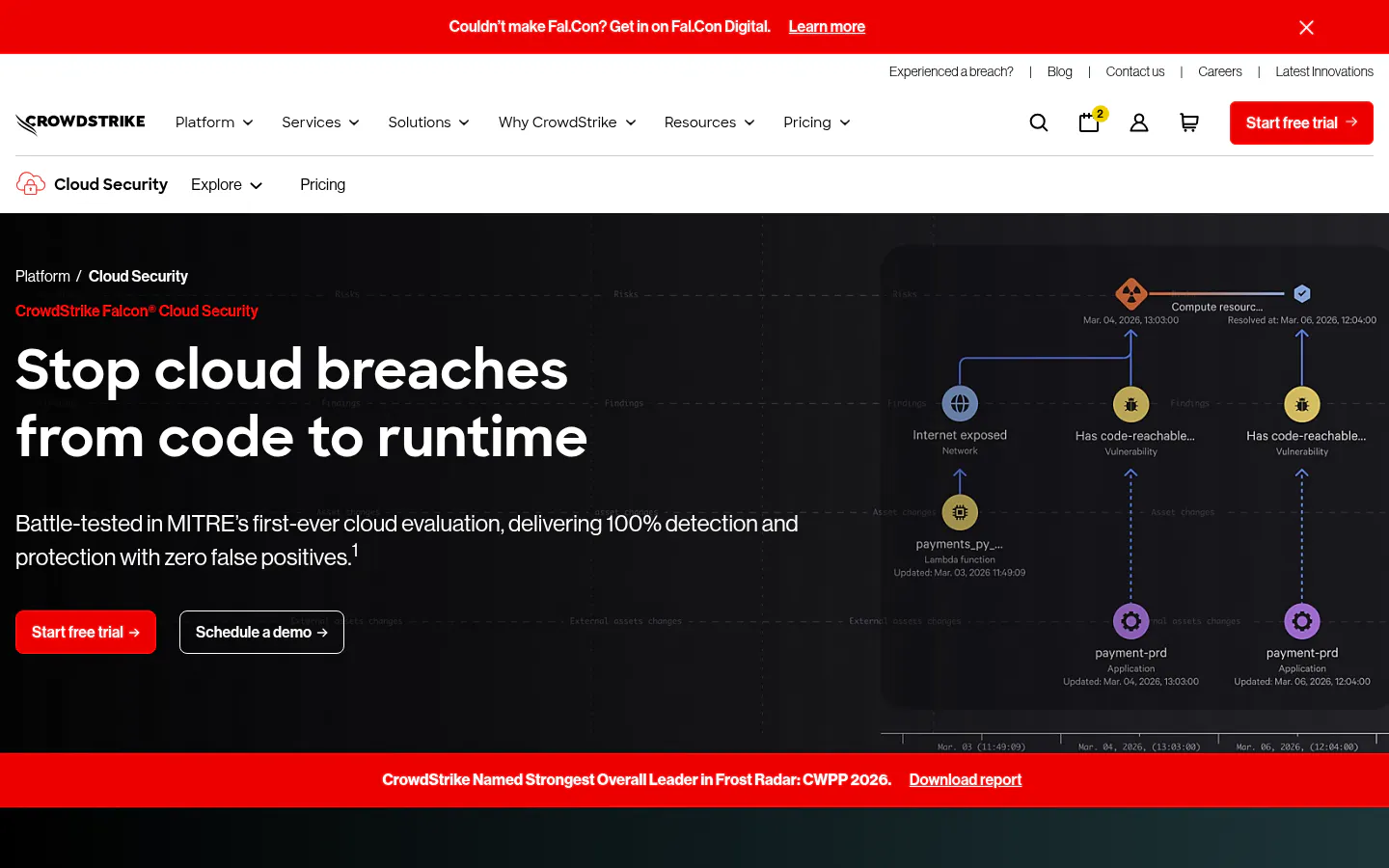
447 reviews in the CNAPP market at 4.7. That is more feedback than any other product on this page.
Score: 7.54/10
Key Strengths
- If Falcon already runs on your endpoints, cloud findings land in a console your team knows and correlate with the threat intelligence CrowdStrike is genuinely good at.
- Agentless onboarding for discovery and posture, with the option to add agents where runtime protection is worth the deployment.
- A 15-day free trial with no credit card and no commitment, though access arrives by email within 24 hours rather than instantly.
Worth knowing
- AWS, Azure, and Google Cloud only. No Oracle Cloud, no Alibaba. Only Microsoft Defender for Cloud scores lower on coverage, and SentinelOne ties CrowdStrike.
- Realistically bought as part of a Falcon platform commitment. As a standalone CSPM purchase it's an expensive way to solve a narrow problem.
- No published pricing.
Best For: Existing CrowdStrike endpoint customers extending the same platform into cloud.
Not Ideal For: Multi-cloud estates that include Oracle or Alibaba, or companies running a different endpoint vendor.
Why It Ranks #6: The strongest review evidence on the list couldn't offset three-cloud coverage and a purchase that mostly makes sense if you've already picked CrowdStrike for something else.
7. Tenable Cloud Security, Good Product, Locked Front Door
Tenable covers AWS, Azure, Google Cloud, and Oracle Cloud, carries a 4.7 across 130 reviews, and made Strong Performer in the Wave.
Score: 7.40/10
There is no self-serve trial. Tenable's own evaluation page routes every cloud security trial through a representative who will be in touch. For a product whose main selling point is how quickly agentless scanning shows you something, making the first step a phone call is a strange choice, and it's the single reason Tenable sits seventh instead of fourth.
Key Strengths
- Identity entitlement analysis is deeper than most, a direct inheritance from Tenable's vulnerability management lineage.
- CSPM, data posture, Kubernetes posture, CIEM, and infrastructure-as-code scanning in one license.
- A mid-market channel that has been selling to companies this size for years, which matters if you buy through a partner.
Best For: Existing Tenable vulnerability management customers, and buyers who prefer a channel partner relationship to a self-serve one.
Not Ideal For: Teams that evaluate software by trying it.
Why It Ranks #7: Competitive on every technical criterion and penalized almost entirely on access. A product this capable should not be this hard to look at.
8. Microsoft Defender for Cloud, Already in Your Tenant and Changing in October
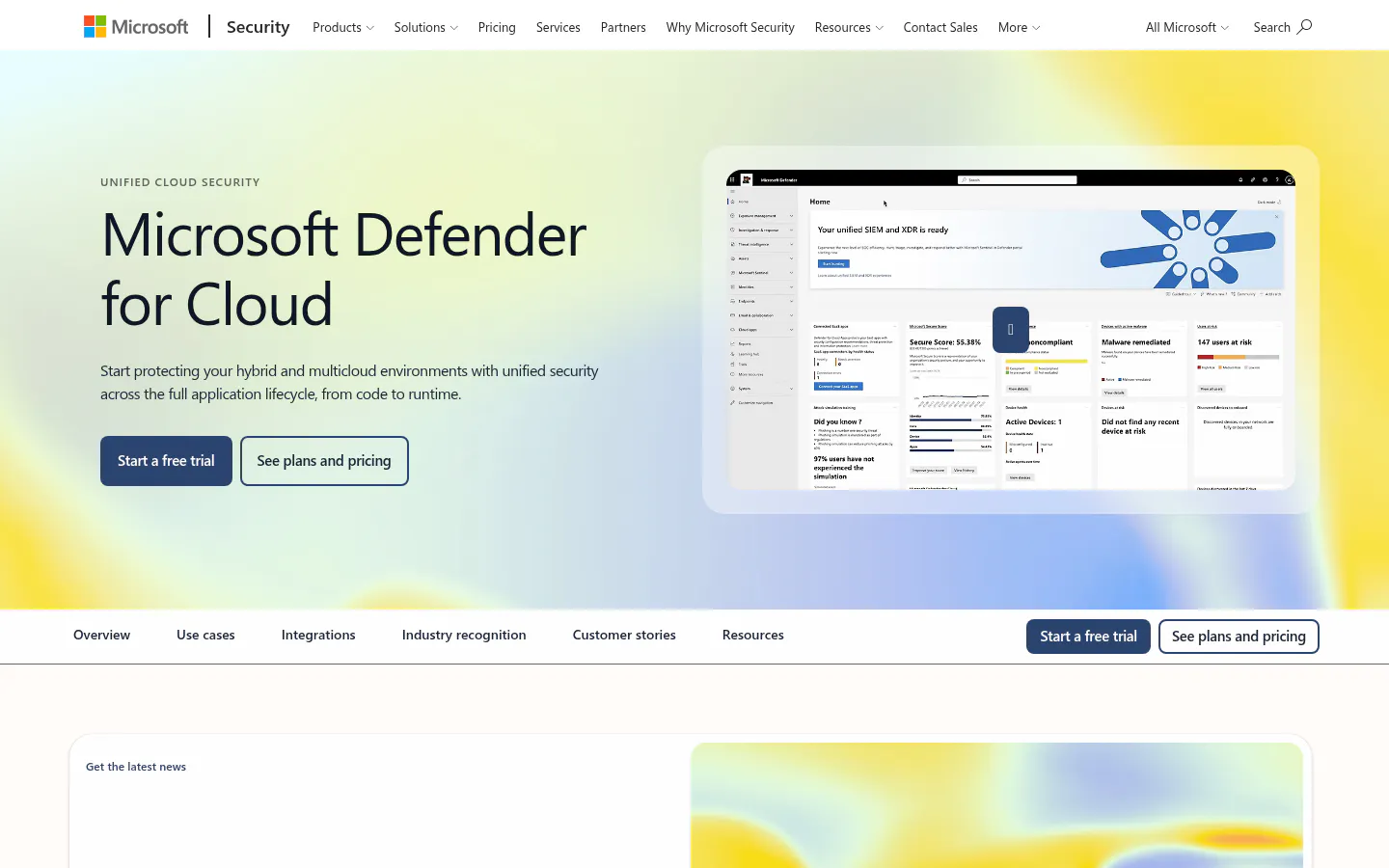
Mark October 27, 2026 on a calendar. From that date, Foundational CSPM is opt-in for new Azure subscriptions rather than on by default, so any subscription spun up after it starts without posture scanning until somebody enables it.
Score: 7.15/10
Key Strengths
- Best fit on this list for companies with 20 to 1000 users, a full point clear of the runner-up. No new vendor, no new contract, no procurement cycle. Foundational CSPM is free and the Defender tier is an Azure line item.
- Regulatory compliance dashboards map to frameworks your auditor already recognizes.
- AWS and Google Cloud connectors exist, and Foundational CSPM stays enabled by default when you onboard them.
Where it runs out
- The delta over free native posture is the smallest here by definition, because Defender for Cloud largely is the native tool. Defender CSPM adds attack-path analysis and agentless scanning on top of Foundational, which is real, but the starting point is a lower bar than what the specialists clear.
- The non-Azure experience is secondary. AWS and Google coverage works and is not where the engineering attention goes.
- Microsoft's own pricing page shows "Free" for Foundational CSPM and a literal dash for Defender CSPM and every paid plan. Even the company with the most published pricing on earth won't put a number on this one.
Best For: Azure-centric or Microsoft 365 organizations without a dedicated cloud security engineer.
Not Ideal For: AWS-first or genuinely multi-cloud estates that need one console to mean something.
Why It Ranks #8: Unbeatable on accessibility, weakest on the criterion asking what a paid tool adds over the free one. Defender for Cloud tied Cortex Cloud at 7.15, and took the higher position on fit for the size range this list is written for.
9. Cortex Cloud, The Broadest Platform, Sold at the Largest Scale
Prisma Cloud doesn't exist as a separate product anymore. Palo Alto merged it with Cortex cloud detection and response into Cortex Cloud, and existing customers moved over.
Score: 7.15/10
Coverage is the argument. Cortex Cloud onboards AWS, Azure, Google Cloud, Oracle Cloud, and Alibaba, second only to Orca by cloud count, and its functional span from code scanning through runtime detection is among the widest here. Palo Alto also holds more Gartner Leader placements across security categories than any competitor, which counts for something in a board conversation.
What it costs you is scale. Cortex Cloud scored lowest here on fit for 20 to 1000 users, and not narrowly. It's positioned alongside XSIAM as an enterprise SOC platform, priced and sold accordingly, with no trial and no published figure. A 300-person company evaluating this is usually evaluating a platform decision, not a posture tool, and the two have very different timelines.
Best For: Larger organizations consolidating cloud security, detection, and response under one vendor.
Not Ideal For: Anyone whose goal is posture management and whose budget cycle is measured in weeks.
Why It Ranks #9: Genuinely broad and genuinely capable, and the hardest product here for a mid-sized company to buy, run, or afford.
10. SentinelOne Singularity Cloud Security, Strong Reviews, Thin Everything Else
SentinelOne holds 4.7 across 381 reviews, the second-largest review base on this page and a review standing that beats six of the nine tools above it and ties a seventh. It finished last.
Score: 6.72/10
Two criteria did it. Forrester didn't name SentinelOne among the vendors identified in the Q1 2026 Wave, and the product publishes no price, no self-serve trial, and no standalone path. Singularity Cloud Security is a separately priced module on top of the Singularity platform, so the cloud posture conversation starts with an endpoint platform conversation. Coverage stops at AWS, Azure, and Google Cloud.
None of that makes it a bad product, and the reviews say plainly that it isn't. It means a buyer at this size has less to go on before committing than nine alternatives offer, and that is exactly what a buying-decision score should reflect. If SentinelOne already protects your endpoints, move it up your own list several places. The ranking here measures what a company can verify from outside.
Key Strengths
- 381 reviews at 4.7, tied third-highest review standing on this list.
- Verified Exploit Paths cut theoretical findings down to the ones that are genuinely reachable.
- One console for endpoint and cloud if you already run Singularity.
Best For: Existing SentinelOne endpoint customers.
Not Ideal For: First-time CSPM buyers with no prior SentinelOne relationship.
Why It Ranks #10: Excellent user sentiment, the least external evidence, and the least a buyer can learn without a sales cycle.
Four of These Vendors Changed Name or Owner Since 2024
Something worth factoring into a three-year contract. The CSPM market consolidated hard, and the vendor you sign with may not have the same name or the same parent by your second renewal.
- Wiz is now Google. The $32 billion deal closed March 11, 2026. Wiz keeps its brand and its multi-cloud commitment.
- Prisma Cloud is now Cortex Cloud. Palo Alto announced the merge with Cortex CDR in February 2025 and migrated existing customers.
- Lacework is now FortiCNAPP. Fortinet acquired Lacework in August 2024, and lacework.com redirects to Fortinet.
- Trend Micro's enterprise business is now TrendAI, renamed on March 23, 2026, with the cloud product carrying the TrendAI Vision One name.
Practical effect on a purchase? Two things. Ask what happens to your contract and your support tier if the vendor is acquired, and get the answer in the agreement rather than on a call. And if a vendor's parent competes with your primary cloud provider, name that now. It won't be a problem for most companies. It will be a board question for a few.
What You Can Learn About Price Before a Sales Call
Ten products. One published price.
Datadog lists $22 and $34 per host per month. Microsoft publishes "Free" for Foundational CSPM and a dash for everything else. The other eight publish nothing at all, and several route the free trial through a representative, so even the trial doesn't end in a number without a conversation.
Budget from the free native tools, which do publish, and treat a third-party CSPM as an unknown you have to scope. A reasonable planning range for a company running 100 to 300 cloud workloads is somewhere between $25,000 and $90,000 a year, and that range is wide because the vendors made it wide. Cyscale, which didn't make the ranking, publishes $850 a month for 1,000 assets and $2,000 for 5,000, which is the clearest public signal available for what this capability costs at the small end.
Pin down two things before signing. Ask what the license counts, because workloads, hosts, resources, assets, and active developers are five different meters and only one of them is yours. And ask what the price does at renewal when your resource count grows 30%, because cloud estates grow and posture licensing almost always grows with them.
Narrowing 10 Down to 2
Start with the free native tools for 30 days, then buy against what they miss.
That sounds obvious. It rarely happens. Turn on Foundational CSPM in Azure, start the AWS Security Hub trial, enable Security Command Center Standard in Google Cloud. Give it a month. You now have a real finding count, a real list of frameworks you fail, and a real sense of whether the gap is coverage, correlation, or nobody having time to read the output. Those three problems have different answers.
If the gap is coverage, meaning you run clouds the native tools don't span, the shortlist is Orca, Cortex Cloud, or Wiz, in that order by breadth.
If the gap is correlation, meaning you have findings but no way to tell which twelve out of 4,000 can actually be chained into a breach, it's Wiz first and Orca second. This is the criterion where the gap between the paid tools and the free ones is widest.
If the gap is nobody has time, be careful. A second console full of alerts makes that problem worse, not better. Either the tool needs to reduce the queue dramatically or the answer isn't a tool at all. It's managed cybersecurity services or a hire.
Then filter on how you buy. Need to see it before you commit? Qualys and Datadog are the only two you can run this week without a sales conversation, with CrowdStrike close behind at 24 hours. Need a number for a budget request? Datadog. Already running Falcon, Singularity, Tenable, or Datadog for something else? Start with the tool you already own, because the console your team already reads beats a better product they check on Fridays.
Multi-cloud teams should also settle the architecture question before the tool question, because posture management gets much simpler when the estate is deliberate rather than accumulated. How Azure, AWS, and Google Cloud compare for mid-market companies covers that ground, and cloud services covers the design work underneath it.
Before You Sign
Wiz earned the top score because it does the most with a finding, and a company with two clouds and someone to own the tool will get the most out of it. Qualys is the one to try first if you want evidence before a commitment. Microsoft Defender for Cloud is the right answer more often than this ranking makes it look, because for an Azure-centric company with no cloud security engineer, the free tool that gets configured beats the excellent one that gets bought and half-deployed.
The tools all find misconfigurations. The difference is what happens on the Tuesday after the first scan, when there are 3,000 findings and two people. That's the question to bring to the demo.
Speak to a cloud security expert about which of these fits the estate you actually run.