Best DRaaS Providers 2026: 8 Managed Disaster Recovery Services Compared
Best DRaaS Providers 2026: 8 Managed Disaster Recovery Services Compared
Consilien leads this 2026 list of DRaaS providers as the publisher's pick, for disaster recovery run by the same team that runs your IT. 11:11 Systems has the deepest verified review record and a managed clean room. Recovery Point covers mainframe and ransomware-first recovery, and TierPoint puts a financially backed RTO in writing. Consilien publishes this editorial list.
Table of Contents
Quick Picks
- Publisher's pick, for recovery run by the team that runs your IT: Consilien
- Deepest verified review record and a managed clean room: 11:11 Systems
- Best for ransomware recovery, mainframe, and IBM Power: Recovery Point
- Best for a recovery-time guarantee backed by money, inside the US: TierPoint
- Best testing terms: InterVision
- Best for paying only when you fail over: Expedient
The best DRaaS providers in 2026 are the ones whose recovery terms you can read before you sign. Badges won't tell you much. Some of them are seven years old.
Disaster recovery as a service (DRaaS) means a provider keeps a running copy of your servers in its own cloud and starts them there when your site can't. Backup gets your data back. DRaaS gets the business back, with the order-entry system, the ERP, and the file shares answering again while your building is dark or your network is encrypted. That difference is what you're paying for. Two numbers decide whether it works. RTO (recovery time objective) is how long you can be down, and RPO (recovery point objective) is how much recent data you can afford to lose.
And the market under that promise has been moving. Between January 2025 and September 2026, three of the eight companies below changed hands, either directly or at the parent level. Gartner published its last DRaaS Magic Quadrant in June 2019. VMware, which sits somewhere in the recovery stack of at least five of these providers, got sharply more expensive after Broadcom bought it, with European cloud providers reporting increases of 800% to 1,500%.
What does an outage cost while you wait? The Uptime Institute's 2026 outage analysis found 57% of organizations said their most recent major outage cost more than $100,000. One in five put it above $1 million. For the second year running.
This list compares eight managed DRaaS companies that serve businesses across the US. Gartner Peer Insights, Google, and Clutch ratings were pulled on October 1, 2026. If you're still weighing a dedicated DRaaS company against managed backup and disaster recovery run by your IT provider, the comparison makes that tradeoff visible too.
How These Eight Were Picked
Consilien publishes this list and put its own service first. The other seven follow in order of a six-criterion review, weighted as shown below and applied the same way to each. No provider paid to appear, and none supplied its own data.
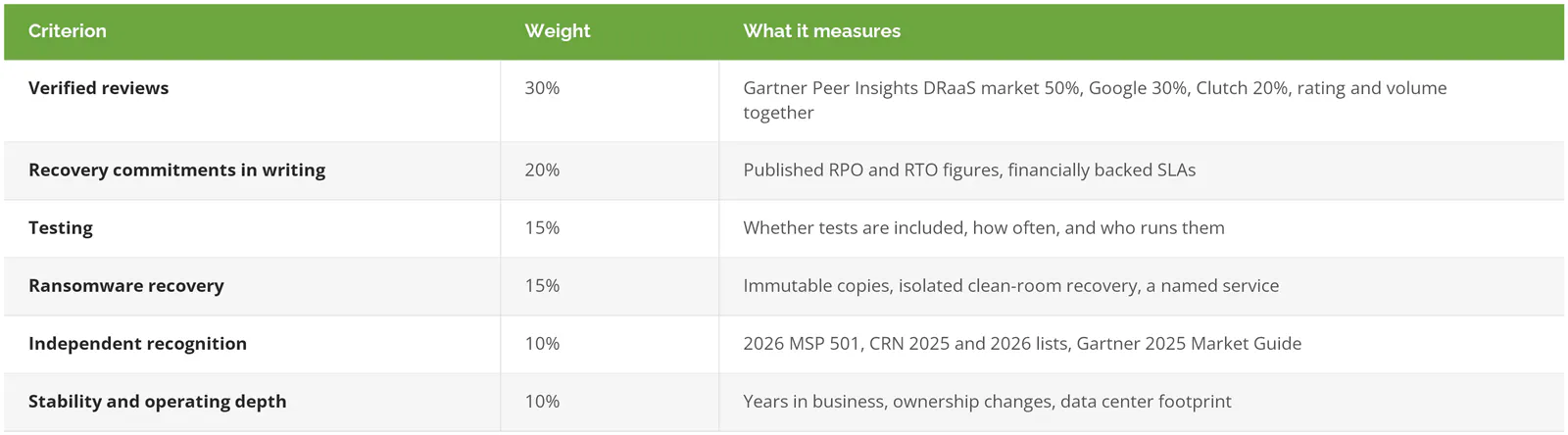
Why Gartner Peer Insights instead of Clutch? Clutch is the usual first stop for IT services, and in this category it's close to empty. TierPoint, Flexential, InterVision, and Expedient each show zero Clutch reviews. 11:11 Systems and Recovery Point don't have a profile at all. Gartner Peer Insights runs a dedicated Disaster Recovery as a Service market with verified reviewers, so it carries half the review weight, Google carries 30%, and Clutch 20%. Consilien and OTAVA have no Gartner profile.
Google doesn't list some of these companies as companies. The TierPoint, Flexential, and Expedient ratings come from a single data center's listing, the nearest thing each has to a public storefront. 11:11 Systems has no Google listing that ties back to its domain under any spelling, so it's reviewed without one instead of with a guess.
What isn't weighed? Price. None of the eight publishes a dollar figure on its DRaaS pages, so cost can't be compared fairly from the outside. The disaster recovery cost guide breaks down what drives the bill.
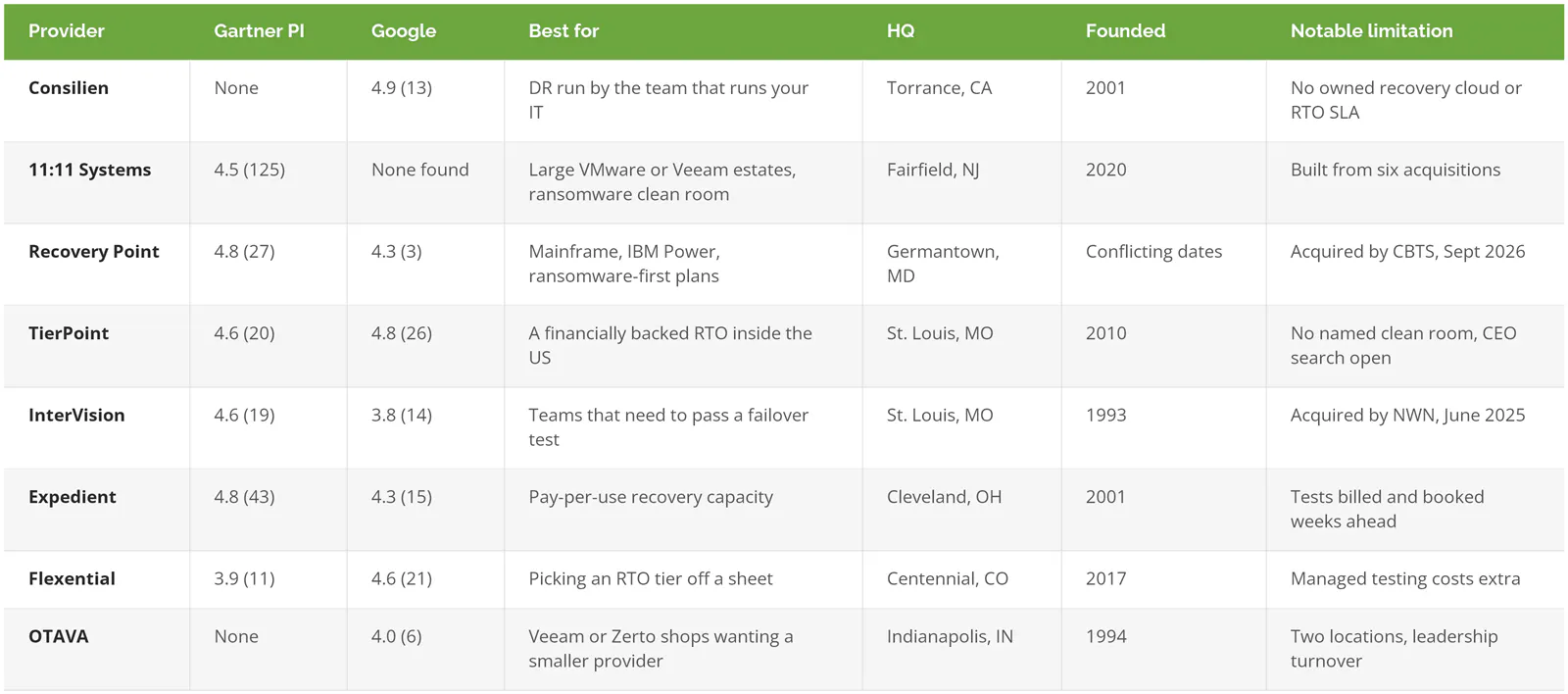
DRaaS Providers at a Glance
The 8 Best DRaaS Providers in 2026
1. Consilien: Publisher's Pick, Recovery Run by the Team That Already Runs Your IT
Consilien isn't a dedicated DRaaS company. It runs disaster recovery as one part of managed IT, which is why it leads its own list and why it won't fit every buyer.
Consilien is a managed IT provider in Torrance, California, serving businesses nationwide since 2001. Recovery runs on Datto, its primary backup technology partner, and the same team handles the client's help desk, security, and infrastructure. So when the 2 a.m. call comes, nobody has to explain the network to a stranger.
Key Strengths
- The highest Google rating on this list, 4.9 from 13 reviews, plus 4.9 from 6 verified reviews on Clutch.
- Backups as often as every 5 minutes, tested every day, and reviewed by a person rather than left to an alert nobody reads.
- Backups are scanned for ransomware before a restore, and copies are kept in two US locations.
- A Datto appliance on site can run failed servers locally within minutes, without waiting on a cloud failover.
- Named to the 2026 Channel Partners MSP 501 at No. 306, its second straight year.
Where it falls short of the operators below it. No Gartner Peer Insights profile. No owned recovery cloud. No published RTO commitment. Daily backup verification is real work, but it's not the same as a full failover rehearsal on a schedule. And it's not built for mainframes, IBM Power, or a VMware estate with hundreds of virtual machines.
Best For: Businesses without dedicated DR staff that want one accountable team for IT, security, and recovery, including a plan for which systems come back first.
Not Ideal For: Organizations that need a contractual recovery time in minutes across a large virtual environment.
Services: Managed IT, co-managed IT, cybersecurity, backup and disaster recovery. Compliance work (NIST, CMMC, SOC 2) is offered as a separate engagement.
Industries: Manufacturing, distribution, professional services, and real estate.
Why It's #1: Publisher's pick. Consilien put its own service first because it fits a specific buyer, the business that wants recovery handled by the people who already handle everything else. On verified reviews, written recovery terms, and footprint, the operators below it are stronger, and each section says where.
2. 11:11 Systems: The Biggest Review Record and a Managed Clean Room
If you want the provider with the most customers vouching for its recovery work on a verified platform, it's this one, by a wide margin.
11:11 Systems was put together fast. Founded in 2020, it closed the iland acquisition in January 2022, took on the Sungard Availability Services recovery business that November, and in January 2026 completed Ntirety, which the company called its sixth purchase of an authorized VMware partner. The result is a recovery cloud across 11 data centers in North America, Europe, and Asia-Pacific and more than 6,000 customers.
Key Strengths
- 4.5 stars across 125 ratings on Gartner Peer Insights. No other provider here is within 80 ratings of that.
- In June 2025 it launched the Cyber Recovery Platform for Cohesity, a fully managed clean room. A clean room is an isolated environment where restored systems are checked for malware before they touch production again.
- Pick your replication engine. Veeam, Zerto, Azure, or Cohesity.
- The uptime service-level agreement (SLA) is 100% and financially backed, and recovery targets can be set "to minutes or even seconds."
The tradeoff. Six acquisitions in four years means you're buying from a company still stitching itself together, and its infrastructure runs on VMware, the platform whose licensing jumped after Broadcom. Testing runs from the customer console without disruption, but 11:11 doesn't publish how often a managed test happens. Ask. Get the answer in the contract.
Best For: Businesses with a sizable VMware or Veeam estate that want a large provider and a managed clean room for ransomware recovery.
Not Ideal For: Buyers who want a small provider where the same engineer answers every call.
Why They Rank #2: Review depth did most of the work. A 4.5 average across 125 verified ratings is a harder number to earn than Recovery Point's 4.8 across 27, and the clean-room service covers getting back from ransomware without restoring the infection.
3. Recovery Point: Built for Ransomware and the Hardware Few Others Recover
Mainframes. IBM Power. AIX. If any of those words describe a system your business can't run without, the shortlist gets short quickly.
Key Strengths
- Recovers IBM Z mainframe, IBM Power, and x86 workloads, using Zerto, Veeam, and Pure Storage.
- Its Ransomware Recovery as a Service stacks immutable backups on write-once, read-many (WORM) storage, which can't be altered after it's written, with air-gapping (a copy kept offline, out of an attacker's reach) and hot-site failover into a clean room. AI-assisted backup validation was added in October 2025.
- No. 37 on the 2026 MSP 501, and named in Gartner's 2025 DRaaS Market Guide.
- 4.8 stars across 27 Gartner Peer Insights ratings. Google is thinner at 4.3 from 3 reviews.
Worth knowing. CBTS acquired Recovery Point on September 10, 2026. Three weeks before this list. Contracts, support contacts, and roadmap can all shift during an integration, so ask what's changing in the next 12 months and what your contract says if it's reassigned. Its pages promise "aggressive RPO and RTO SLAs" without printing a number.
Recovery Point's site still references Magic Quadrant recognition. That report stopped in 2019, so read any MQ badge on any DRaaS site as history.
Best For: Businesses running mainframe, IBM Power, or IBM i alongside Windows and Linux, and anyone whose recovery plan starts with ransomware.
Not Ideal For: Buyers who need a stable vendor relationship through 2027 and don't want to live through an integration.
Why They Rank #3: The ransomware recovery stack is the most complete on this list, and the legacy-platform coverage is rare. The thin Google record and the unprinted SLA numbers kept it behind 11:11.
4. TierPoint: A Recovery-Time Guarantee With Money Behind It
TierPoint puts something in writing that several larger names don't. A financially backed RTO.
RTO vs. RPO explains both numbers in depth. TierPoint financially backs the RTO on its managed Zerto service, and Zerto's continuous replication gives recovery points with seconds of granularity.
Key Strengths
- Testing is part of the managed service. One test at implementation, then annual drills, with extra tests available.
- Four replication options. Azure Site Recovery, Zerto, VMware Live Site Recovery, and IBM recovery. Failover can land in TierPoint's cloud, AWS, or Azure.
- 40 data centers in 20 US markets.
- 4.6 stars across 20 Gartner Peer Insights ratings and 4.8 from 26 Google reviews on its St. Louis data center listing.
The tradeoff. TierPoint describes isolated backups and encryption detection, but there's no named clean-room recovery product to compare with 11:11's or Recovery Point's. Ownership has also been busy. Apollo acquired Argo Infrastructure Partners, TierPoint's majority owner, in January 2025, and on March 30, 2026 the company started a search for its next CEO. It's a US-only footprint, too, which matters if you have offices abroad.
Best For: US businesses that want a recovery time written into the contract with a penalty attached.
Not Ideal For: Companies with international sites, or anyone who wants a named ransomware clean room.
Why They Rank #4: Close to a tie with Recovery Point and InterVision. TierPoint wins on written commitments and included testing, and loses ground on ransomware recovery and on recognition, where it has no current independent list placement.
5. InterVision: "We Test Until You Pass"
Every DR plan looks fine on paper. InterVision is the only provider here that guarantees the test.
Key Strengths
- A "100% testing success guarantee" in its own words. "We test until you pass."
- Secure Recovery Landing Zones, built with encryption, immutability, isolation, and segmentation, plus air-gapped accounts holding immutable copies.
- Veeam, VMware, and Zerto, recovering into AWS or Azure. InterVision bought Bluelock, a DRaaS specialist, in 2018.
- On the CRN MSP 500 for 2025, in the Elite 150.
Where it slips. Its Google rating, 3.8 from 14 reviews, is the lowest here, though Gartner Peer Insights reviewers are kinder at 4.6 across 19 ratings. RTO is "mutually agreed" rather than published. And NWN acquired InterVision in June 2025, so like Recovery Point, it's mid-integration. The company positions itself for mid-sized to enterprise organizations and the public sector.
Best For: A team that has never run a clean failover and wants a partner on the hook until it works.
Not Ideal For: Smaller businesses outside its stated mid-to-enterprise focus.
Why They Rank #5: The best testing terms on the list, and solid ransomware isolation. The weak Google record and an unpublished RTO left it a whisker behind TierPoint.
6. Expedient: Pay When You Fail Over
Expedient prices recovery by consumption. You pay when you test or fail over, not for idle capacity.
Key Strengths
- No. 4 on the 2026 MSP 501, the highest placement of anyone here.
- 4.8 stars across 43 Gartner Peer Insights ratings, second only to 11:11 in volume.
- Near-real-time recovery points with Zerto and 5-minute recovery points with VMware Cloud Director Availability. Nutanix and Cohesity are supported too.
- In business since 2001, when it started as US VoiceData in Cleveland.
What holds it back. Testing. Expedient's own knowledge base says DR tests "must be scheduled several weeks in advance," and on its On-Demand tier, tests are charged like a real failover. On-demand resources are shared, so performance depends on load at the time. Ransomware recovery isn't described on its DR pages at all. That's a bad combination for a plan that only works if you rehearse it.
Best For: Businesses with a tight monthly budget that will still pay to test at least once a year.
Not Ideal For: Anyone who wants frequent, low-friction testing.
Why They Rank #6: Excellent reviews and the strongest recognition on the list. The testing model held it back more than anything else.
7. Flexential: The Most Specific Recovery Times in Print
Flexential publishes real numbers, which deserves credit.
The base Zerto-powered package includes an 8-hour RTO with DR activation support, or you can control recovery yourself. Add-ons cut that to 2 or 4 hours. Journal retention, meaning how far back you can rewind, starts at two days with 5, 14, and 30-day options, and five DR centers cover most US metro areas within 600 miles.
Key Strengths
- Concrete RTO tiers you can hold the provider to.
- CRN's 2025 Cloud 100 and its 20 Coolest Cloud Infrastructure Companies of 2026.
- 4.6 from 21 Google reviews on its Charlotte data center listing.
The catch. Self-service testing is included, but managed testing is an add-on. Its Gartner Peer Insights rating is the lowest here, 3.9 across 11 ratings. Replication runs on Zerto only. And the big 2026 headline was an $800 million credit facility for data center capacity, not DR.
Best For: Buyers who want to choose an RTO tier off a sheet and know exactly what they bought.
Not Ideal For: Teams that want the provider to run every test.
Why They Rank #7: Clear commitments, weak reviews, and testing that costs extra.
8. OTAVA: Managed Zerto, Veeam, or VMware From a Smaller Shop
OTAVA runs fully managed DRaaS on Zerto, Veeam, or VMware from a smaller footprint than the other dedicated DRaaS operators here.
It's been around since 1994, first as Online Tech in Ann Arbor, and moved its headquarters to Indianapolis in June 2025. Its service comes with RTO and RPO tiers "from near-zero to 24 hours" and immutable copies.
- No. 167 on the 2026 MSP 501.
- Veeam named it a 2025 VCSP Partner of the Year. That's a vendor award, but a fair signal of Veeam depth.
- 5.0 from 3 Clutch reviews and 4.0 from 6 on Google.
No Gartner Peer Insights profile, two listed locations, and its second new CEO since 2023.
Best For: Veeam or Zerto shops that want a smaller provider and a direct line to its engineers.
Not Ideal For: Buyers who need multiple recovery regions.
Why They Rank #8: A capable managed service with the thinnest verified record of the eight.
How to Choose a DRaaS Provider
Start with the recovery time your business can survive, then pick the provider whose contract puts that number in writing and includes a test you don't pay extra to run. Everything else is a tiebreaker.
Work out the RTO before you talk to anyone. Which systems stop revenue first? The order desk? Production scheduling? Payroll? The RTO calculator puts a number on it, and the answer usually splits your servers into two or three tiers, which matters because hot, warm, and cold recovery sites carry very different price tags.
Then match the scenario.
- Mainframe or IBM Power in the mix: Recovery Point, after you get straight answers about the CBTS integration.
- Big VMware or Veeam estate, ransomware as the main worry: 11:11 Systems.
- US-only, and you want the RTO enforceable: TierPoint.
- You've never passed a full failover test: InterVision.
- Tight budget, rare tests: Expedient, as long as you budget for those tests.
- No in-house IT team, and you'd rather not manage a separate DR vendor: an MSP that runs recovery as part of managed IT, such as Consilien.
Ransomware deserves its own question. Sophos's 2026 State of Ransomware puts the average recovery cost at $1.7 million, and 56% of attacks still got as far as encrypting data. Where does a clean copy live if the attacker reaches your backups first? Who checks it before it goes back into production? A provider that can't answer both in plain words isn't ready for the scenario you're most likely to face. The ransomware recovery playbook walks through the first 72 hours.
Five questions to put to every finalist:
- Who runs the failover at 2 a.m., your staff or theirs?
- What does one test cost, and how often is it included?
- Is the RTO in the contract, or only in the brochure?
- Has ownership changed in the last 18 months, and what does the contract say about assignment?
- Which of my systems are excluded?
That last one catches people. A DRaaS contract that covers the VMware cluster but not the SQL server in the closet is a plan with a hole in it, and you won't find the hole until the day you need it. DR testing best practices shows how to find it on a quiet Tuesday instead.
Still deciding whether you need DRaaS or better backup? The DRaaS buyer's guide lays out where one ends and the other begins. California-based? There's a separate ranking of California DRaaS providers built on a different model.
The Short List
Consilien is the publisher's pick for businesses that want recovery run by the team already running their IT. Among the dedicated DRaaS operators, 11:11 Systems has the deepest review record and a managed clean room. If your environment includes a mainframe or IBM Power, Recovery Point is the stronger fit. Want an enforceable recovery time inside the US? Look hard at TierPoint. Never passed a failover test? InterVision.
Not sure which recovery time your business actually needs? Speak to a disaster recovery expert before you sign anything.