Best IT Compliance Companies: 8 Consulting Firms Ranked (2026)
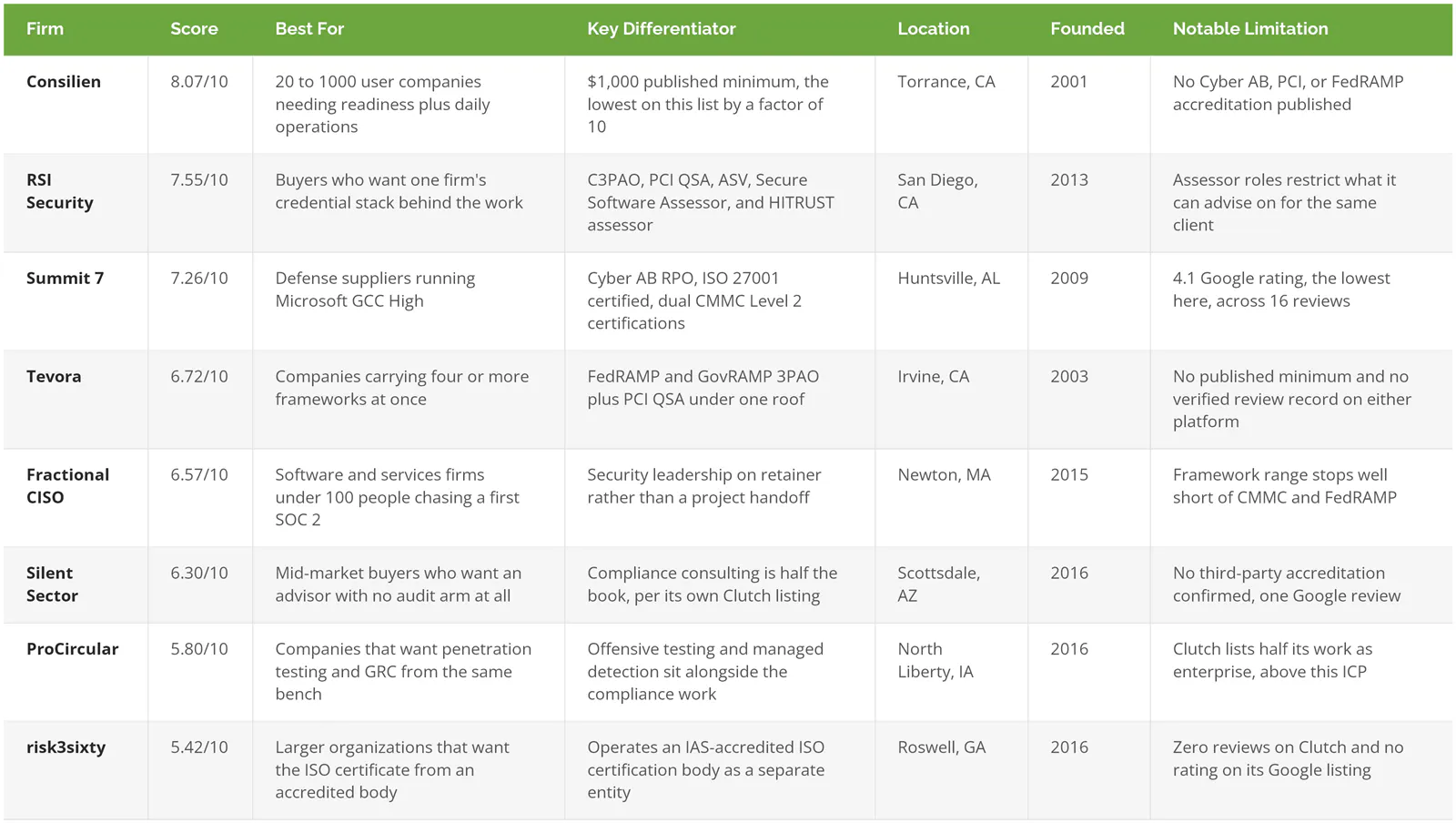
Consilien ranks first among the best IT compliance companies in 2026 with an 8.07 Confidence Score, earned on engagement accessibility, independence from the audit side, and ongoing program ownership. RSI Security follows at 7.55 on assessor credentials, then Summit 7 at 7.26 for defense work. Scores come from live Clutch and Google data across seven weighted criteria.
Table of Contents
Quick Picks
- Best Overall for 20 to 1000 Users: Consilien
- Best Credential Stack: RSI Security
- Best for Defense Contractors: Summit 7
- Best Framework Range: Tevora
- Best for Companies Under 100 People: Fractional CISO
- Best Pure Advisory Shop: Silent Sector
- Best for Testing Alongside the Paperwork: ProCircular
- Best If You Want the ISO Certificate Itself: risk3sixty
Search for the best IT compliance companies and you'll get Deloitte, KPMG, PwC, EY, Accenture, and IBM. Every list. Same six names. None of them will build a NIST 800-171 System Security Plan for a 240-person aerospace supplier in Wichita, and if one did, the invoice would arrive with a program management office attached to it.
Eight firms are ranked below. All eight will sign an engagement with a company running 20 to 1000 users. Every rating came from a live pull of Clutch and Google Business Profile run on September 17, 2026, and where a firm has no verified review record, the article says so rather than filling the gap.
This ranking is published by Consilien, which was scored against the same seven criteria as everyone else and finished first. The methodology section shows the two weight changes that would hand first place to RSI Security instead.
Readiness or Attestation? Get This Wrong and You Pay Twice
Two different companies have to touch your compliance program. One builds it. One certifies it. They can't be the same company.
On the CMMC side the rule is blunt. A Certified Third-Party Assessor Organization (C3PAO, the firm authorized to run your official CMMC assessment) cannot assess a company it has consulted for, and the separation runs the full 36-month certification cycle. Hire a C3PAO to write your policies and you've just disqualified them from certifying you until 2029.
SOC 2 runs the same logic through a different door. The AICPA Independence Rule (ET 1.200.001) and the attestation standards at ET 1.297 bar a CPA firm from auditing controls it designed, and the Journal of Accountancy flagged in April 2026 that arrangements touching scope, timing, or evidence access create independence threats the profession is watching closely. Translation for a CFO. The firm that helps you pass can't be the firm that says you passed.
So which half are you actually buying?
Readiness and advisory firms run the gap assessment, write the System Security Plan and Plan of Action and Milestones, stand up the controls, train the staff, and collect the evidence. That's what every firm in this ranking does.
Assessors and auditors show up at the end, look at what you built, and issue the report or the certificate. Those firms are named further down, unranked, because ranking them against advisors compares a general contractor to a building inspector.
One firm. One role. The companies that get burned are the ones that sign a single vendor for both halves on the theory that fewer contracts means less friction, then discover in month 7 that the partner who built the program has to hand the file to a stranger who wants the evidence formatted differently.
How We Ranked These Firms
Seven criteria, applied identically to all eight firms, weighted toward what actually decides a mid-market compliance engagement. No firm paid for placement. No firm submitted its own data.
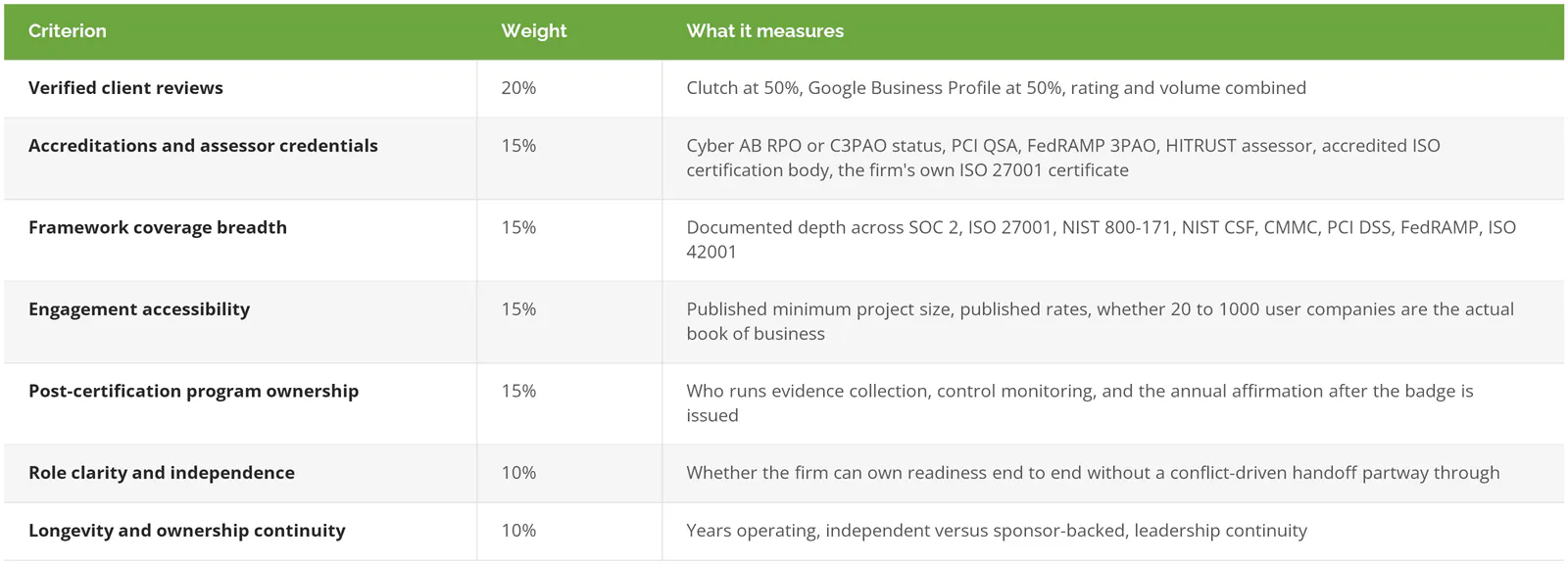
Two weights were moved off the standard model, and both moves are worth explaining because one of them costs Consilien points.
Reviews normally carry 35% on a rankings model like this. Here they carry 20%. Why drop the biggest factor in the standard model? Five of the eight firms have a Clutch profile with zero reviews on it, and a sixth has no profile at all. Compliance advisory is bought through referral and through the auditor's short list, not through a marketplace, so a 35% review weight would be measuring the wrong thing loudly. Dropping it hurts Consilien more than anyone, because Consilien has the only substantial verified review record on the list.
Credentials went the other way. An accreditation from the Cyber AB, the PCI Security Standards Council, or the FedRAMP program office is a harder signal than a star rating, so it earns a full 15%. Consilien scores 2.0 out of 10 there. Last place, by a wide margin, and the reason is in its section below.
Run the model with reviews back at the standard 35% and Consilien still finishes first, 7.94 to 7.62. Push credentials to 25% and cut accessibility to 5%, and RSI Security wins at 7.80. Remove the independence criterion entirely and RSI Security wins again at 8.00. Two of three sensitivity runs flip the top spot. That's a thin lead and the table below should be read that way.
IT Compliance Consulting Firms at a Glance
1. Consilien: Readiness Built By the Team That Runs the Environment
Compliance programs fail in month nine, not month one. The gap assessment gets done, the policies get written, and then the evidence stops getting collected because nobody owns the calendar. Consilien is the firm on this list best positioned against that specific failure, because the same organization that writes the compliance program also runs the patching, the identity controls, and the logging it depends on.
Score: 8.07/10
Key Strengths
- A $1,000 published minimum project size on its verified Clutch profile. The next lowest on this list is $10,000. Two firms publish nothing at all.
- 4.9 on Clutch across 6 verified reviews and 4.9 on Google across 13. Nobody else here has a substantial record on both platforms, and five of the eight have zero Clutch reviews.
- Independently owned since 2001, which in a market where private equity now sits behind most national IT brands means the person who signs the engagement is still there in year three.
- Dedicated service documentation per framework rather than one compliance page listing acronyms. CMMC, SOC 2, NIST 800-171, ISO 27001, and PCI DSS each get their own page and their own scope.
- Named on the Channel Partners MSP 501 for 2026 at #306 globally, a second consecutive year.
Where the fit breaks down
No Cyber AB Registered Provider Organization listing. No PCI Qualified Security Assessor status. No FedRAMP 3PAO, no HITRUST assessor authorization, no CPA license. A search of the public record turns up none of it, and that's the single largest gap in this ranking. [VERIFY: Cyber AB Marketplace RPO listing status for Consilien, not found in public search as of September 17, 2026]
For a defense supplier that wants an RPO logo in the procurement file, that gap is disqualifying on its own. Summit 7 exists for that buyer. And the MSP 501 recognition is a managed services award, not a compliance one, so it shouldn't be read as framework validation.
Consilien's Clutch listing also shows compliance consulting at 5% of its service mix against managed IT at 70%. The compliance work is a standalone offering and is sold that way, never bundled into a managed IT contract, but a buyer looking for a pure GRC shop should know the shape of the business before the first call.
Best For: Companies running 20 to 1000 users that need a NIST, CMMC, SOC 2, or PCI program built and then operated, particularly manufacturers, distributors, and professional services firms without a full-time security lead.
Not Ideal For: Defense suppliers who need an RPO-badged partner on paper, organizations above 1000 users with an internal GRC team already in place, or anyone who needs the certificate issued rather than the program built.
Services: Compliance readiness and gap assessment, policy and control architecture, vCISO and vCIO advisory, managed cybersecurity, managed and co-managed IT, security awareness training, AI governance.
Industries: Manufacturing including aerospace and medical device, distribution and logistics, food processing, real estate management, professional services, media and creative.
Why They Rank #1: Consilien wins on the criteria a 240-person manufacturer actually weighs, which are whether the firm will take the engagement, whether it will still be there for the year-two affirmation, and whether anyone will operate the controls once the report is filed. It loses the credentials criterion outright and the lead survives only one of three sensitivity runs. Read that as a close first place, not a comfortable one.
2. RSI Security: The Most Credentials on the List, With Strings
Nobody else here carries this many authorizations at once.
Score: 7.55/10
Key Strengths
- Authorized as a C3PAO by the Cyber AB, which puts it in the small group of organizations authorized to run official CMMC assessments.
- PCI Qualified Security Assessor, Approved Scanning Vendor, and Secure Software Assessor, plus HITRUST External Assessor authorization.
- 5.0 on Clutch across 2 verified reviews and 5.0 on Google. Thin volume, but it's the only other firm here with any verified Clutch record at all.
- Roughly 40% of its Clutch service mix is managed IT services, so the ongoing operations capability is genuine rather than a line on a slide.
The tradeoff: Every one of those credentials narrows what RSI Security can do for a given client. Hire it to prepare you for CMMC and the C3PAO arm is out for 36 months. Hire it to advise on PCI and the QSA arm has an independence question to answer. The credential stack is real, and the scoping conversation has to happen before the contract, not after.
Its Clutch profile also lists a 2008 founding, Southlake, Texas, and 1,000 employees, while its Google Business Profile and public record point to San Diego and a 2013 start. [VERIFY: founding year, headquarters, and employee count for RSI Security, Clutch and public sources conflict] This ranking used the more conservative 2013 figure.
Best For: Buyers who want assessor-grade rigor and are willing to run the role-separation conversation up front, especially PCI DSS and HITRUST scopes.
Not Ideal For: A company that wants one firm to carry it from gap assessment through certification without a handoff.
Why They Rank #2: Highest credential score on the list at 9.0 and strong framework range, dragged back by a 4.5 on independence and by the founding-data conflict. In two of three sensitivity runs it takes first place.
3. Summit 7: Built for the Defense Industrial Base and Almost Nothing Else
Ask a defense supplier in Huntsville who handles their CUI environment and this name comes up before you finish the sentence.
Score: 7.26/10
Key Strengths
- A Cyber AB Registered Provider Organization, which is the credential that matters on the advisory side of CMMC, since an RPO prepares and a C3PAO certifies.
- ISO 27001 certified itself, and holds dual CMMC Level 2 certifications. A compliance firm that has passed the assessment it sells is a different proposition from one that hasn't.
- Azure Expert MSP with Microsoft Partner of the Year recognition, which is the difference between advising on GCC High and actually running it. GCC High is Microsoft's government cloud tenant, the one most contractors handling Controlled Unclassified Information end up in.
- Named to the Inc. 5000 in 2025. Incorporated 2009 by two founders who met at NASA.
Worth knowing: 4.1 on Google across 16 reviews. That's the lowest rating in this ranking and the highest review volume, which is usually what a real operating history looks like rather than a curated one. No Clutch profile at all, which cost it half the Tier 1 weight under this model.
Range is the bigger limitation. Summit 7 is deep on CMMC, DFARS, NIST 800-171, ITAR, and the Microsoft government stack. It's not the firm for a SaaS company that needs a first SOC 2 Type II, and it doesn't pretend to be.
Best For: Defense contractors and aerospace suppliers handling CUI, particularly those already committed to Microsoft GCC High.
Not Ideal For: Commercial companies outside the defense supply chain, or anyone whose primary driver is SOC 2, ISO 27001, or PCI DSS.
Why They Rank #3: The strongest credentials on the list tied with Tevora, plus real operational depth, held back by the narrowest framework coverage of any firm here. For a DoD subcontractor it should probably rank first.
4. Tevora: Widest Framework Range, Thinnest Public Record
23 years in, Tevora covers more compliance ground than anyone else on this list.
Score: 6.72/10
Key Strengths
- Listed on the FedRAMP Marketplace as an accredited third-party assessment organization, and an approved GovRAMP 3PAO, alongside PCI QSA status and a C3PAO authorization.
- Framework coverage runs SOC 1 and 2, ISO 27001, ISO 42001 for AI management systems, PCI DSS, HITRUST, FedRAMP, GovRAMP, and CMMC.
- Founded 2003, making it the second-oldest firm ranked. The company states 10,000 completed audits across 2,000 client organizations, figures it publishes itself.
- Its Clutch listing splits the practice evenly, 50% compliance consulting and 50% cybersecurity.
Worth knowing: Tevora carries the same independence constraint as RSI Security and carries it across more programs. FedRAMP, PCI, and CMMC roles each fence off a piece of what the firm can advise on for the same client.
The public review record is essentially empty. Clutch profile with zero reviews. Three Google reviews at 5.0. But for a firm claiming 2,000 clients, that gap is strange, and it's most of why Tevora sits fourth rather than second. No published minimum project size either, and the marketing language leans toward large brands.
Best For: Organizations juggling four or more frameworks simultaneously, especially anything touching FedRAMP or GovRAMP authorization.
Not Ideal For: A 60-person company with one framework and a fixed budget.
Why They Rank #4: Elite credentials and the widest coverage on the list, undercut by a 4.0 review score and a 5.0 on accessibility. Strong firm, hard to price-check before you're in the room.
5. Fractional CISO: Security Leadership on Retainer, Not a Project
The model here is different from everyone else on this list. Rather than selling a readiness project that ends, Fractional CISO sells a part-time security executive who stays.
Score: 6.57/10
Key Strengths
- 5.0 on Google across 10 reviews, the second-highest verified review volume in this ranking.
- Named to Inc. magazine's Best Workplaces list in 2023, which matters more than it sounds in a category where the consultant assigned to your account leaving mid-program is the most common complaint.
- The retainer structure means somebody owns the control monitoring and the annual evidence cycle by default, instead of it becoming an open question after the report ships.
- Founded 2015 in Newton, Massachusetts, with a CISSP-led practice and named practitioners published on the site.
Where it falls short: Framework range is the narrowest here after Summit 7, concentrated on SOC 2 and ISO 27001. No CMMC, no FedRAMP, no PCI QSA relationship documented. No Clutch profile either, which triggered the missing-platform penalty.
For a 400-person defense manufacturer this is the wrong firm. For a 70-person software company that just got a SOC 2 request from an enterprise prospect, it's close to the right one.
Best For: Software and professional services companies under roughly 100 people facing a first SOC 2 Type II or ISO 27001 certification.
Not Ideal For: Anyone in the defense supply chain, or a company that needs PCI DSS or FedRAMP work.
Why They Rank #5: Best independence and program-ownership profile of the smaller firms, with a credential and framework score that keeps it out of the top three.
6. Silent Sector: No Audit Arm, No Conflict, No Badge Either
Silent Sector does one thing. It prepares companies and hands them off.
Score: 6.30/10
Key Strengths
- Its Clutch listing puts compliance consulting at 50% of the practice, the highest compliance concentration of any firm ranked.
- Framework coverage spans SOC 2, ISO 27001, NIST 800-171, NIST 800-53, NIST CSF, CMMC, PCI DSS, CIS Controls, GDPR, and CCPA.
- Mid-market focus is stated explicitly rather than inferred, and the service pages are written for a buyer rather than an auditor.
- Zero attestation business means zero independence conversations. What it can advise on is whatever you hire it for.
The tradeoff: No third-party accreditation surfaced in the public record. No RPO, no QSA, no C3PAO, no certification body. For most commercial buyers that's fine. For a DoD subcontractor filling out a procurement questionnaire, it's a blank line.
Verified review data is thin, one Google review at 5.0 and a Clutch profile with none. Its Clutch listing shows Boise, Idaho, while the Google Business Profile shows Scottsdale, Arizona. [VERIFY: primary headquarters for Silent Sector, Clutch and Google listings disagree]
Best For: Mid-market commercial companies that want an advisor with no attestation conflicts and a broad framework bench.
Not Ideal For: Buyers who need a credentialed name on the procurement form.
Why They Rank #6: Tied for the best independence score on the list and strong on framework range, held down by a 3.0 on credentials and almost no verifiable review history.
7. ProCircular: Testing and Compliance From the Same Bench
Compliance frameworks keep asking for penetration testing results. ProCircular can produce them without a subcontractor.
Score: 5.80/10
Key Strengths
- Governance, risk, and compliance sits alongside penetration testing, attack surface management, and managed detection and response, so the technical evidence a framework demands comes from the same team writing the documentation.
- Named to the Inc. 5000 in 2025, and its CEO was Iowa's SBA Small Business Person of the Year in 2023.
- Publishes a $10,000 minimum project size on Clutch, which at least gives a buyer a number before the call.
- The Cyber Advisory Program is a retainer, not a project, which puts real weight behind the post-certification criterion.
Worth knowing: Its Clutch client mix is 50% enterprise, 25% mid-market, 25% small business. That's the only firm here whose largest client segment sits above this ranking's 20 to 1000 user band, and it shows up in the accessibility score.
Framework documentation is also thinner than the field. The site leads with services rather than standards, so a buyer shopping specifically for NIST 800-171 or CMMC has more digging to do. No third-party accreditation confirmed.
Best For: Companies that want offensive testing, monitoring, and compliance documentation from one vendor.
Not Ideal For: Buyers who need framework-specific depth documented before they'll take a meeting.
Why They Rank #7: Genuine technical capability and a real award record, pulled down by an enterprise-weighted client base and the least framework documentation in the group.
8. risk3sixty: The Only Firm Here That Can Issue the Certificate
Everybody else here prepares you for someone else's audit. risk3sixty runs an accredited ISO certification body as a separate legal entity under International Accreditation Service oversight, so the certificate itself can come from inside the same brand.
Score: 5.42/10
Key Strengths
- Framework range covers ISO 27001, ISO 42001, ISO 27701, ISO 22301, ISO 9001, SOC 1, SOC 2, SOC 3, PCI DSS, HITRUST, and FedRAMP.
- Splitting the certification body into its own accredited entity is the cleanest answer to the independence problem anyone on this list has built.
- CMMC Registered Practitioner capability, founded 2016 in Roswell, Georgia, with 2,000 stated engagements.
Where it falls short: No verified review record anywhere. Zero on Clutch, and a Google listing with no rating at all. That produced a 0.0 on the review criterion, the only zero here, and it's most of why a firm this capable finishes last.
Client base is the wrong shape for this list too. Enterprise case studies, enterprise language, no published minimum. A 150-person distributor isn't who this firm is built around. And separate entity or not, a buyer using both arms should get the independence structure in writing before signing.
Best For: Organizations above 1000 users pursuing ISO 27001 or ISO 42001 certification who want advisory and certification paths available from one brand.
Not Ideal For: Mid-market buyers, anyone whose primary framework is CMMC, and any company that shortlists on public review evidence.
Why They Rank #8: The best independence structure here and the second-widest framework range, undone by zero verifiable review data and an enterprise orientation this model weights against.
Who Actually Issues the Report
These firms aren't ranked here, because they do the other half of the job. When a readiness partner says you're ready, one of these organizations decides whether that's true.
- Schellman and A-LIGN are the volume leaders in SOC 2 attestation, both AICPA-accredited, both also authorized on the CMMC side.
- Coalfire is the name most often cited for FedRAMP authorization work.
- BARR Advisory and 360 Advanced are CPA firms covering SOC, ISO, PCI DSS, and HITRUST for smaller scopes.
- KirkpatrickPrice works down-market on SOC 2 for companies that would get lost at a larger firm.
Pick the assessor before you pick the advisor, or at least early enough that the advisor can ask what that assessor wants to see. Auditors carry real preferences about evidence format, sampling periods, and how a control narrative is written, and a readiness firm that has already worked alongside the assessor you chose will anticipate those preferences instead of discovering them during fieldwork, which is the difference between one revision cycle and three.
How to Choose an IT Compliance Consulting Firm
Which framework, and by when? Those two facts eliminate most of the list before you compare anything else, and the firms that fit will be obvious within an hour.
Then work through the rest.
If you're in the defense supply chain, the calendar just changed under you. The Department of Defense suspended CMMC Phase 2 requirements on July 13, 2026, pulling back the November 10, 2026 mandate for third-party C3PAO assessments. Contracting officers are back to Level 1 and Level 2 self-assessments while a reform task force finishes a 60-day review.
Nothing else moved. NIST SP 800-171 Rev. 2 controls still apply. DFARS 252.204-7012 still applies. Annual affirmations still apply, and False Claims Act exposure for a misrepresented score is still very much live. The assessment paused. The obligation didn't.
That matters for hiring, because the pause is temporary and capacity is not. Firms booked solid in June have calendar space now. Contractors who read the suspension as a reprieve rather than a window will be shopping for a readiness partner at the exact moment the task force reports and several thousand other suppliers reach the same conclusion on the same week, which is how a 9-month program turns into an 18-month one.
If your driver is a customer contract, you're almost certainly looking at SOC 2 Type II or ISO 27001, and the deadline is somebody else's procurement cycle. Fractional CISO and Silent Sector are built for that. So is Consilien, which also sells gap assessment as a standalone first step if the scope isn't clear yet. The choice between SOC 2 and ISO 27001 usually comes down to who's asking and where they're located.
Consultants versus compliance automation software. Real fork, and not an either-or. Platforms handle evidence collection and control monitoring well. They don't scope your environment, write a defensible System Security Plan, or sit across from an auditor. The build versus buy comparison matters more than most buyers expect, because the tooling decision shapes what the consultant is actually being paid to do.
If the budget is the constraint, ask for the published minimum before the discovery call. Three firms here publish one. Consilien at $1,000, RSI Security and ProCircular at $10,000. The other five want a conversation first, which is a business model, not a red flag, but it does tell you something about who they're used to selling to.
On the question everyone skips. Ask what happens in month 13. The certification is a point-in-time artifact. Controls drift, staff turn over, evidence goes uncollected, and the annual affirmation arrives whether anyone prepared for it or not. A firm that hands you a report and disappears has sold you a document. A firm that stays has sold you a program. Both are legitimate purchases. They cost different amounts and they're not interchangeable.
One more from the data. The 2026 State of the Defense Industrial Base report surveyed 302 defense contractors and found mean self-assessment scores climbing to +51, the second straight positive year, while confidence in those same scores fell from 89% to 65%. Only 1% claimed full readiness. Multifactor authentication was in place at 63% of them. Endpoint detection at 40%.
Scores went up. Controls didn't. A compliance program that produces a number nobody believes is a reporting exercise, and the firms worth hiring will tell you that before you sign.
Where This Leaves You
Consilien takes first at 8.07 on a model built around engagement accessibility, independence from the audit side, and who owns the program after the report is filed. The lead is narrow and the methodology section above shows exactly which weight changes reverse it.
A defense supplier in Microsoft GCC High should call Summit 7. A company that wants the strongest credential stack available and is prepared to scope around the independence rules should call RSI Security. A 70-person software firm chasing a first SOC 2 should call Fractional CISO.
Speak to a compliance expert about which framework applies to your contracts, what the gap actually looks like, and what the first 90 days cost.