Best Phishing Simulation & Training Platforms 2026
Most companies buy a phishing testing platform and assume they're covered. They pick a tool with a big template library, switch on a quarterly campaign, and move on. Then a real invoice-fraud email lands in finance, someone clicks, and they find out the thing they bought was a piece of software, not a program.
Table of Contents
Here is the uncomfortable part. A platform sends the simulated emails. It doesn't decide who gets tested, tune the difficulty, chase down repeat clickers, or turn the results into something your auditor will accept. That work is the program. The platform is just the delivery mechanism.
So this list scores both. We ranked five of the strongest phishing simulation and security awareness training options for 2026 on what they actually do to lower human risk, not on feature-sheet length. Where a tool is brilliant at simulations but hands you the operational burden, we say so. Where the answer is a managed program rather than a login, we say that too.
If you only want to know which way to lean, pick a platform when you have a security team with hours to run it, and pick a managed program when you do not. Everything below explains why.
How we scored these platforms
Every credible ranking is built on stated criteria. Here are ours, with the weighting visible so you can follow the math and disagree with it if you want to.
- Managed delivery and setup burden removed (25%): how much of the run-it-every-week work is done for you.
- Phishing simulation realism and coverage (20%): template depth, scenario variety, attachment and credential lures.
- Behavioral change and analytics (15%): whether reporting proves risk actually dropped.
- Compliance alignment (15%): how cleanly the evidence maps to an audit against the NIST Cybersecurity Framework, CMMC, PCI, and SOC 2.
- Support and local accountability (15%): who answers when a campaign breaks or a board asks.
- Pricing transparency and SMB fit (10%): whether a 50 to 250 person company can buy it without a six-week procurement cycle.
A note on bias, because you should ask. We weighted managed delivery and support heavily because that's where most small and mid-market companies fail, not because it flatters any one vendor. A business with a staffed security operations center should reweight simulation realism and analytics higher, and the order below would shift. The scores are a starting point, not a verdict on your environment.
All third-party ratings below were pulled live from G2 and Gartner Peer Insights during research for this article. Consilien's own offering carries no third-party software rating because it's a managed service, not a product you download. We flag that openly rather than invent a number.
The 2026 ranking at a glance
- Consilien IC24 SATaaS (managed program) scores 9.2 out of 10. Best for companies without a security team to run it.
- KnowBe4 (self-serve platform) scores 7.8 out of 10. Best for large in-house programs that want template volume.
- Hoxhunt (self-serve platform) scores 7.3 out of 10. Best for enterprises chasing engagement and AI personalization.
- Proofpoint ZenGuide (self-serve platform) scores 7.2 out of 10. Best for shops already standardized on Proofpoint email security.
- Cofense PhishMe (self-serve platform) scores 6.7 out of 10. Best for security teams building report-and-triage muscle.
1. Consilien IC24 Security Awareness Training (Score: 9.2)
What it is: A fully managed security awareness training program, not a platform you log into and operate. Consilien runs the phishing simulations, the micro-training, dark web monitoring, and compliance training for you, and owns the outcome. Pricing runs roughly $10 to $72 per employee per year depending on scope.
Why it ranks here: The thing that breaks most awareness programs is not the software. It's the second quarter, when the person who set up the campaign gets busy and the program quietly dies. A managed program removes that failure point. Consilien selects the scenarios, escalates difficulty for repeat clickers, and reports results in a format that lines up with compliance readiness for NIST, CMMC, PCI, and SOC 2. For a 50 to 250 person company with no dedicated security staff, the operational lift is the whole problem, and that's exactly the 25% of our score that this wins outright. A vCISO reviews the data so it feeds a decision, not a dashboard nobody opens.
Where it is strong:
- Nobody on your team has to build, schedule, or chase a single campaign.
- Local Southern California support with named accountability, not a ticket queue.
- Simulation results map directly to audit evidence.
- Transparent per-employee pricing you can budget against.
Honest weaknesses:
- It's not self-serve software. If your security team wants to administer every setting itself, a platform fits better.
- Geographic focus is Southern California and California, so a national enterprise with in-house staff may not need the managed layer.
- Built for organizations that want it run for them. A company with a mature internal program is buying capability it may not use.
Best for: SMB and mid-market companies that know they should be testing employees and do not have anyone with the hours to actually do it.
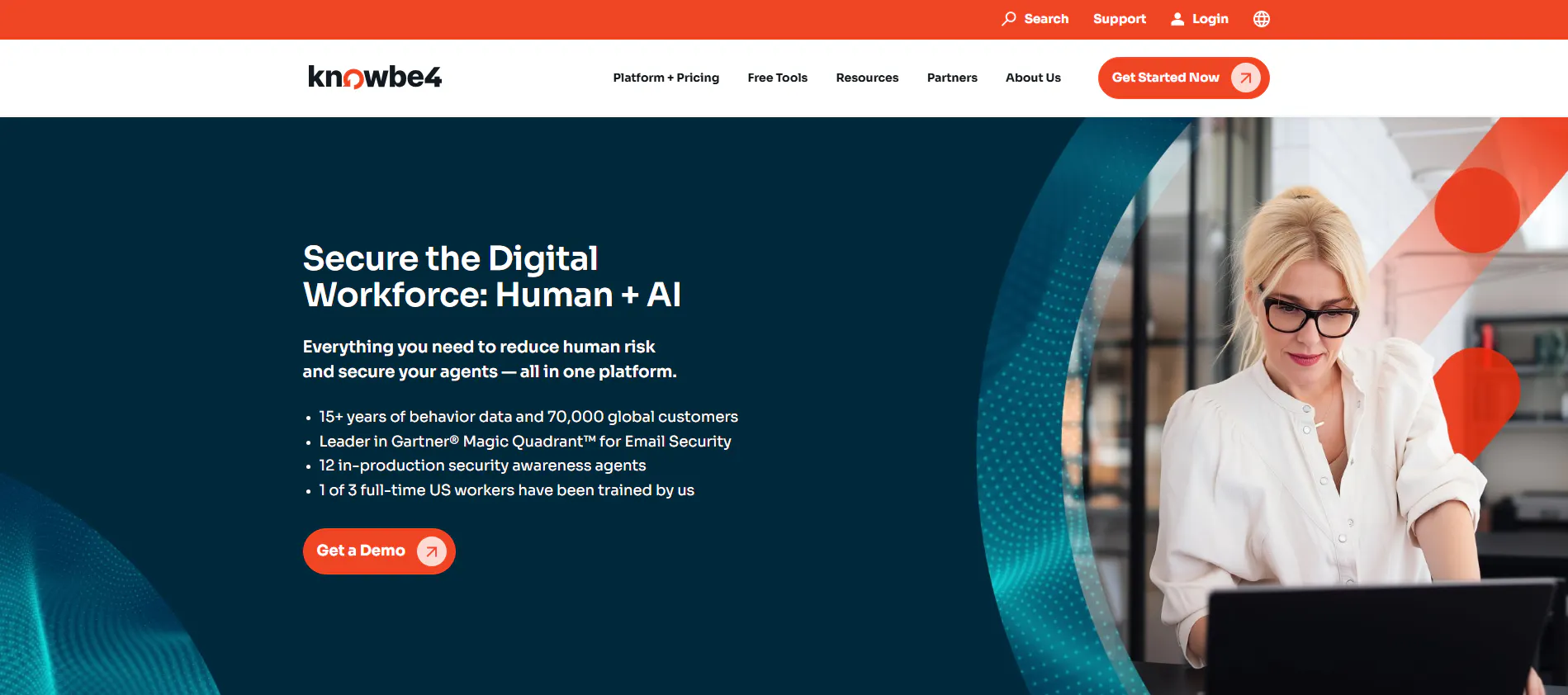
2. KnowBe4 Security Awareness Training (Score: 7.8)
KnowBe4 is the platform everyone benchmarks against, and the rating reflects it. It holds 4.6 out of 5 on G2 and 4.6 on Gartner Peer Insights across more than 2,400 reviews. If a self-serve tool is what you want, this is the default for a reason.
The case for it is volume. The template library is the largest on the market, the AIDA engine auto-selects simulation templates based on a user's click history, and the published benchmarking carries real weight. According to KnowBe4's benchmarking, untrained organizations sit at a 33.1% phishing-prone percentage, which falls to 18.9% after 90 days of training and simulated phishing, and to 4.6% after a year of continuous use. That's the clearest proof in this category that sustained testing works.
The catch is operational. Reviewers consistently note a dated reporting interface and a dashboard that gets complex fast at scale. Setting up and tuning campaigns is hands-on work, and that work is yours. KnowBe4 sells you a capable engine. It does not drive the car.
Where it is strong:
- One of the largest template and training libraries on the market.
- AI-selected templates that adapt to user behavior.
- Transparent per-user pricing, roughly $1.30 to $2.35 per user per month.
Honest weaknesses:
- Reporting interface feels dated next to the platform's maturity.
- Dashboard and campaign setup carry a learning curve.
- All the day-to-day administration falls on your team.
Best for: Organizations with the in-house hours to run a large program and a preference for breadth of content.
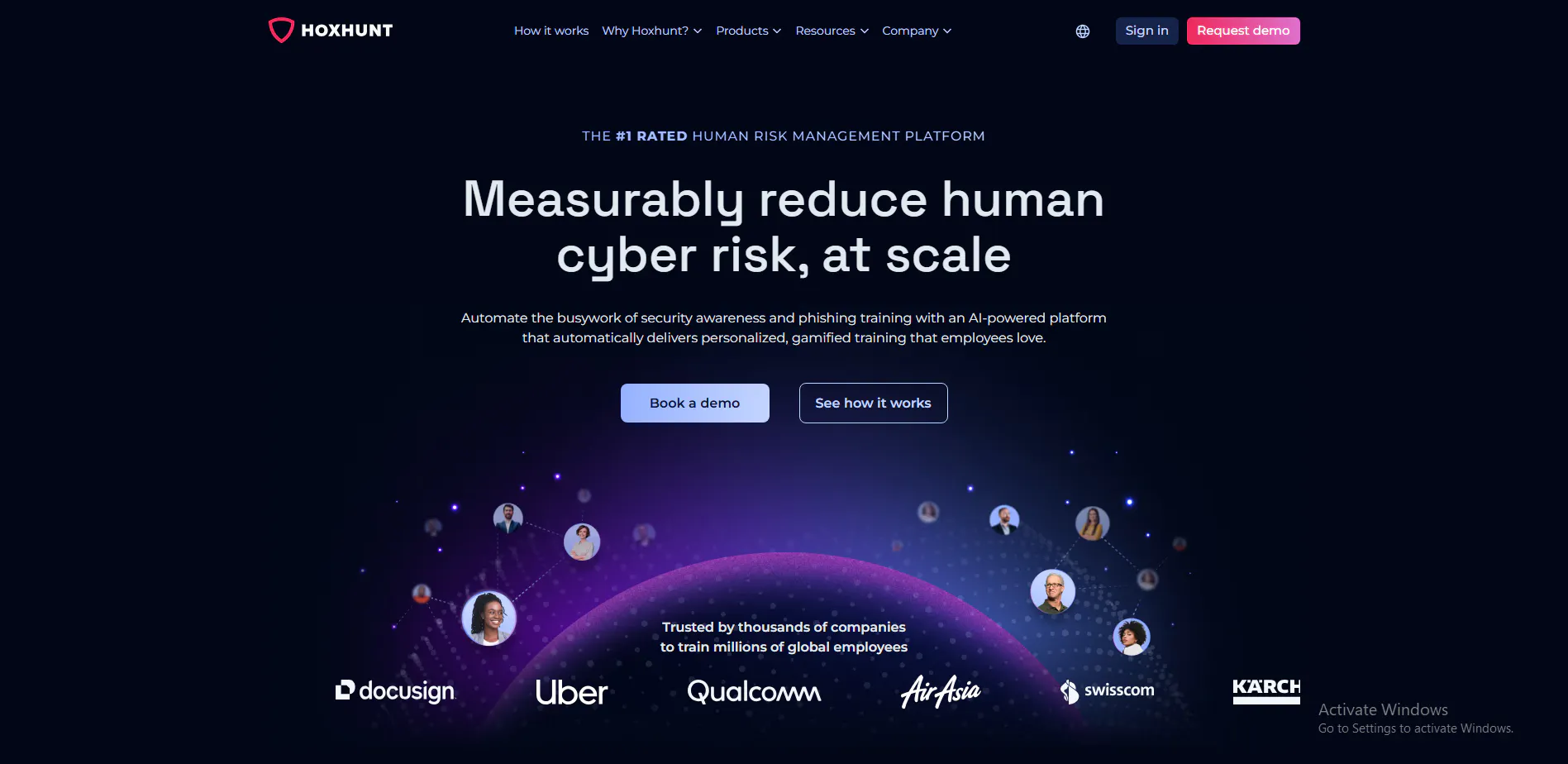
3. Hoxhunt (Score: 7.3)
Hoxhunt has the highest user rating in this group, a 4.8 on G2 across more than 3,500 reviews, and most of those come from enterprise users. People genuinely like using it, which is rare for security training.
The reason is the model. Hoxhunt uses AI and behavioral science to tune each simulation to the individual. Someone who reports phishing reliably gets harder lures. Someone still learning gets gentler ones. Wrap that in gamification and you get engagement numbers most platforms cannot touch. If your problem is that employees ignore training, this is the strongest answer on the list.
The trade-off is who it's built for. Pricing is quote-only and oriented to enterprise budgets, so a smaller company cannot just look up a number and buy. Setup is more involved than lighter tools, and reviewers note the admin dashboard is less intuitive than the polished end-user experience. The people taking the training love it. The person running it has more to learn.
Where it is strong:
- Per-user adaptive difficulty driven by real behavior.
- The strongest engagement and gamification on this list.
- Strong measurable behavior change over time.
Honest weaknesses:
- Quote-only pricing, weighted toward enterprise spend.
- Admin side is less polished than the user side.
- Onboarding takes more effort than a basic platform.
Best for: Larger organizations where getting employees to care is the main obstacle.
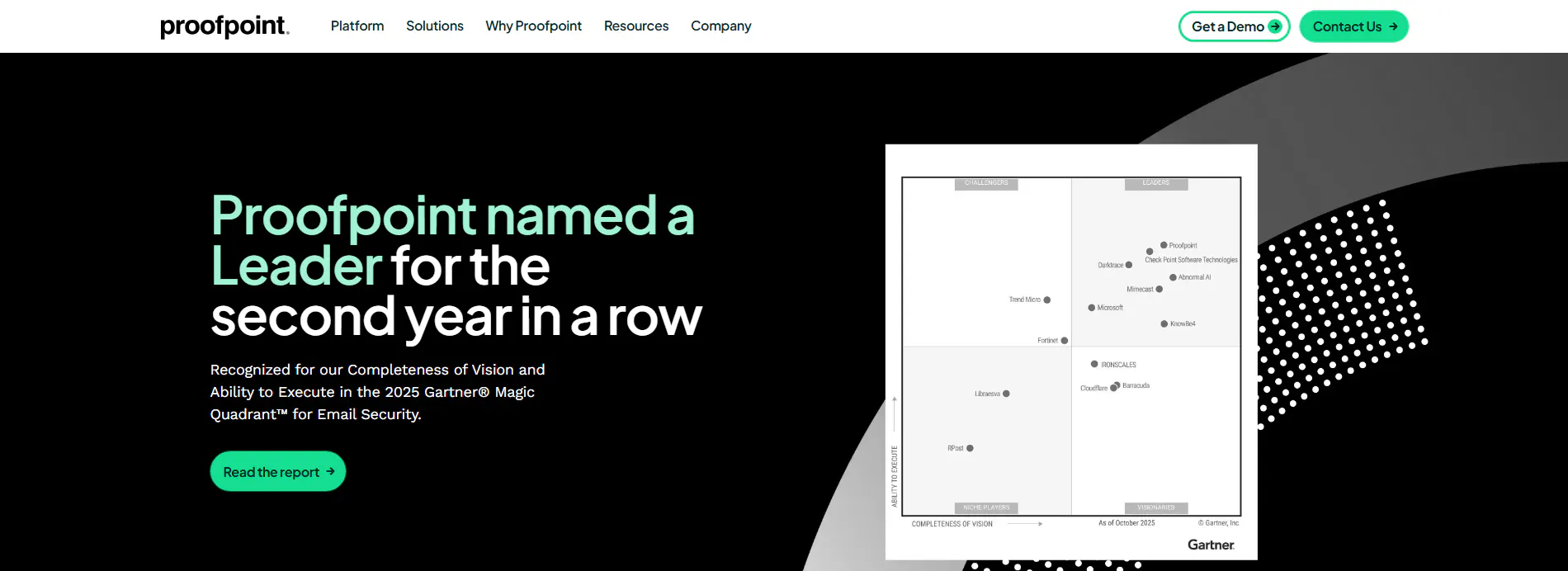
4. Proofpoint Security Awareness Training / ZenGuide (Score: 7.2)
Proofpoint earns a 4.5 on G2 and 4.6 on Gartner Peer Insights across nearly 800 reviews. It's a solid, enterprise-grade training platform with one defining trait. It's best when you are already a Proofpoint shop.
ZenGuide pulls threat intelligence from Proofpoint's email security backbone and uses real attack patterns to shape training and risk-based assignments. If your email security, threat protection, and awareness training all sit in one ecosystem, the integration is the selling point. Reviewers praise the training library and the support.
That same strength is the limitation. The value concentrates inside the Proofpoint ecosystem. If you run a different email security stack, you are buying a capable but standalone training tool and leaving the best part on the table. Pricing is enterprise-oriented and quote-based, which slows down smaller buyers.
Where it is strong:
- Training informed by live Proofpoint threat intelligence.
- Tight fit with the broader Proofpoint security suite.
- Strong content library and technical support.
Honest weaknesses:
- Most of the upside requires the rest of the Proofpoint stack.
- Enterprise-oriented, quote-based pricing.
- Heavier than a 50 to 250 person company usually needs.
Best for: Enterprises already standardized on Proofpoint email security.
5. Cofense PhishMe (Score: 6.7)
Cofense PhishMe sits at a 4.4 on G2 and solves a different half of the phishing problem than the others. Most tools focus on stopping the click. Cofense focuses on what happens after someone spots a suspicious email and reports it.
That's the real strength. Reported messages flow into Cofense Triage and Vision for analyst review and automated takedowns, which turns employee reporting into measurable security operations outcomes. The simulation side, PhishMe, runs customizable scenarios with role-based lures, attachment simulations, and credential-harvesting tests, paired with just-in-time education. If you are trying to build a human reporting network that feeds your security team, nothing here does it better.
The cost is fit and footprint. It carries fewer reviews than the market leaders, leans toward security-operations and incident-response use rather than broad awareness, and its training library is smaller. One documented quirk is that logs default to UTC, which has caused missed alerts when the timing isn't accounted for. For a company that just wants employees trained, this is more machinery than the job requires.
Where it is strong:
- The strongest report-to-triage workflow and SOC integration here.
- Realistic simulations with just-in-time training.
- Turns employee reports into real threat response.
Honest weaknesses:
- More incident-response oriented than pure awareness.
- Smaller training library and fewer reviews than the leaders.
- UTC log timing has caused missed-alert issues.
Best for: Security teams that want to build report-and-triage capability, not just run training.
How to choose the right option for your business
Strip away the feature sheets and the decision comes down to one question. Who is going to run this every week?
If you have a security team with real hours to spend, buy a platform and pick by your weak spot. Need content breadth and proven benchmarks, choose KnowBe4. Fighting employee apathy, choose Hoxhunt. Already standardized on Proofpoint, choose Proofpoint. Building a reporting and triage capability, choose Cofense.
If you do not have those hours, and most companies between 15 and 500 employees do not, then the platform you pick matters far less than whether anyone operates it. That's the case for a managed program. Someone owns the campaigns, the escalation, the reporting, and the audit evidence, and you get the risk reduction without the second-quarter collapse. Consilien runs that as a managed cybersecurity service alongside the rest of your security program.
The cost of security awareness training is small either way. The cost of buying a tool nobody runs is the breach you thought you had prevented.