Best SIEM Software & Tools for 2026: 10 Platforms Ranked
Microsoft Sentinel ranks first among the best SIEM tools for 2026 at 8.79/10, helped by free ingestion of Microsoft 365 and Defender logs. FortiSIEM (8.30) and Elastic Security (8.29) follow on rating strength and published pricing. Ten platforms scored on six independently verified criteria.
Table of Contents
Quick Picks
- Best overall: Microsoft Sentinel
- Most predictable bill: Rapid7 InsightIDR, priced per asset with unlimited log ingestion
- Lowest published rate per GB: Elastic Security, from $0.09 per GB ingested
- Best if the network is already Fortinet: FortiSIEM
- Best free starting point: Graylog Open
- Approach with caution: IBM QRadar, where the SaaS edition has been withdrawn from sale
Picking a SIEM is a five-year decision wearing a one-year price tag. A SIEM platform collects logs from every server, firewall, laptop, and cloud tenant a company runs, correlates them, and raises alerts when something looks wrong. Ripping one out later means rebuilding every parser, every detection rule, and every compliance report from scratch.
Which is why the two questions that decide whether a SIEM works out for a 20 to 500 user company barely appear in the comparison content ranking for "best siem tools." Who owns the product now? And does the pricing meter punish you for connecting more log sources?
Both questions have answers that changed sharply between 2024 and 2026. This ranking scores them directly.
Ten platforms, six criteria, every review figure pulled live from Gartner Peer Insights on August 26, 2026. Companies without an internal security team should read the managed SIEM options alongside this list, because a platform is only half the purchase.
How These Rankings Were Built
Each platform carries a Confidence Score out of 10, built from six independently verifiable criteria applied identically to all ten products. No vendor paid for placement. No vendor submitted its own data. Consilien does not appear on this list and has no reseller relationship with any platform ranked here.
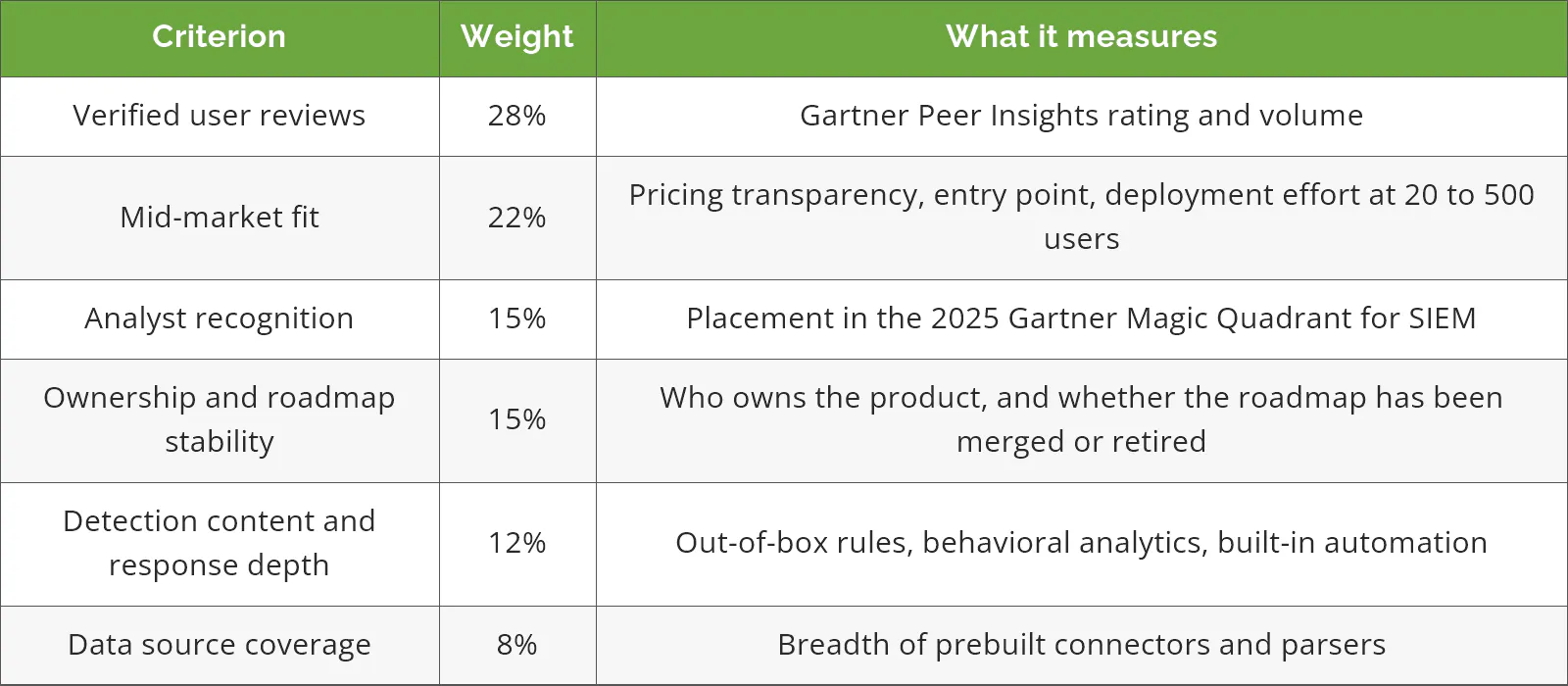
Two of those need explaining, because they're the ones that make this ranking come out differently from the rest of the category.
Reviews come from one platform, on purpose. G2 blocks automated access to its SIEM category entirely. Capterra's SIEM listing is contaminated with log-management and backup products that don't belong in the comparison. Gartner Peer Insights is the only verified review source in this category that returns complete, readable data, so it carries the full 28% rather than being averaged with sources that would add noise instead of signal. Every product here has at least 170 ratings, so volume differences don't distort the result.
Ownership stability is worth 15% because of what happened in 2024. Three of the largest SIEM products in the market changed hands inside 7 months of each other. Cisco completed its $28 billion acquisition of Splunk in March 2024. Exabeam and LogRhythm completed their merger that July, folding two competing SIEM portfolios into one roadmap. Palo Alto Networks closed its acquisition of IBM's QRadar SaaS assets in September, and IBM left the SIEM SaaS business.
A comparison table that lists features while ignoring that is describing a market that stopped existing two years ago. Ownership churn isn't gossip. It determines whether the parsers a team spends 6 months tuning still get updated in 2029.
Scores are shown to two decimal places because several products land within a tenth of each other, and rounding would hide genuine ties.
SIEM Tools at a Glance
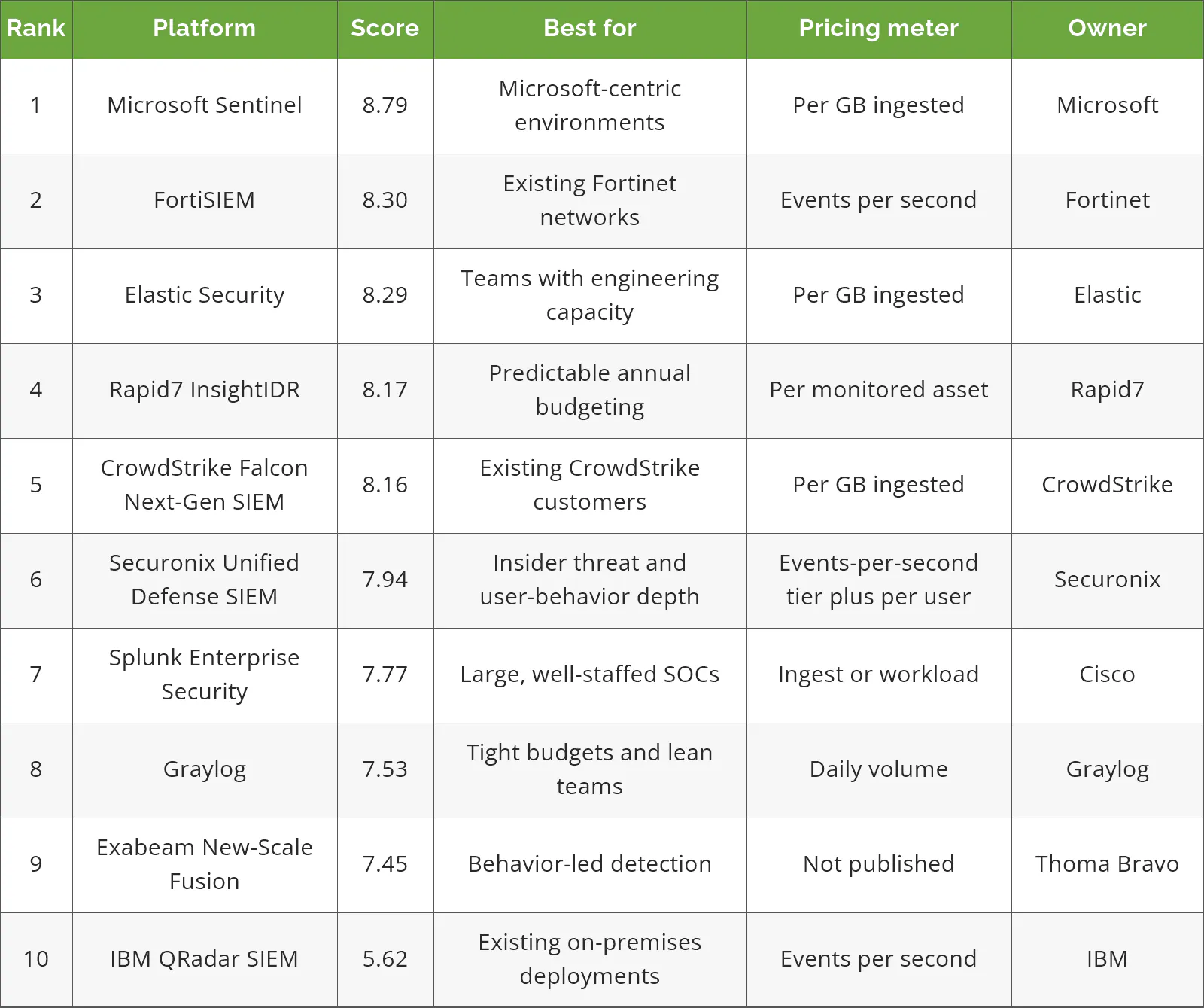
Two platforms that belong in any serious conversation are missing, and the reason is worth stating. Google SecOps and Gurucul Next-Gen SIEM were both named Leaders in the 2025 Gartner Magic Quadrant. Neither carries a comparable Peer Insights rating in this market, so scoring them on the same 28% review criterion isn't possible without inventing a number. They're excluded rather than estimated.
1. Microsoft Sentinel
Confidence Score: 8.79/10
The economics here are unusual, and they're the reason Sentinel finishes first rather than the feature list. Microsoft ingests a specific set of logs at no charge, and for a company already running Microsoft 365 those logs are most of what a SIEM would otherwise bill for.
Key strengths
- Azure Activity Logs, Office 365 audit logs covering SharePoint, Exchange, and Teams activity, and security alerts from the entire Defender family all ingest free. For a 200-person Microsoft shop, that removes a large share of the billable volume before the meter starts.
- All ingested data is retained at no charge for the first 90 days, which covers the retention window most cyber insurance applications ask about.
- A 31-day trial covers the first 10 GB per day at no cost, so the platform can be evaluated against real production logs rather than a vendor demo environment.
- Named a Leader again in the 2025 Gartner Magic Quadrant for SIEM, with a 4.54 Peer Insights rating across 243 ratings.
- Playbooks, behavioral analytics, and native correlation with Defender XDR are part of the platform rather than separate purchases.
The tradeoffs. Commitment tier pricing, where the real discounts live, starts at 100 GB per day. A 200-user company generating 15 to 30 GB per day doesn't reach that floor, which means paying the highest per-GB rate available. Microsoft opened a 50 GB per day tier, but it's in public preview with promotional pricing that runs only through December 31, 2026, so it can't be relied on as a permanent line item. There's also a dated migration ahead. After March 31, 2027, Sentinel stops being available in the Azure portal and moves to the Defender portal only.
Best for: Companies running Microsoft 365 E3 or E5 with an Azure footprint and someone who can write KQL queries, Microsoft's log query language.
Not ideal for: Organizations with little Microsoft presence, where the free-ingestion advantage disappears entirely and the per-GB rate is simply high.
Why it ranks first: Sentinel isn't the highest-rated platform on this list, and it doesn't have the deepest detection content. It wins because the pricing structure fits the size of company this ranking is written for better than anything else that also carries a Leader placement and a 4.5-plus review score. That combination is rarer than it should be.
2. FortiSIEM
Confidence Score: 8.30/10
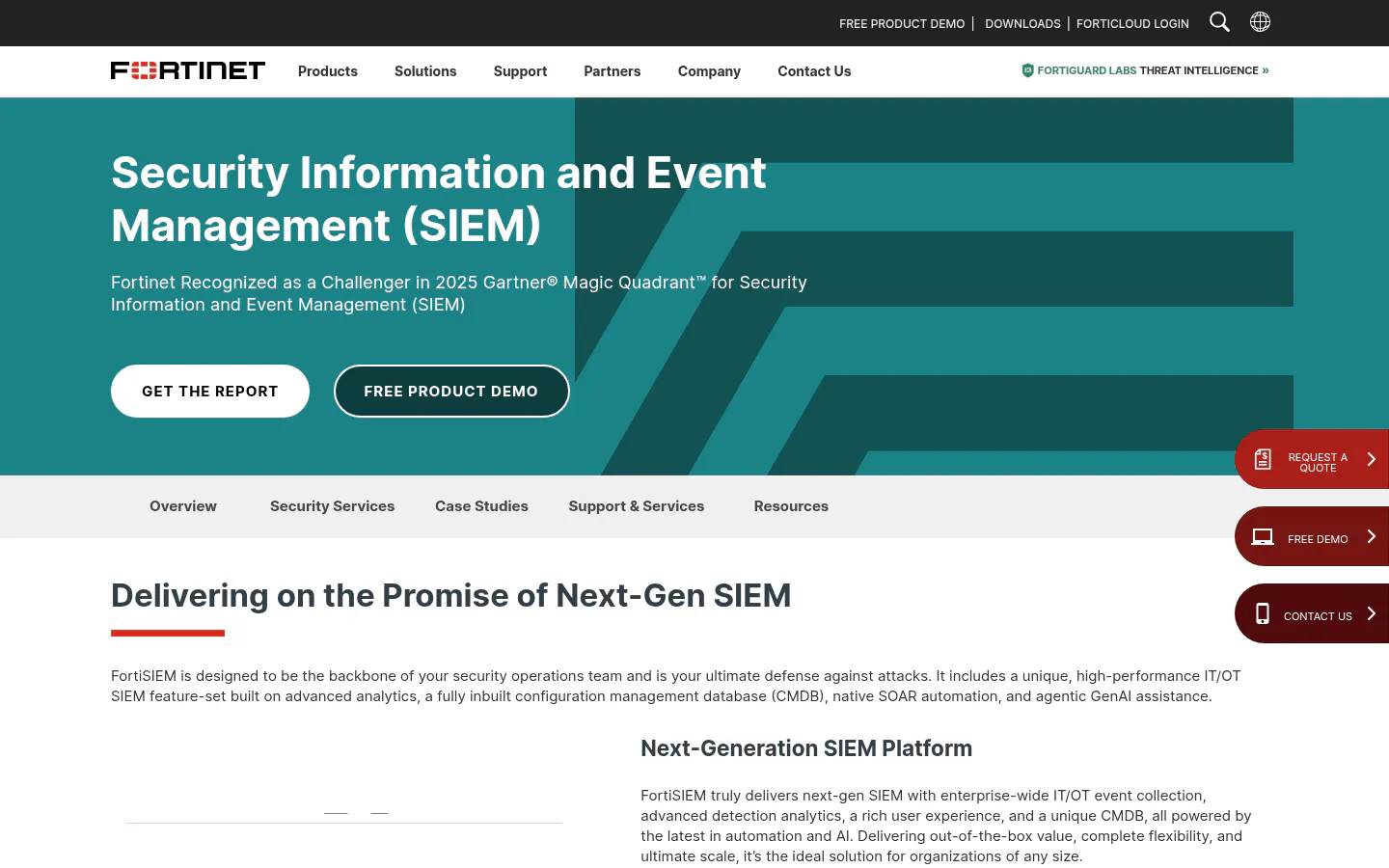
At 4.83 out of 5 across 316 ratings, FortiSIEM holds the highest verified user rating of any product on this list. That's not a small gap either. The next-closest is Securonix at 4.71.
Key strengths
- Highest Gartner Peer Insights rating in the category, by a clear margin.
- The base all-in-one perpetual license covers 50 devices and 500 events per second, which is a genuine mid-market starting size rather than an enterprise floor dressed up as an entry tier.
- Licensing is measured in events per second rather than gigabytes, and Fortinet doesn't differentiate by device type. A device license carries 10 EPS, an endpoint license carries 2 EPS, and the math stays the same whatever you connect.
- Fortinet has owned the product since acquiring AccelOps in 2016. No divestiture, no merger, no roadmap consolidation. Eight consecutive Magic Quadrant inclusions, most recently as a Challenger in 2025.
- Deployable as an appliance, on-premises software, or SaaS, which matters for companies with data residency constraints.
Worth knowing. The value case tilts heavily toward companies already running Fortinet firewalls and switches, where the correlation and automated remediation work out of the box. In a mixed-vendor network, a good deal of that advantage evaporates. Fortinet also doesn't publish list pricing, so budgeting means a conversation with a reseller. And the behavioral analytics are thinner than what Securonix or Exabeam offer.
Best for: Companies with an existing Fortinet network estate that want predictable licensing and on-premises deployment.
Not ideal for: Multi-vendor environments where the native integration advantage doesn't apply, or teams that need deep user-behavior analytics.
Why it ranks second: The users who run it rate it higher than anyone rates anything else in this category, the ownership is as stable as anything here, and the entry license is sized for a real mid-market network. It ranks below Sentinel only because the strongest version of the product assumes a Fortinet network underneath it.
3. Elastic Security
Confidence Score: 8.29/10
One hundredth of a point behind FortiSIEM. Treat them as tied and choose on architecture rather than score.
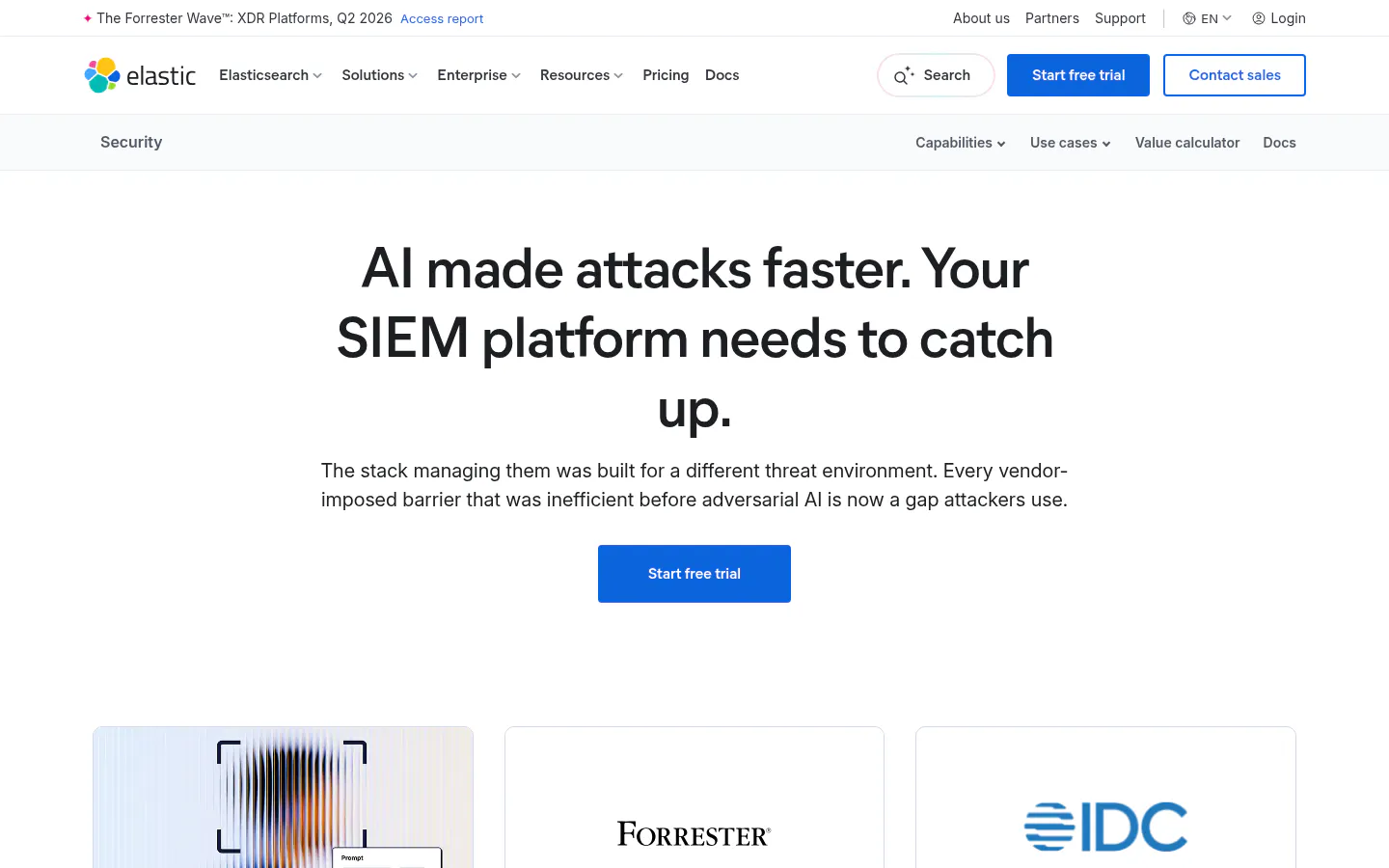
Elastic publishes its rates openly, which is close to unheard of in this market. Security Analytics Essentials ingests at $0.09 per GB with retention at $0.017 per GB per month. The Complete tier runs $0.11 per GB with retention at $0.019. Those prices took effect November 1, 2025.
Compare that to a market where ingest rates are commonly quoted in whole dollars per gigabyte and the difference isn't a discount. It's a different order of magnitude.
Key strengths
- Published, specific, per-GB pricing that a finance team can model without a sales call.
- Recognized as a Visionary in the 2025 Gartner Magic Quadrant, with a 4.55 Peer Insights rating across 419 ratings.
- Detection rules are open and version-controlled, so a team can read exactly what triggers an alert and modify it, rather than filing a support ticket.
- Endpoint protection is now included in both tiers rather than sold as an add-on.
- Independent public company. No acquisition, no merger, no roadmap convergence. Tied with FortiSIEM for the cleanest ownership picture on this list.
The honest catch. The low per-GB rate exists partly because Elastic hands you more assembly work. Someone has to design the data pipelines, tune the rules, and keep the cluster healthy. Companies without that skill on staff end up paying the difference in consulting hours or in a SIEM nobody maintains. The savings are real, but they're conditional.
Best for: Teams with an engineer who's comfortable in Elasticsearch and wants full control over detection logic.
Not ideal for: A three-person IT department that needs the platform to work correctly on day one without tuning.
Why it ranks third: The most transparent pricing on the list and a share of the top ownership score, held back by the fact that a meaningful part of the product is the work you do to it.
4. Rapid7 InsightIDR
Confidence Score: 8.17/10
Every other platform in the top five bills you more for connecting more log sources. InsightIDR doesn't, and for a company trying to build a budget that survives the year, that single design choice outweighs a lot of feature comparison.
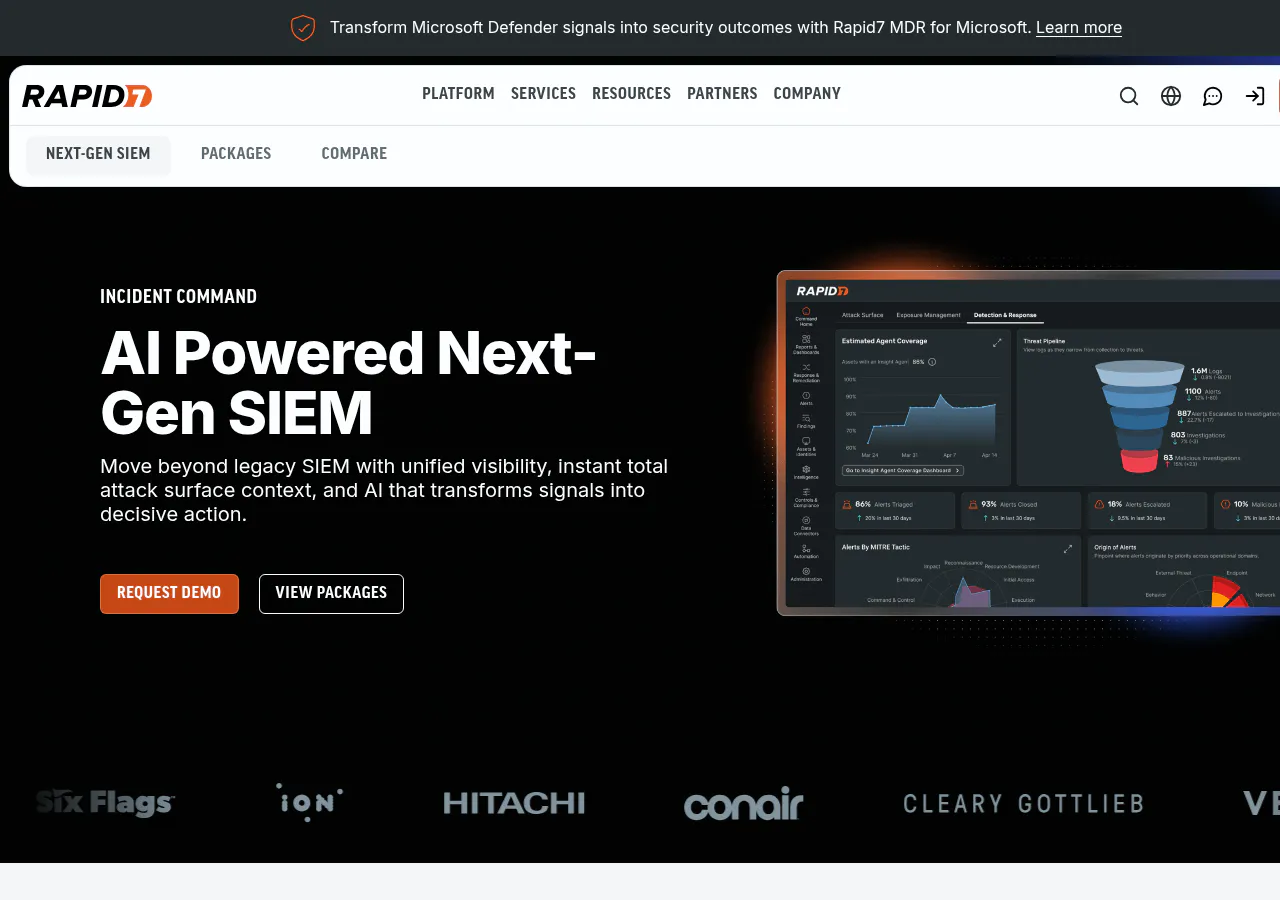
Licensing is per monitored asset with unlimited log ingestion and 13 months of retention included. Turn on a new firewall's syslog feed, add a cloud tenant, start forwarding application logs, and the invoice doesn't move.
Key strengths
- Asset-based licensing with unlimited ingestion. The bill tracks company size, which is a number a CFO can forecast, rather than log volume, which is a number nobody can.
- 13 months of retention included as standard, which clears most annual compliance lookback requirements without a separate archive purchase.
- Behavioral analytics, deception technology, and the endpoint agent are bundled rather than priced separately.
- Named a Challenger in the 2025 Magic Quadrant. 4.37 Peer Insights rating across 372 ratings.
- List pricing is publicly visible through AWS Marketplace, which is more transparency than most of this category offers.
Worth knowing. The per-asset model stops being an advantage for a company with unusually high asset counts relative to its log volume, which sometimes describes manufacturing environments with a lot of connected equipment. Detection content is solid but not as deep as Splunk's or Securonix's. And full automation runs through InsightConnect, a separate product with its own cost.
Best for: Finance-conscious teams that want the SIEM bill to be a predictable line item rather than a variable one.
Not ideal for: Asset-heavy environments, or teams that need the deepest available correlation and threat-hunting content.
Why it ranks fourth: It scores highest of any platform here on mid-market fit. The gap to the top three comes from analyst placement and detection depth, not from anything a 200-person company would feel day to day.
5. CrowdStrike Falcon Next-Gen SIEM
Confidence Score: 8.16/10
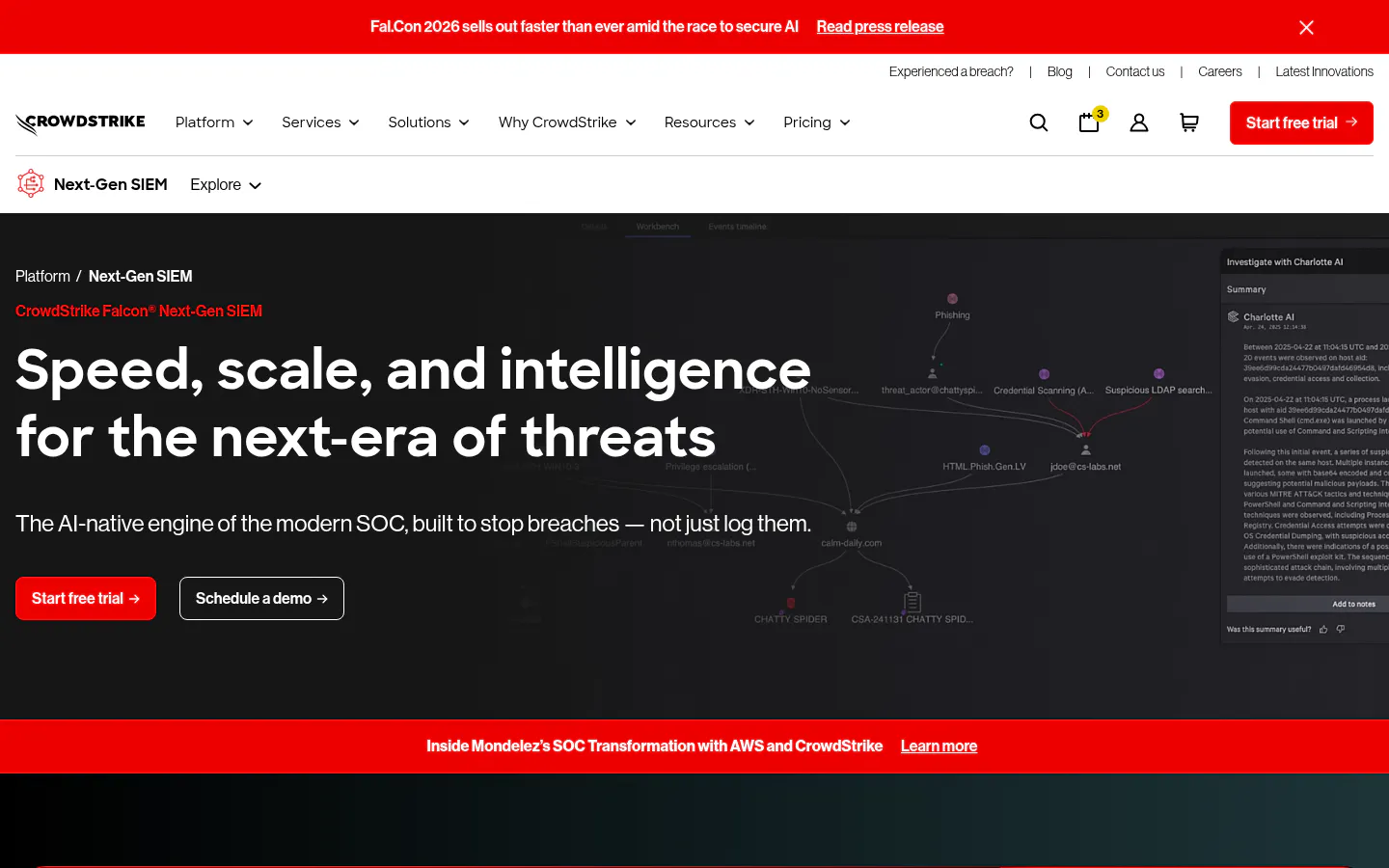
Existing Falcon Insight XDR customers get 10 GB per day of third-party data ingestion at no additional cost, across more than 100 integrations. For a company already paying CrowdStrike for endpoint protection, that's a way to stand up a working SIEM without a new budget line, at least initially.
10 GB per day covers a surprising amount for a 100 to 200 user environment. It won't cover everything.
Key strengths
- 4.68 rating across 453 ratings, third-highest on this list.
- The free third-party ingest allowance for Falcon Insight XDR customers is a genuinely low-friction way to start.
- Endpoint telemetry and SIEM correlation live in one console, so an analyst investigating an alert isn't switching tools to see what the endpoint actually did.
- Named a Visionary in the 2025 Magic Quadrant. Built in-house rather than acquired, and actively invested in.
- Automation and AI-assisted triage are included in the platform.
The tradeoffs. The economics only work if you're already a CrowdStrike customer. Coming in cold, this is an ingest-priced SIEM with no published list rate, and the endpoint-native advantage that justifies the price doesn't apply. The integration catalog, at 100-plus connectors, is the newest and smallest ecosystem among the top five. And a single-vendor security stack concentrates a lot of operational risk in one place, which some boards will ask about.
Best for: Companies already running Falcon Insight XDR that want SIEM correlation without adding another console.
Not ideal for: Organizations with a different endpoint vendor, or anyone who wants ingest pricing published before signing.
Why it ranks fifth: Excellent product, strong ratings, clean ownership. It sits behind Rapid7 by a hundredth of a point because the price advantage is conditional on a purchase you've already made.
6. Securonix Unified Defense SIEM
Confidence Score: 7.94/10
Securonix has been a Magic Quadrant Leader for six consecutive years, and user behavior analytics is where the company started rather than something bolted on later. If the concern is an insider quietly exfiltrating data over 8 weeks rather than a ransomware operator making noise, this is the detection engine built for that problem.
Key strengths
- Leader in the 2025 Magic Quadrant for the sixth consecutive year. 4.71 rating across 425 ratings, second-highest on this list.
- Behavioral analytics genuinely designed for insider risk and slow-moving credential abuse, not repackaged correlation rules.
- Automated threat sweeping retroactively hunts new indicators across historical data.
- Bring Your Own Snowflake lets an organization keep its security data in a Snowflake instance it owns and controls.
Where it gets complicated for a mid-market buyer. Pricing runs on two meters, an events-per-second capacity tier for the SIEM plus per-monitored-user charges for the user-behavior analytics layer. On top of that, the Snowflake data plane is a separate bill the customer owns directly. Three cost surfaces to manage, none of them published. For an organization with a dedicated procurement function that's manageable. For a company where the IT director is also the person negotiating the contract, it's a lot.
Best for: Organizations with real insider-risk exposure and the procurement capacity to manage a multi-meter contract.
Not ideal for: Smaller teams that need one number they can budget against.
Why it ranks sixth: Among the strongest products here on detection quality and analyst standing. It drops on the criterion that carries 22%, because the commercial model asks more of a buyer than most companies this size can give it.
7. Splunk Enterprise Security
[SCREENSHOT: Splunk Enterprise Security homepage, capture failed, USER TO SUPPLY]
Confidence Score: 7.77/10
Nearly every "best SIEM" article puts Splunk at or near the top, and on capability that's defensible. Eleven consecutive years as a Magic Quadrant Leader. The largest integration ecosystem in the category. Detection content nobody else matches for breadth.
It lands seventh here for one reason. Nobody will tell you what it costs.
Key strengths
- Named a Leader in the 2025 Magic Quadrant for the eleventh consecutive time, the longest streak in the category.
- 4.52 rating across 575 ratings, and the broadest integration library of any platform on this list.
- Risk-based alerting and the Enterprise Security Content Update give a mature SOC more prebuilt detection logic than any competitor.
- Search and investigation capability that experienced analysts consistently prefer.
The problem. Splunk publishes no list price. The pricing calculator on Splunk's own site collects inputs and routes to a sales conversation. Enterprise Security is also a separate license layered on top of the platform, so the SIEM features are a second purchase after the first one. And the platform now sits inside Cisco following the $28 billion acquisition that closed in March 2024. The product continues and the roadmap looks intact, but a company that was entirely about its data platform is now a business unit inside a networking company with a broader agenda.
Best for: Large organizations with a staffed SOC, experienced analysts, and a security budget that isn't line-itemed against headcount.
Not ideal for: Companies under 500 users, where the licensing conversation typically ends the evaluation.
Why it ranks seventh: Top of the class on detection content and integration breadth, second-worst on mid-market fit, ahead of only a product that can't be bought as SaaS anymore. On a list scored for 20 to 500 user organizations, that costs it.
8. Graylog
Confidence Score: 7.53/10
Graylog Open is free, and unlike a lot of things described as free in this category, it's a working log management and analysis platform rather than a trial with a countdown on it. For a company that needs centralized logging before it needs a full SIEM, that's a real starting point.
The paid editions publish their floor, which almost nobody else does. Graylog Enterprise starts at $15,000 per year and Graylog Security at $18,000 per year, priced on daily volume or annual consumption.
Key strengths
- A genuinely free open-source edition with no artificial data cap on the core product.
- Published starting prices for both paid editions, which puts Graylog in a very small group here alongside Elastic.
- 4.45 rating across 285 ratings, respectable against products costing many times more.
- Independent, open-core company. No acquisition, no merger, no divestiture.
Worth knowing. Graylog Open gives you the log platform, not the security content. Detection rules, anomaly detection, and SOC workflow live in Graylog Security, which is where the $18,000 starts. Running Open also means running the infrastructure yourself, including Elasticsearch or OpenSearch underneath, and keeping it healthy. Graylog didn't appear in the 2025 Magic Quadrant, which isn't disqualifying but does mean less independent analyst scrutiny than the others here have had.
Best for: Companies that need centralized logging now, a security layer later, and want to control when that second cost arrives.
Not ideal for: Teams that need mature out-of-box detection content on day one.
Why it ranks eighth: The lowest entry cost on this list and clean ownership, offset by the thinnest detection library and no analyst placement.
9. Exabeam New-Scale Fusion
Confidence Score: 7.45/10
Exabeam is a Magic Quadrant Leader with genuinely strong behavioral analytics, and the score below is not a judgment on the technology. It reflects what happened to the portfolio.
Exabeam and LogRhythm completed their merger on July 17, 2024 under Thoma Bravo ownership. Two companies that had competed for the same buyers became one company selling two overlapping SIEM products. New-Scale was designated the go-forward platform and LogRhythm's Axon offering was discontinued.
Key strengths
- Named a Leader in the 2025 Magic Quadrant. 4.42 rating across 258 ratings.
- User and entity behavior analytics that consistently rate among the best available, with timeline-based investigation that materially cuts analyst time per incident.
- The self-hosted LogRhythm SIEM is still actively developed. There was an April 2026 release adding a detection-rule management API, an encrypted JSON listener, and updated collectors. That's more commitment than merged products usually get, and it deserves credit.
- Combined parser coverage from both product lines is broad.
The structural issue. A buyer evaluating Exabeam today is choosing between two products from one vendor with one roadmap and one engineering budget. LogRhythm's published support policy runs 24 months from a version's general availability date, which is a normal policy in isolation and a shorter horizon than it sounds when the platform's long-term position is unsettled. Pricing isn't published. And the merger came with layoffs, which is a normal part of consolidation and also a thing that affects how quickly support tickets get answered.
Best for: Organizations where insider threat detection is the primary driver and behavioral analytics is the deciding capability.
Not ideal for: Buyers who need a clear ten-year platform commitment before signing.
Why it ranks ninth: Strong product, strong analyst standing, unresolved portfolio question. The ownership criterion is doing most of the work here, exactly as intended.
10. IBM QRadar SIEM
Confidence Score: 5.62/10
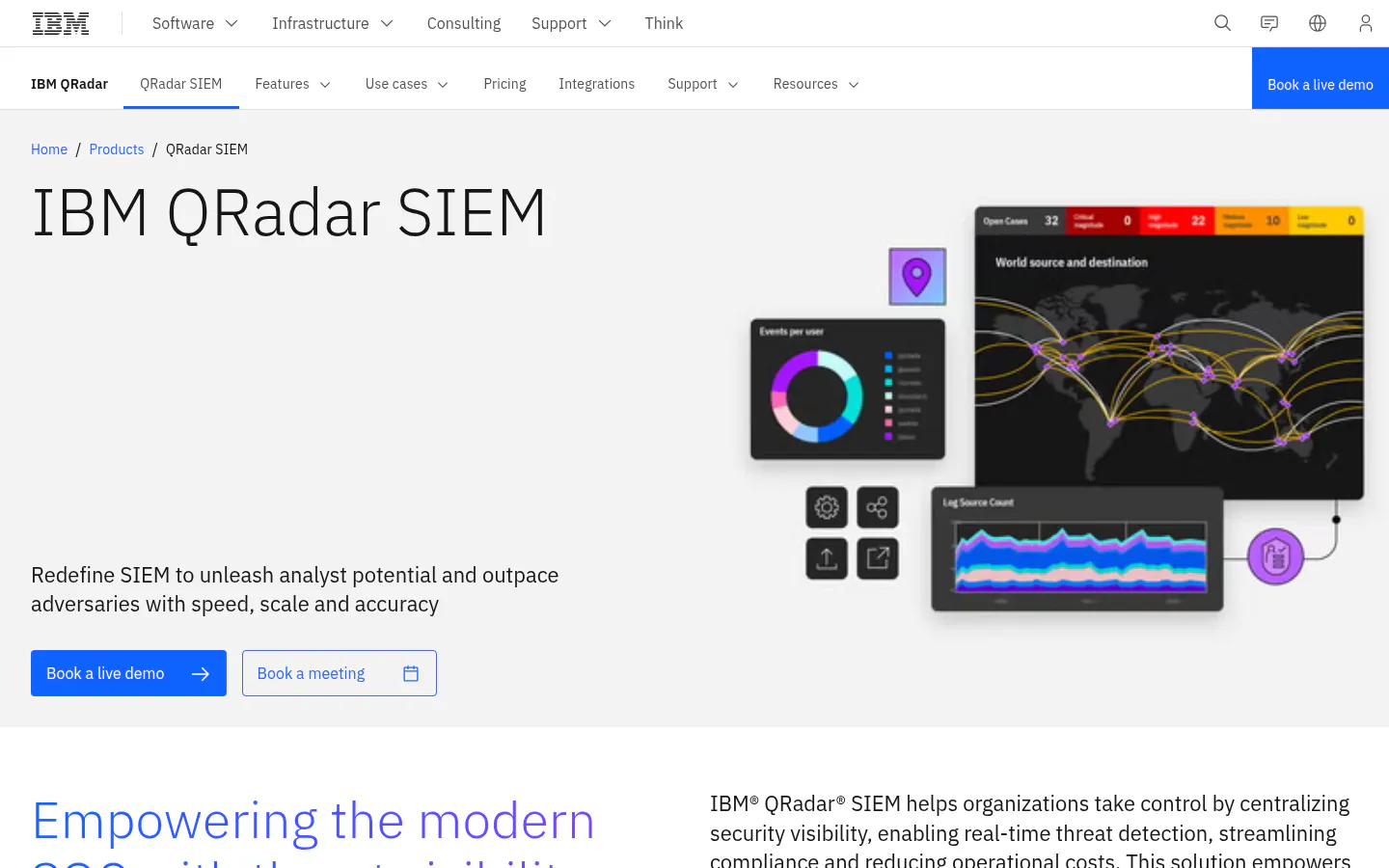
QRadar has more Gartner Peer Insights ratings than any other product in this comparison. 672 of them, at 4.37. Two decades of deployments, an enormous parser library, and detection logic refined across thousands of environments.
It ranks last anyway, and the reason is entirely about what a new buyer can actually purchase in 2026.
According to IBM's own divestiture notification, QRadar SIEM SaaS was divested to Palo Alto Networks on September 5, 2024 and withdrawn from market the same day. IBM's page also records that on April 14, 2025, Palo Alto Networks announced end of life for the acquired QRadar SaaS products.
The on-premises product is a different situation. IBM continues to provide support for QRadar on-premises customers, including security fixes, critical bug fixes, and connector updates, and existing customers can expand their consumption. No end-of-life date has been announced for on-premises QRadar.
Key strengths
- The largest verified review base in this comparison, at 672 ratings.
- A device support module library built over roughly 20 years, covering log sources newer platforms still don't parse natively.
- Mature, battle-tested correlation rules and compliance reporting.
- IBM has publicly committed to continued support for on-premises deployments.
Why this is a caution rather than a recommendation. A new buyer in 2026 is choosing an on-premises-only platform whose cloud sibling has been sold to a competitor and put on an announced end-of-life path. That means appliances, capacity planning, and version upgrades, on a product line where the vendor has already exited half the market. Existing on-premises customers with working deployments are in a reasonable position and shouldn't panic. Companies signing a new five-year SIEM contract should understand exactly what they're signing.
Best for: Existing QRadar on-premises customers with tuned deployments and no pressing reason to migrate.
Not ideal for: Any organization selecting a SIEM platform for the first time in 2026.
Why it ranks tenth: It holds its own on detection content and data source coverage, and its review score is carried by the largest ratings base here rather than by the rating itself, which is the joint-lowest on the list at 4.37. Then it scores at the bottom on ownership stability and mid-market fit, and those two criteria together carry 37% of the model. That's the ranking working as designed rather than a verdict on the technology.
How to Choose a SIEM in 2026
Start with the pricing meter, not the feature list. Ingest-priced platforms bill by gigabyte, so the cost is driven by how many log sources are connected rather than how many employees there are. Asset-priced platforms bill by device count. That single choice shapes the budget more than any capability difference.
A 200-person company assumes its SIEM cost will be modest because it's a small company. Then someone turns on firewall logging, adds three cloud tenants, and starts forwarding application logs from the ERP system, and the monthly bill triples. Headcount didn't change. Log volume did. On an ingest-priced platform, doing security more thoroughly costs more, which is a genuinely backwards incentive.
Three ways out of it, all represented on this list. Pay per asset instead of per gigabyte, which is Rapid7's model. Get the highest-volume sources ingested free, which is Microsoft's, provided the environment is Microsoft-centric. Or drive the per-GB rate down far enough that volume stops mattering, which is Elastic's, provided there's engineering capacity to run it.
Then check who owns the roadmap. Ask any vendor two questions directly. Has this product changed ownership in the last 3 years? Is there another SIEM product in your portfolio, and which one is the go-forward platform? The answers are public for every vendor here, and they should be part of the evaluation rather than something discovered at renewal.
Size the license honestly. A 200-user company typically generates somewhere between 15 and 40 GB of log data per day depending on how much cloud infrastructure it runs and how verbose the firewall configuration is. Run a 2-week measurement before signing anything. Vendors size from estimates, estimates run low, and overage rates are always worse than committed rates.
A SIEM generates alerts. It does not investigate them. A platform producing 400 alerts a day into an inbox nobody watches has not improved anyone's security posture. A vendor demo makes the platform look essential, someone spends 6 months on deployment, and then the alerts pile up unread because there's no one whose job is reading them.
[NEEDS PROOF POINT: a real Consilien example of a client who owned a SIEM license nobody was monitoring. Industry, employee count, how long it ran unwatched, and what surfaced when it was finally reviewed. This is the single strongest paragraph in the piece if it can be filled with a real one. Ships without it rather than with an invented one.]
Companies with a security analyst on staff should buy the platform that fits their environment and their budget, and the ranking above will point at the right two or three. Companies without one should be comparing SOC-as-a-service coverage against platform licenses, because the recurring cost of a person to watch the alerts usually exceeds the license itself. That comparison is laid out in more detail in the in-house SOC versus SOC-as-a-service cost analysis.
And if the terminology is still fuzzy, the difference between MDR, MSSP, and SIEM is worth 10 minutes before any vendor call, because vendors use all three words to describe different things.
The bottom line
Microsoft Sentinel takes the top spot at 8.79 because the free ingestion of Microsoft 365, Entra, and Defender logs removes a large share of billable volume for exactly the kind of company this list was scored for. That advantage is conditional. In an environment that isn't Microsoft-centric, it disappears, and Sentinel becomes an ordinary ingest-priced platform at an unremarkable rate.
FortiSIEM at 8.30 is the better answer for a Fortinet network, and it carries the highest verified user rating in the category. Rapid7 InsightIDR at 8.17 is the better answer for any company that needs the SIEM line item to hold still all year. Elastic Security at 8.29 is the better answer for a team with an engineer who wants to own the detection logic outright.
The platform is the smaller half of this decision. Someone has to read what it produces. Consilien's team builds and runs managed SIEM for companies between 20 and 500 users, including tuning, alert triage, and the escalation path that turns a detection into a response. Speak to a SIEM expert about what your environment actually generates before you size a license against a guess.