10 Best Threat Intelligence Platforms for 2026
CrowdStrike Falcon Adversary Intelligence ranks first among the best threat intelligence platforms for 2026 at 8.80 out of 10, because its intelligence ships inside an endpoint bundle with a published price. SOCRadar (8.58) has the easiest free start, and Recorded Future (8.24) has the most documented Microsoft integrations. Scores blend live Gartner Peer Insights ratings with five documented criteria.
Table of Contents
Quick Picks
- Top score overall: CrowdStrike Falcon Adversary Intelligence
- Cheapest way to start: SOCRadar Extended Threat Intelligence
- Best for Microsoft Sentinel and Defender shops: Recorded Future
- Largest verified review base: Cyble Vision
- Takedowns handled for you: ZeroFox Platform
Buying one of the best threat intelligence platforms doesn't make a company safer by itself. Intelligence only pays off when a person reads it, decides it matters, and then changes something, like a blocked domain, a new patch date, or a reset password. The platform collects. Someone still has to act.
That someone is the hard part for a company with 20 to 1000 users, whether it's one stretched IT manager or an outside SOC as a service team, a hired security operations center that watches the alerts. The 2026 SANS Cyber Threat Intelligence Survey found that formal threat intelligence teams still tend to run with fewer than four full-time people, and 44% of respondents named lack of time as a top barrier. A 300-person distributor might not have even one of those people.
So the question here isn't which platform holds the deepest archive of hacker chatter. It's which one a lean team, or the provider monitoring its environment, can actually put to work without hiring an analyst first.
Several of the lists ranking for this search come from vendors that place their own product at number one. This one scores 10 platforms on live review data and a model that's published in full below. If the category itself is still fuzzy, what threat intelligence actually is is the better starting point.
Four Kinds of Threat Intelligence Platforms
Vendors use "threat intelligence platform" for four different products. Mixing them up is how a company ends up paying for the wrong one.
- Intelligence built into a security platform. CrowdStrike Falcon Adversary Intelligence, Google Threat Intelligence, and the Microsoft intelligence inside Defender XDR all put context next to alerts a team is already investigating.
- External risk monitoring with takedowns. ZeroFox, Cyble, SOCRadar, and Group-IB watch for a company's own leaked passwords, lookalike domains, and exposed systems, then get the fakes removed.
- Research platforms. Recorded Future, Flashpoint, and Feedly collect deeply and report well, and they're designed for people who read intelligence all day.
- Aggregation hubs. Anomali, OpenCTI, and MISP pull many feeds together, strip duplicates, and push indicators to other tools. That's the original meaning of the term.
Lines blur, though. Recorded Future sells brand monitoring, and Cyble sells vulnerability intelligence. Still, the bucket a vendor started in predicts where its product is strongest, and a 200-person manufacturer worried about fake invoices sent from a lookalike of its own domain needs the second bucket far more than the third.
How Each Platform Was Scored
Each platform earned a Confidence Score out of 10 from six weighted criteria, led by Gartner Peer Insights reviews (25%) and whether a team without a dedicated threat analyst can realistically use it (20%).
Rankings are produced using a Confidence Score methodology, six independently researched criteria applied the same way to every platform. No vendor paid for placement. No vendor submitted its own data.
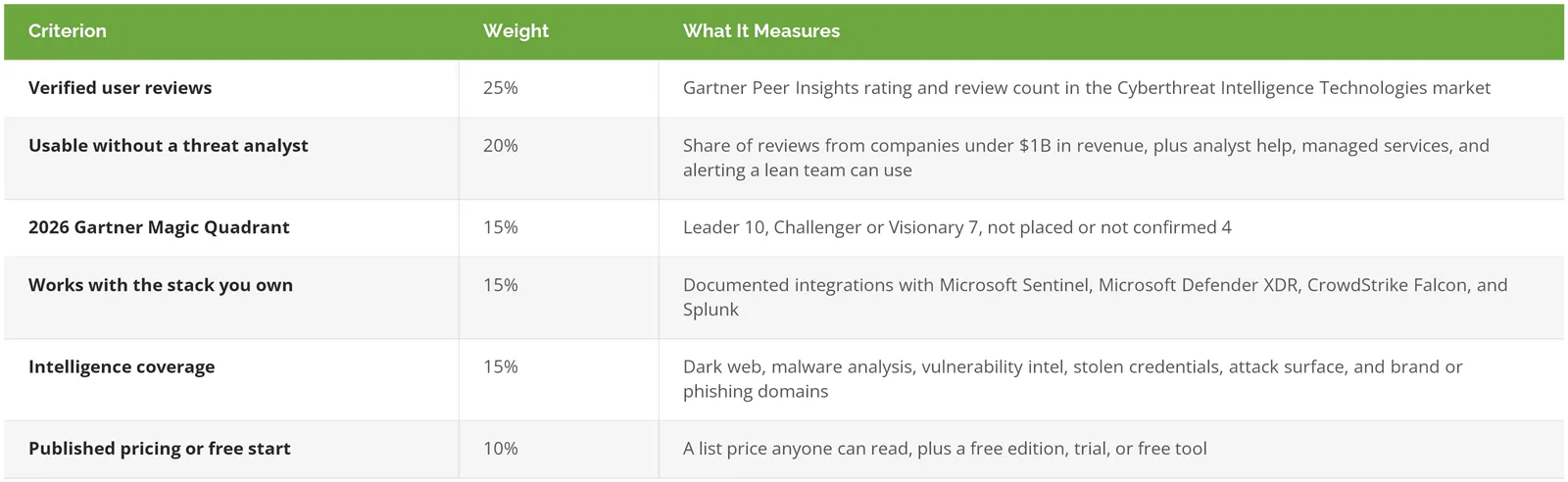
Reviews come from the Cyberthreat Intelligence Technologies market on Gartner Peer Insights, pulled live on September 15, 2026. Only ratings inside that market count, which is why a vendor's number here can differ from the figure on its product page.
Usable without a threat analyst is the criterion that shapes this list most. Gartner tags each review with the reviewer's company size, so it's possible to count how many reviews came from companies under $1B in revenue. That share is half the score, and 60% or more earns full marks. The other half is documented help a thin team can lean on, such as analysts who answer questions, managed monitoring, and alerts that arrive without someone writing a query.
That revenue split turned out to be the most revealing number in the research. At CrowdStrike, 155 of 187 reviews came from companies under $1B. At Flashpoint, it was 8 of 32. Same market. Same review site. Very different buyers.
The 2026 Gartner Magic Quadrant was Gartner's first Magic Quadrant for this market, released on May 4, 2026. Placements come from each vendor's own announcement. Leaders score 10, Challengers and Visionaries score 7, and platforms without a confirmed placement score 4. Gartner does not endorse any vendor, product, or service depicted in its research publications. GARTNER, MAGIC QUADRANT, and PEER INSIGHTS are trademarks of Gartner, Inc.
Works with the stack you own checks four tools that companies this size already run. Microsoft Sentinel is a SIEM, the system that collects and searches security logs. Microsoft Defender XDR and CrowdStrike Falcon are endpoint and detection platforms. Splunk is another SIEM. Each documented integration adds 2.5 points. An integration shown only as a logo gets partial credit.
Coverage counts six areas: dark web and criminal forums, malware analysis, vulnerability intelligence, stolen credentials, attack surface (the internet-facing systems a company exposes), and brand or phishing domains.
Published pricing or a free start rewards any vendor that lets a buyer see a number before a sales call.
Drop the pricing criterion and Recorded Future moves to first at 8.82, five hundredths ahead of CrowdStrike. Drop the Magic Quadrant criterion and SOCRadar leads at 8.86. At the top, the weights decide the order.
Three names are missing on purpose. ThreatConnect doesn't appear in this Gartner market, and Dataminr completed its $290M acquisition of ThreatConnect in November 2025. EclecticIQ has no listing there. Palo Alto Networks, Cisco, and IBM sell threat intelligence, but none has rated products in this market to compare.
Threat Intelligence Platforms Side by Side
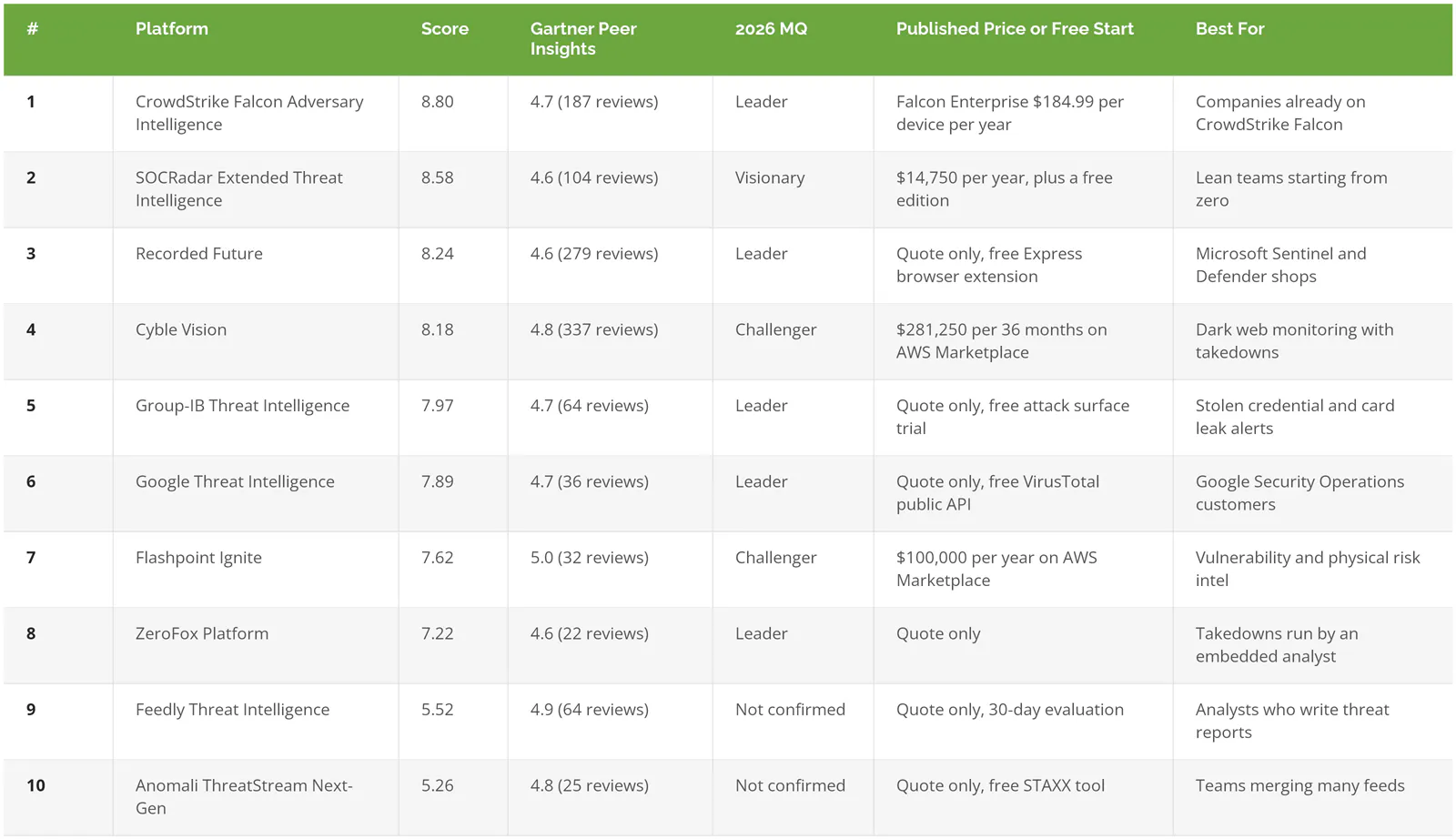
The 10 Best Threat Intelligence Platforms, Ranked
1. CrowdStrike Falcon Adversary Intelligence, Intel Inside the Endpoint Tool
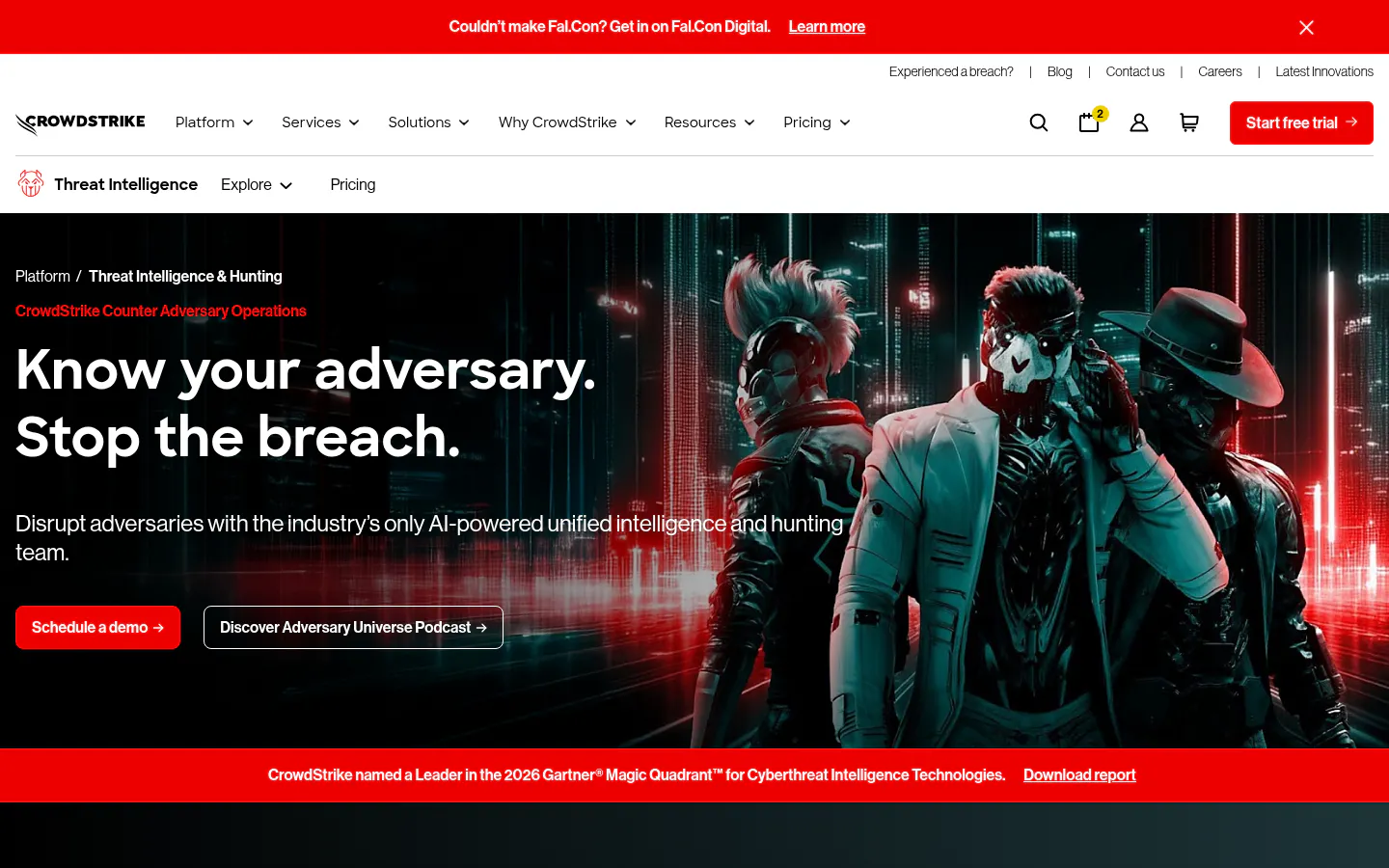
CrowdStrike Falcon Adversary Intelligence puts attacker profiles, dark web monitoring, and a malware sandbox inside the same Falcon console that already stops threats on laptops and servers.
Confidence Score: 8.80/10
For a company that runs CrowdStrike, threat intelligence stops being a separate project. It becomes a line on the renewal quote.
That's what CrowdStrike's public pricing page shows. Threat Intelligence and Hunting is switched on in Falcon Enterprise, at $184.99 per device per year, and switched off in Falcon Go and Falcon Pro. A company with 250 devices already on Falcon Pro at $99.99 would pay about $21,250 more a year to move up. That includes endpoint detection and response, not only the intelligence. It's the only Magic Quadrant Leader on this list with a price anyone can look up.
Key strengths
- A Leader in the 2026 Magic Quadrant, and CrowdStrike's announcement says it was positioned furthest right for Completeness of Vision among all vendors evaluated.
- 4.7 out of 5 across 187 Peer Insights reviews. Of those reviewers, 83% work at companies under $1B in revenue, the highest share on this list.
- Covers the open, deep, and dark web, domain impersonation, exposed credentials, and vulnerability insights, according to the Falcon Adversary Intelligence Premium data sheet, which also lists automated phishing site takedowns.
- Works outside Falcon too. Microsoft lists a Sentinel connector for it, and CrowdStrike builds its own Splunk add-on.
- Prebuilt detection rules in YARA and Snort, two rule formats many security tools already read, so a team doesn't have to write those detections from scratch.
- Free ways in, a 15-day trial and the Hybrid Analysis malware sandbox.
The tradeoff. Analyst-facing options, like requests for information, sit in higher tiers that don't carry a public price. One Peer Insights reviewer put the other catch bluntly, saying it "may require skilled resources to fully leverage its capabilities" and suits big companies more than small ones. No Microsoft Defender XDR integration turned up in its documentation, either. A company that standardized on Defender would be buying a second endpoint platform to get this intelligence.
Best for: companies of 100 to 1000 users already running CrowdStrike Falcon, especially those weighing an upgrade from Falcon Pro.
Not ideal for: Microsoft Defender shops, or teams that want a standalone intelligence portal separate from their endpoint tool.
Why it ranks #1: It wins on the combination this list values most. Top-tier analyst recognition, a review base dominated by mid-sized companies, and a price a finance team can check on a public web page. Nothing else on the list clears all three.
2. SOCRadar Extended Threat Intelligence, the One With a Free Door
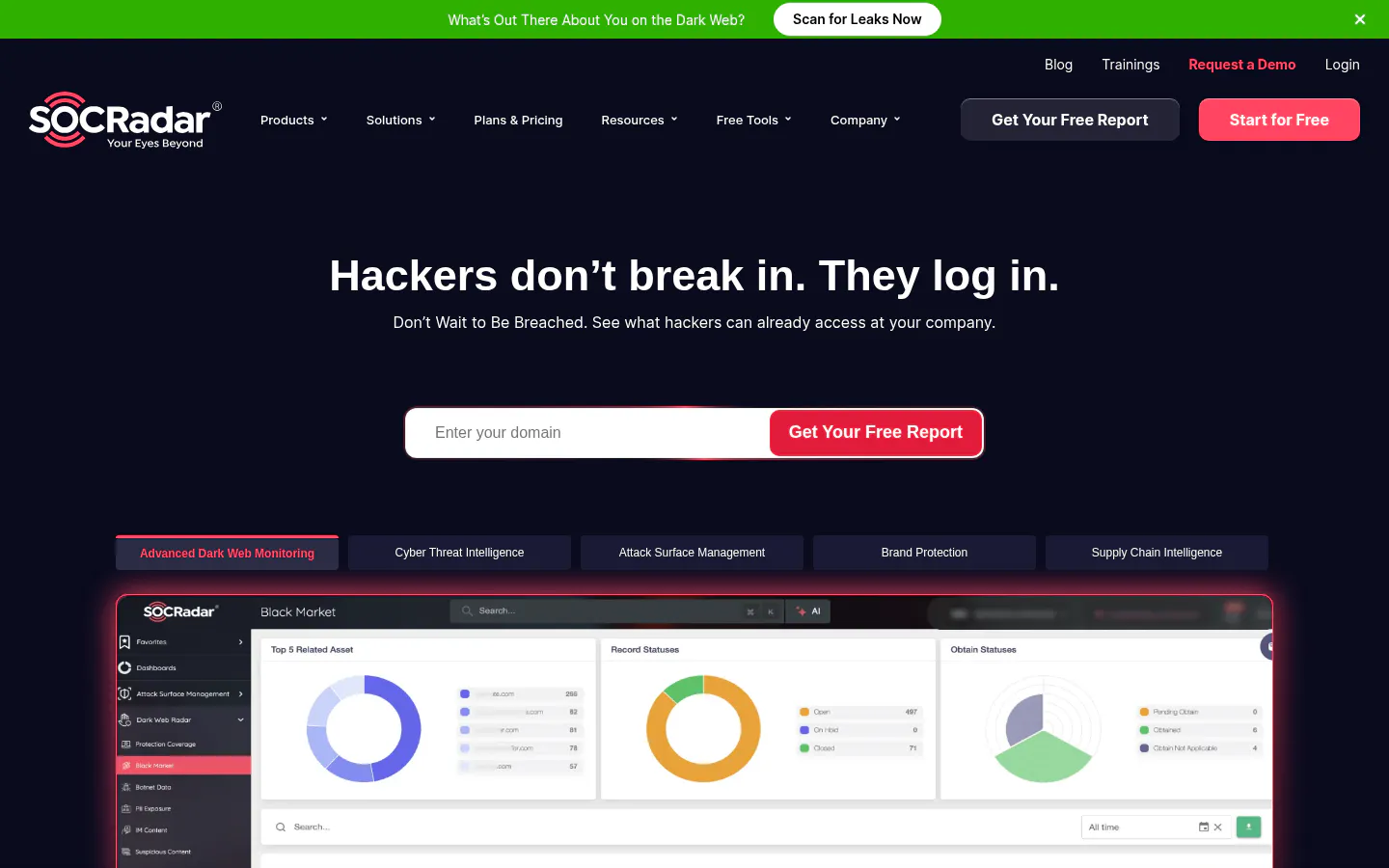
SOCRadar publishes prices down to its entry plans and hands out a free edition, which makes it the easiest platform here to test before anyone signs a contract.
Confidence Score: 8.58/10
Price transparency is rare in this category. SOCRadar's plans and pricing page lists dark web monitoring at $4,550 a year for businesses under 100 employees and $9,100 a year for 100 to 500 employees. Its Cyber Threat Intelligence Essential plan is $14,750 a year. The Free Edition runs for up to a year, needs a corporate email address, and gets approved or rejected within 48 hours.
Key strengths
- Of its 104 Peer Insights reviews, 76% come from companies under $1B, second only to CrowdStrike.
- Watches hacker forums, Telegram channels, dark web markets, and stealer logs (files of passwords lifted from infected computers), plus phishing domains and exposed internet-facing assets.
- Microsoft's own Sentinel repository carries a SOCRadar solution, and the integrations page lists Defender XDR, CrowdStrike, and Splunk.
- An analyst support team customers can bring questions to.
- SOCRadar raised a $25.2M Series B in May 2024 led by PeakSpan Capital and named managed service providers as a market it wanted to reach, which matters for companies that would rather have their provider run the platform for them.
Worth knowing. The Defender XDR, CrowdStrike, and Splunk integrations appear as logos without documentation, so ask for a working demo of each one. A Peer Insights reviewer also flagged that some capabilities run on credits, and "it is not very clear how they work." The self-serve dark web plans cover one domain and one seat.
Best for: companies of 20 to 500 users with no security analyst, or anyone who wants a year of real data before paying.
Not ideal for: teams that need a Leader placement to satisfy a procurement checklist. SOCRadar was named a Visionary in its first Gartner evaluation.
Why it ranks #2: Few lean teams can say no to a free year and a printed price. It trails CrowdStrike on analyst recognition and, narrowly, on review scores.
3. Recorded Future, Built for Microsoft Shops
Recorded Future covers every intelligence area this ranking checks, and it has the most documented Microsoft integrations of any platform here.
Confidence Score: 8.24/10
Scale is the headline. Recorded Future says it collects from "over a million sources, including the open web, dark web, technical feeds, and customer telemetry," and sells separate modules for vulnerability intelligence, stolen credentials, attack surface, and brand abuse, including takedowns of lookalike domains. Mastercard completed its acquisition of the company on December 20, 2024.
Key strengths
- A 2026 Magic Quadrant Leader with 279 Peer Insights reviews, the second-largest review base on the list.
- Its integration compatibility table marks Sentinel, Defender, and Splunk integrations as certified.
- Analyst on Demand and Managed Monitoring services add human help.
- A free Express browser extension shows risk scores, and a 30-day trial runs through Microsoft Sentinel.
Fit is the issue, not quality. About 40% of its reviews come from companies under $1B, and 33 come from companies above $30B. No price is published. One reviewer's headline sums up the adoption problem, "technical jargon hinders wider adoption." And the CrowdStrike connection is thinner than the Microsoft one, since Recorded Future's own documentation says its Risk Lists, the scored lists of malicious indicators it publishes, can't yet be pulled into CrowdStrike through that integration.
Best for: companies of 500 to 1000 users on Microsoft Sentinel and Defender that have at least one person who'll own the platform.
Not ideal for: a company with no one to read the output. Coverage this wide produces a lot of it.
Why it ranks #3: On raw capability it's arguably the strongest platform here. Pricing opacity and an enterprise-heavy customer base cost it the top spot, and the sensitivity test above shows how much that one criterion matters.
4. Cyble Vision, Dark Web Monitoring at Volume
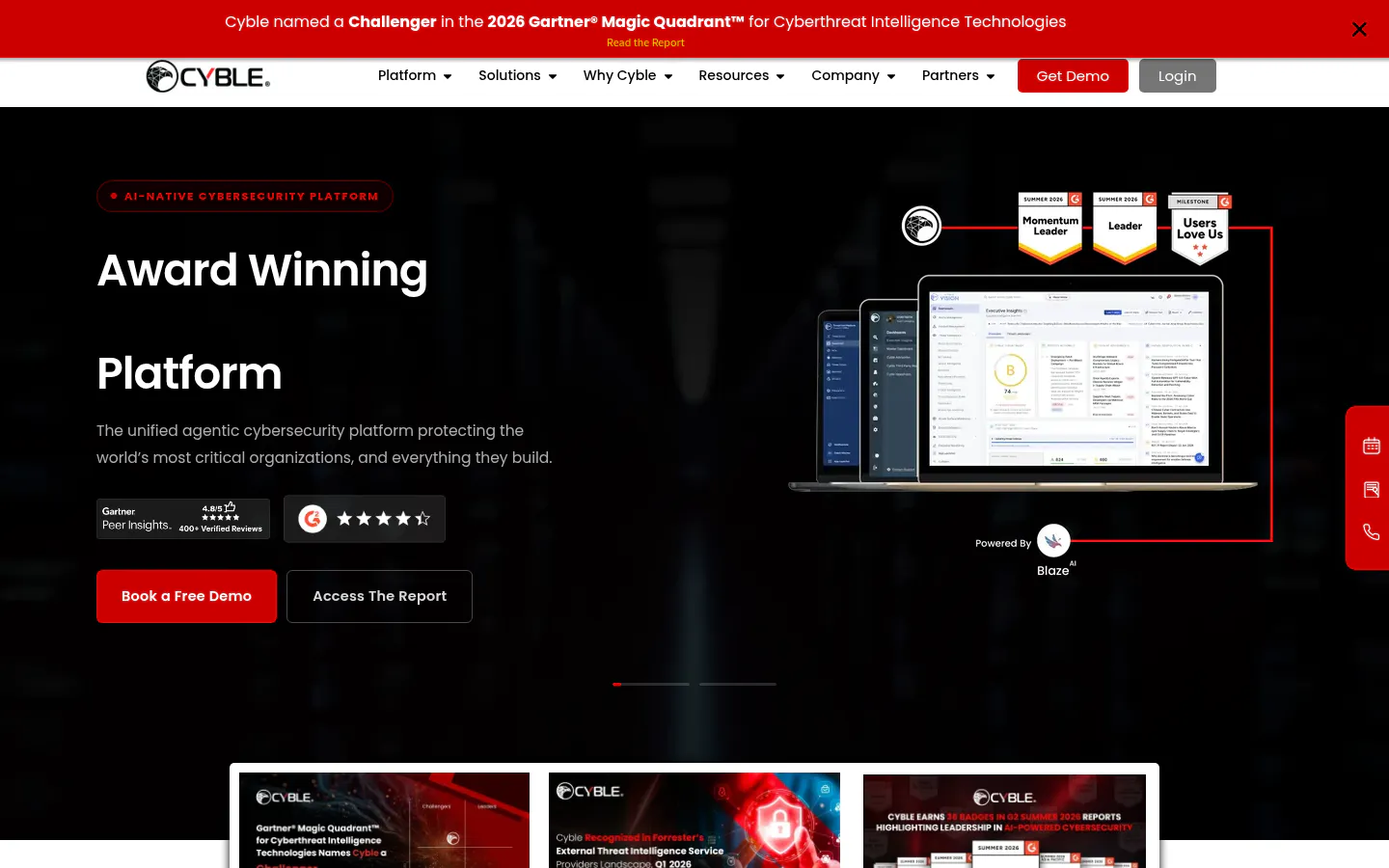
Cyble Vision pairs broad dark web and brand monitoring with takedown services, backed by more Peer Insights reviews than any other platform on this list.
Confidence Score: 8.18/10
Key strengths
- 4.8 out of 5 across 337 reviews, and 69% of reviewers work at companies under $1B.
- Coverage spans ransomware forum tracking, malware reverse engineering, exposed credentials, attack surface monitoring, phishing domains, and even physical threats.
- Free tools, including AmIBreached and a free external threat assessment report.
- A partner program for managed security providers.
- Named a Challenger in the 2026 Magic Quadrant.
Watch the math. Cyble's AWS Marketplace listing prices the Threat Intelligence module at $281,250 on a 36-month contract, roughly $93,750 a year, with brand intelligence and vulnerability management sold as separate modules. Orders placed there are listed as non-cancellable, and while integrations with Sentinel and Splunk are documented, nothing for CrowdStrike or Defender XDR turned up on its integrations page. A September 2025 reviewer also said false positive handling isn't as mature as other services, "especially in regard to user detections."
Best for: companies facing phishing sites and impersonation that want monitoring and takedowns from one vendor.
Not ideal for: budgets under six figures, or anyone who can't commit to a multi-year term.
Why it ranks #4: Its review base is the largest on the list, and only Feedly and Flashpoint score higher on reviews. Thinner integrations and a Challenger placement keep it six hundredths behind Recorded Future.
5. Group-IB Threat Intelligence, Built Around Fraud and Leaks
Group-IB tracks the criminal side of the internet with undercover agents and alerts customers when their credentials or payment cards turn up.
Confidence Score: 7.97/10
Key strengths
- A 2026 Magic Quadrant Leader, rated 4.7 across 64 product reviews, with 71% of the vendor's reviews coming from companies under $1B.
- Monitoring of compromised credentials, VIP personal accounts, and payment card data, plus malware reverse engineering and takedowns of malicious sites.
- Customers can submit requests to Group-IB's researchers, and embedded managed service teams are available.
- A free 21-day attack surface management trial covers up to five domains.
- Its Prevyn AI coordinates 12 specialist agents across the platform.
Group-IB was established in 2003, opened its Singapore global headquarters in 2019, and says it completed its exit from Russia in April 2023, with no employees left working there. Integrations are thinner than the top three. Sentinel playbooks and Splunk apps exist, but no Defender XDR or CrowdStrike integration turned up. One reviewer also said the platform has "a problem with detection" when it comes to phishing.
Best for: companies where stolen logins and card data are the main worry, such as businesses that take payments online.
Not ideal for: CrowdStrike or Defender shops that want intelligence inside their existing console.
Why it ranks #5: A far larger share of mid-sized reviewers than Google puts it one place higher, even with fewer integrations.
6. Google Threat Intelligence, Mandiant Plus VirusTotal
Google Threat Intelligence combines Mandiant's incident response research with VirusTotal's malware repository and Google's own view of the internet.
Confidence Score: 7.89/10
Key strengths
- A Leader in the 2026 Magic Quadrant, according to Google's announcement.
- Covers underground marketplaces, credentials, attack surface, brand impersonation, and curated vulnerability intelligence, with Digital Threat Monitoring included.
- Users can ask a Mandiant expert for help inside the console.
- Plugs into Sentinel, Splunk, and CrowdStrike's marketplace, plus Google Security Operations directly.
Pricing is the sticking point. Google describes subscriptions as a "flat annual rate with a set number of API calls per subscription level" and publishes no figures, and the free VirusTotal public API, the closest thing to a free start, allows 500 requests a day but can't be used in commercial products or services. Google's own packaging sheet splits the product into Standard, Enterprise, and Enterprise+ editions, and the AI agent features in the web interface show up only in the two higher editions, so it's worth asking which edition a demo is running. A Peer Insights review headline reads simply, "Cost Remains a Concern." Its 36 market reviews, which include legacy Mandiant products, are the second-fewest among the Leaders, after ZeroFox.
Best for: companies already on Google Security Operations, or those that want Mandiant research without an incident response retainer.
Not ideal for: buyers who need a price before a meeting.
Why it ranks #6: Coverage and recognition earn top marks. Only 39% of its reviews come from companies under $1B, though, which pulls down the lean-team criterion.
7. Flashpoint Ignite, the Highest Rating on the List
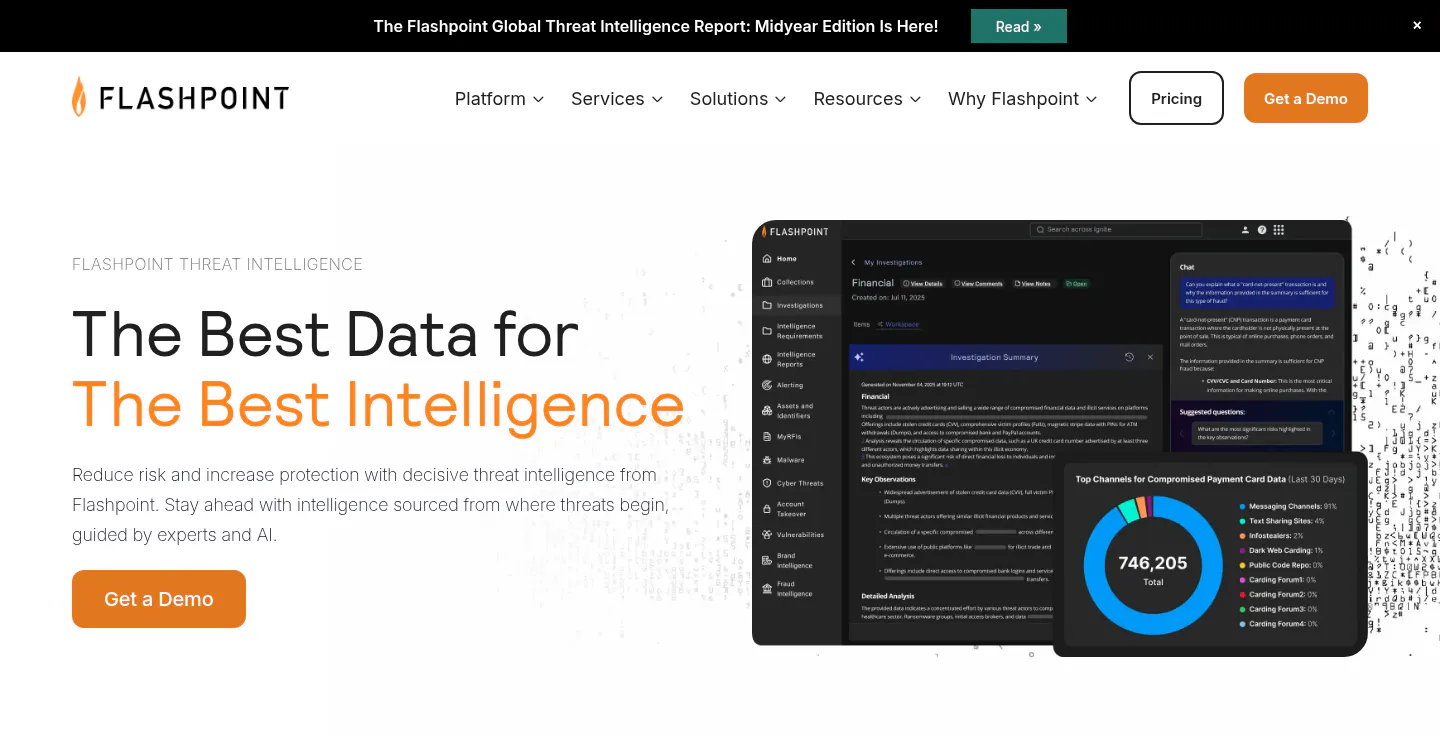
Flashpoint Ignite holds a perfect 5.0 on Peer Insights and publishes real list prices, which are aimed squarely at large security programs.
Confidence Score: 7.62/10
Key strengths
- 5.0 out of 5 across 32 reviews, the highest rating in this ranking.
- Tracks more than 69 billion stolen credentials and 435,000 vulnerabilities, including 105,000 that don't yet have a CVE number (the public ID most scanners depend on).
- Physical security intelligence is sold as its own module.
- Flashpoint acquired Risk Based Security in January 2022 and Echosec, an open source intelligence company based in Victoria, British Columbia, that August.
- Requests to Flashpoint analysts, AI summaries, and a no-cost 90-day access order on AWS.
Look at who wrote those perfect reviews, though. Only 8 of 32 reviewers work at companies under $1B, and 12 work at companies above $30B. The AWS Marketplace listing matches that audience, with Ignite Cyber Threat Intelligence at $100,000 for 12 months in its smallest band, 0 to 5,000 employees. Vulnerability and physical security intelligence add $80,000 each. Its integrations page lists Sentinel and Splunk, not CrowdStrike or Defender.
Best for: companies near the top of the 1000-user range with a dedicated security team and a six-figure intelligence budget.
Not ideal for: a company whose entire security budget is smaller than the entry price.
Why it ranks #7: Excellent product, wrong buyer for this list. The lean-team score is the lowest among the top eight.
8. ZeroFox Platform, an Analyst Comes With It
ZeroFox bundles takedowns and human analysts into its plans, which makes it the most hands-off platform here for a company with no security staff.
Confidence Score: 7.22/10
A Magic Quadrant Leader in eighth place looks odd. It isn't.
ZeroFox earned the top mark for analyst help. Its OnWatch Expert service is "a dedicated intelligence analyst embedded in your team," its analysts validate findings around the clock, and the company says it completes more than a million takedowns a year. The Foundation bundle includes 500 takedowns a year. What drags the total down is everything a buyer can't see before a sales call. No price is published, no free trial or free edition turned up, and 22 Peer Insights reviews is the thinnest base on the list.
Key strengths
- Monitors more than 500 criminal forums and marketplaces, stealer logs, and impersonating domains and social profiles.
- Executive protection and physical security intelligence in the same platform.
- Owned by Haveli Investments since May 2024, a year after ZeroFox completed its acquisition of LookingGlass Cyber Solutions in April 2023.
Reviewer complaints are specific. They name false positives in certain categories, limited reporting customization, and occasional delays in data search, and on the integration side only Sentinel and Splunk turned up, with nothing documented for CrowdStrike or Defender XDR.
Best for: companies with executives or brands that attract impersonation, and no one internally to chase takedowns.
Not ideal for: buyers who need to compare prices before involving sales.
Why it ranks #8: It does the most work on a customer's behalf. It shows the least before a contract.
9. Feedly Threat Intelligence, Made for Analysts Who Write
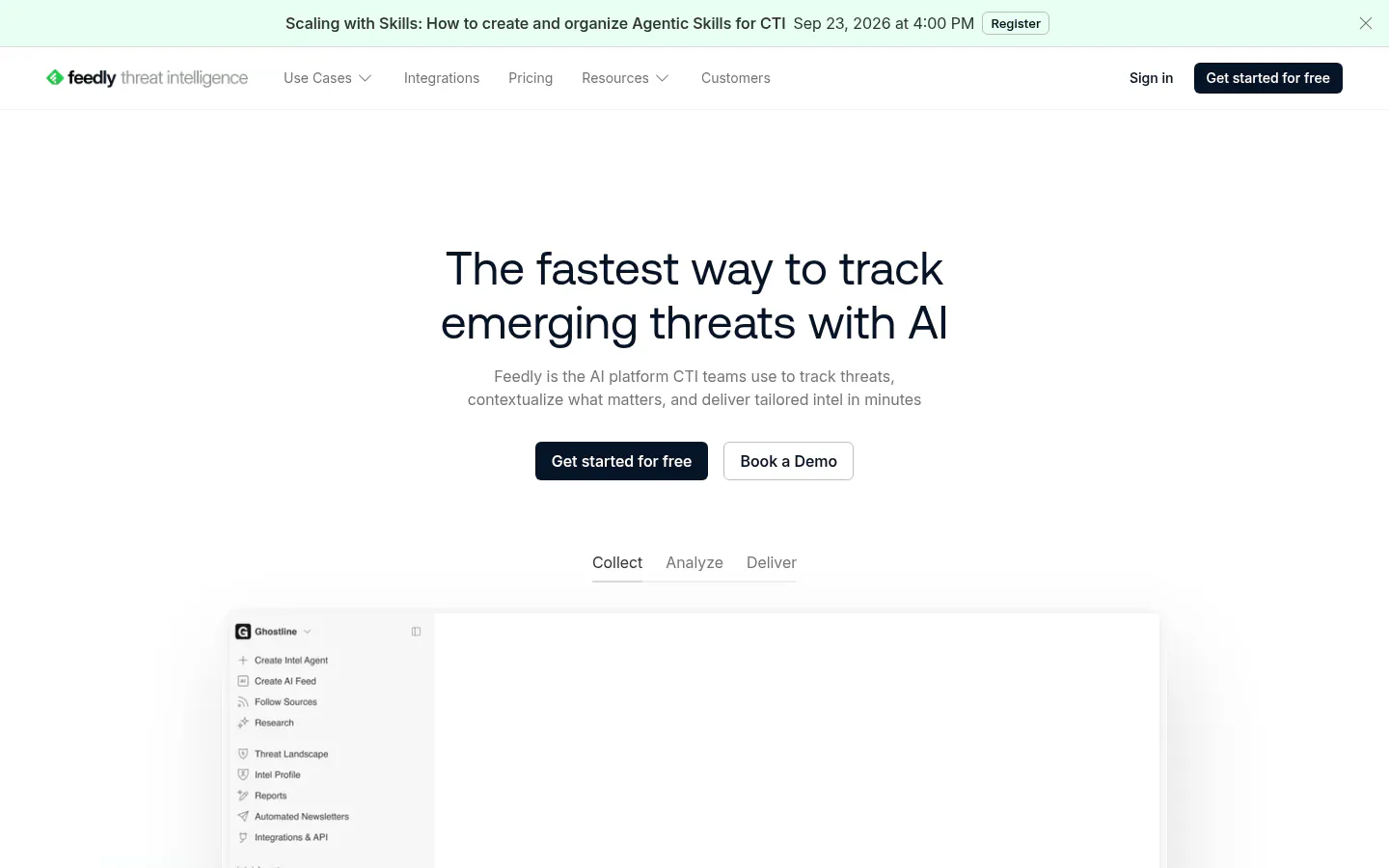
Feedly Threat Intelligence turns thousands of news, research, and dark web sources into reports and alerts for analysts who produce threat briefings.
Confidence Score: 5.52/10
Key strengths
- 4.9 out of 5 across 64 reviews.
- Draws on more than 10,000 clear and dark web sources and tracks over 300,000 CVEs and 12,000 malware families.
- The Standard tier includes a dedicated threat intelligence advisor, and an Ask AI feature drafts deliverables with citations back to the source.
Feedly calls itself "the AI platform CTI teams use" and says 380 threat intelligence teams rely on it, including half of the Fortune 10. Its reviews point the same way. Just 8 of its 64 reviews came from companies under $250M in revenue, while 17 came from companies above $30B. There's no confirmed Magic Quadrant placement, both pricing tiers say "Request pricing," and Splunk support is limited to sample scripts. One reviewer's complaint was "the overuse of AI."
Best for: a security lead at a larger company who writes a weekly threat brief for leadership.
Not ideal for: anyone hoping intelligence will act on its own.
Why it ranks #9: Great reviews from a different buyer. The scoring reflects who this list is written for.
10. Anomali ThreatStream Next-Gen, One Place for Many Feeds
Anomali is a classic threat intelligence platform, a hub that pulls in feeds from many sources and sends cleaned-up indicators to other security tools.
Confidence Score: 5.26/10
Key strengths
- 4.8 out of 5 across 25 reviews, from a company founded in 2013 and backed by investors including GV, Paladin Capital Group, and In-Q-Tel.
- Aggregates "hundreds of open, commercial, and community sources," according to the ThreatStream product page.
- Integrations with Sentinel, Splunk, and CrowdStrike are listed in its partner marketplace.
- A free tool, STAXX, shares threat intelligence over STIX/TAXII, the standard formats security tools use to exchange indicators.
Platforms like this assume someone is curating the feeds. Only 24% of its reviews come from companies under $1B, no Magic Quadrant placement was confirmed, and none of the six coverage areas was documented as Anomali's own collection. One reviewer said the noise made it too cluttered to use and pointed to different naming conventions for the same malware. ThreatStream Next-Gen launched in May 2026 with autonomous triage available now, while more autonomous response levels are still in development.
Best for: companies with analysts who already buy several feeds and need one place to normalize them.
Not ideal for: teams without anyone to tune it.
Why it ranks #10: The model underneath is built for a staffed team, and this ranking is built for the companies that don't have one.
What Year One Costs a 250-Device Company
Only four of the ten platforms publish a price, so this is the whole list of real numbers. Everything else starts with a sales call.
- CrowdStrike Falcon Enterprise. Moving 250 devices up from Falcon Pro adds about $21,250 a year. Buying Falcon Enterprise from scratch for those 250 devices lists at $46,247.50, and that figure also buys antivirus, firewall management, and endpoint detection and response.
- SOCRadar. Cyber Threat Intelligence Essential lists at $14,750 a year. Its separate Dark Web Monitoring Business plan, priced for 100 to 500 employees, adds $9,100 if a company buys both.
- Cyble Vision. The Threat Intelligence module works out to about $93,750 a year, but only as part of a $281,250 commitment over 36 months.
- Flashpoint Ignite. $100,000 for 12 months in the 0 to 5,000 employee band, before the vulnerability or physical security modules.
These are list prices from public pages, and negotiated deals often land elsewhere. None of them includes the line item that decides whether any of this works, which is the hours someone spends every week reading, triaging, and acting on what the platform finds, the same lack of time that 44% of SANS respondents called a top barrier.
Check What You Already Own First
Before buying any of the ten, look at what's already paid for. Four options cost nothing, and one of them may already be in the Microsoft tenant.
- Microsoft Defender XDR. Microsoft retired its standalone threat intelligence portal on August 1, 2026, and its documentation says publicly available Microsoft Threat Intelligence data, including entity enrichments, is accessible to all Defender XDR customers at no extra cost.
- CISA Automated Indicator Sharing. AIS is free for private companies, but it needs a STIX/TAXII client to receive the feed.
- OpenCTI, whose community edition is open source under the Apache 2.0 license.
- MISP, a free, open source platform for storing and sharing threat indicators.
Open source options are free to download, not free to run. Somebody installs them, patches them, connects feeds, and removes stale indicators. For a company with one IT manager, that's a second job.
How to Pick One When Nobody Owns Threat Intelligence
Start with the tools already in place, then ask who will act on alerts. The right platform is usually the one that lands intelligence inside a console someone already watches every day.
Some common starting points:
- Already on CrowdStrike Falcon Pro? Price the Falcon Enterprise upgrade before looking at a standalone platform. The gap is $85 per device per year at list price.
- Running Microsoft 365 with Defender and Sentinel? Use what Defender XDR includes first. If that falls short, Recorded Future has the most documented Microsoft integrations on this list.
- Under 100 employees with no security staff? SOCRadar's free edition shows what's out there about the company before any money moves.
- Customers getting phished by lookalike domains? Compare ZeroFox and Cyble on how many takedowns are included, and how fast they happen.
- Already paying for an outside SOC? Ask the team running the company's security operations center which intelligence it uses and whether it's scoped to the company's domains, executives, and vendors. The platform may already be covered.
Who reads the alerts? A dark web hit on a finance manager's password is worthless if it lands in an inbox nobody checks until Monday.
Three contract questions matter more than feature lists. Is the integration with the company's SIEM or endpoint tool documented, or just a logo? How many takedowns are included before extra charges start? Can the contract be canceled, or is it a multi-year commitment like Cyble's 36-month marketplace listing? Intelligence also depends on the detection layer beneath it, so a company still comparing EDR, MDR, and XDR should settle that first. The same goes for log collection, covered in the ranking of the best SIEM tools.
Run a 30-Day Test Before Signing
Five of the ten offer a trial, a free edition, or a no-cost access period for the product itself. Use it. Thirty days of real data about the company tells a buyer more than any demo built on someone else's environment.
Four things are worth tracking during that month:
- Findings about the company itself. Count alerts that name its own domains, executives, or employee credentials, and set aside generic news about ransomware gangs.
- False alarms. Tally every alert someone opened and dismissed. Ten a day is a part-time job.
- Time to takedown. Report one lookalike domain and time how long removal actually takes.
- Whether the integration fires. Confirm indicators show up inside Sentinel, Defender, Falcon, or Splunk, not only in the vendor's own portal.
Finding nothing about the company in 30 days is an answer too.
Where the Scores Leave a Mid-Sized Company
CrowdStrike Falcon Adversary Intelligence earns first place because a company already on Falcon can see the price, turn it on, and watch the intelligence show up in a console its team uses anyway. SOCRadar is the better first step for a company with no security tooling budget yet, since a free year costs nothing but attention. Recorded Future is the pick for Microsoft-heavy environments that have someone to run it.
And for plenty of companies at this size, the honest answer is that the intelligence should be one part of managed cybersecurity services rather than another console to check. An outside team that watches alerts every day will get far more out of any platform on this list than an IT manager who opens it twice a month. Before comparing that against staffing internally, it helps to know what an in-house SOC costs.