Cybersecurity for Anaheim Manufacturers and Distributors
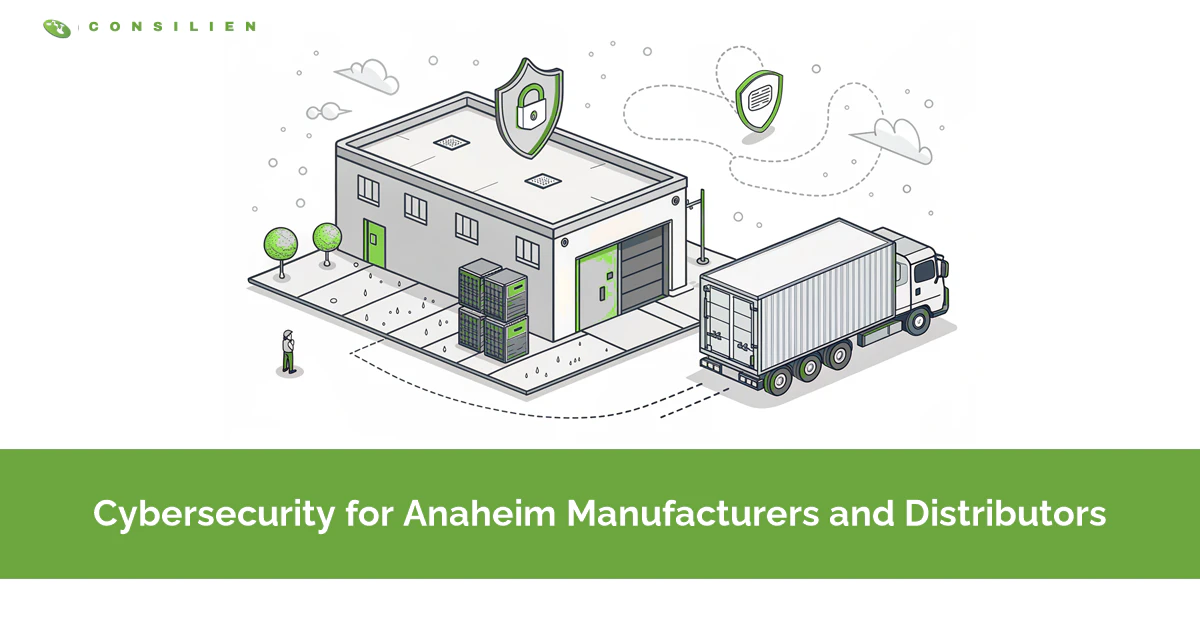
Cybersecurity for Anaheim manufacturers and distributors starts in the office, not on the machines. Attackers get in through email, the ERP system, vendor remote access, and payment requests, and the plant or warehouse stops because those business systems went down.
Table of Contents
Anaheim Canyon covers "more than 2,600 acres," and the city "has the largest number of manufacturers in OC," according to then-Mayor Harry Sidhu in an April 2019 Orange County Business Journal interview. Walk down La Palma Avenue and you'll notice that a lot of those buildings do two jobs at once. Parts get machined or assembled in the back, and finished goods get picked, packed, and shipped out the dock door to customers who order through a portal or an EDI feed (electronic data interchange, the system that passes purchase orders and invoices between companies automatically). That mix is what shapes the security problem here, and it's why a plan built for an office tenant in Irvine or a pure warehouse in Ontario usually misses something. If you're comparing providers for managed IT services in Anaheim, this is the part of the conversation I'd start with.
Key Takeaways: Manufacturing has been the most attacked industry for five straight years, and ransomware crews rarely touch the machines themselves. They encrypt the office side, and production stops anyway. For an Anaheim plant that also ships product, the main exposures are an unpatched ERP server, fake supplier payment requests, vendor remote access nobody tracks, and no paper fallback for orders. Each of those has a fix you can start on without new hardware.
Why do attackers go after Anaheim manufacturers and distributors?
Manufacturers have very little tolerance for downtime, and criminals know a stopped line gets a ransom paid faster. IBM's 2026 X-Force Threat Intelligence Index found manufacturing "tops the target list for the fifth year," with 27.7% of the incidents X-Force handled in 2025.
Where those attacks land is telling. Dragos tracks ransomware against industrial companies, and its Q2 2026 analysis, published August 10, 2026, counted 1,140 incidents worldwide, 747 of them (65%) at manufacturers. Transportation and logistics ranked third with 95. Dragos also reported no case that quarter where a ransomware operator reached the point of directly manipulating a control system. Where production stopped, it "followed encryption or precautionary shutdown."
So the machines kept their programming. What went down was the scheduling system, the file server holding the work instructions, the label printers, the shipping software. And the people running the plant shut the rest off to be safe, which is a reasonable decision that still costs a week.
That's good news, in a way. The systems you need to protect first are ordinary IT systems, and ordinary IT controls protect them.
What happens when a distributor's ordering system goes down?
You lose the ability to take orders, ship them, and bill for them, all at once. The clearest recent example is United Natural Foods, the grocery distributor that supplies Whole Foods, which shut down its systems after finding an intruder in June 2025.
CyberScoop's July 17, 2025 report lays out the timeline. UNFI discovered the attack June 5, disclosed it four days later, and didn't restore its primary electronic ordering systems until June 16. It operates 52 distribution centers. The company estimated lost sales of up to $400 million, plus about $20 million spent on manual workarounds while systems were offline, and purchase orders, invoicing, and payments were all delayed.
An Anaheim distributor with two buildings and 40 employees isn't UNFI. The shape of the problem is the same, though, and it scales down uncomfortably well. Ask yourself a few plain questions.
- If the ERP went dark at 7 a.m. tomorrow, could the warehouse still pick today's orders?
- Who has a printed list of open orders, customer ship-to addresses, and carrier contacts?
- Can your biggest customer send a PO by email while EDI is down, and would anyone know to watch for it?
- How long before you can't invoice, and what does that do to cash flow in week two?
Nobody needs a perfect answer. A one-page downtime plan that a shipping lead has actually read beats a 40-page disaster recovery binder sitting in a server room that's also offline. For getting systems back afterward, see the ransomware recovery playbook.
Is your ERP server the easiest way in?
It often is. That's especially true when it faces the internet and hasn't been patched in a while. IBM found vulnerability exploitation caused 40% of the incidents it handled in 2025, and Sophos found exploited vulnerabilities were the leading root cause of ransomware at manufacturers, at 32%.
The Sophos figure comes from its State of Ransomware in Manufacturing and Production 2025, which surveyed 332 manufacturing IT and security leaders between January and March 2025. Malicious email came second at 23%.
A specific case shows how this plays out. In April 2025, attackers exploited a flaw in SAP NetWeaver, the platform under many SAP ERP installations, before a patch existed. Cybersecurity Dive reported that Rapid7 saw exploitation dating back to at least March 27, that SAP issued an emergency patch April 24, and that "the customers being exploited are almost exclusively manufacturing companies." Many of the affected installations were more than 10 years old.
That last detail matters most. ERP systems at mid-size manufacturers usually get installed by an outside consultant, customized heavily, and then left alone because nobody wants to break the custom reports. IT patches Windows every month. The ERP application, its web portal, and the database underneath often sit outside that routine because the in-house team assumes the ERP partner owns it, and the ERP partner assumes IT does. Whether you run SAP Business One, Epicor, Sage, or something older, find out who patches it and when it was last done. Then write the answer down.
How does invoice and payment fraud hit a manufacturer?
It usually starts with an email that looks like it's from a real supplier, saying its bank details have changed. Accounts payable updates the vendor record, pays the next invoice, and the money goes to a criminal's account instead of the supplier's.
The FBI defines business email compromise in its 2025 IC3 Annual Report as a scam "targeting businesses or individuals working with suppliers and/or businesses regularly performing wire transfer payments," which describes almost any distributor. The same report logged 24,768 BEC complaints in 2025 with $3,046,598,558 in losses. California led every state with 116,414 complaints of all types and $3,674,716,305 in reported losses.
It's not rare, either. AFP's 2026 Payments Fraud and Control Survey, released April 14, 2026, found 74% of U.S. organizations were affected by BEC in 2025. Checks were still the payment type hit most, at 58%, ahead of ACH debits (electronic pulls from your bank account) at 30% and wires at 25%.
The fixes here are mostly process, with a little technology behind them:
- Call back on any bank change. Use a phone number already in your vendor file, never the one in the email.
- Hold every changed bank account for a set number of business days before the first payment goes out.
- Require a second approver on payments above a threshold you pick.
- Turn on multi-factor authentication (a second sign-in step beyond the password) for every mailbox in accounting, because many of these emails come from a supplier's real account that was hijacked, or from yours.
- Get an alert when someone creates a mailbox rule that forwards or hides messages. Attackers set those up to keep the real supplier's replies out of sight.
Speed matters. If a payment does go out, know that the IC3 Recovery Asset Team handled 3,900 incidents in 2025, froze $679,013,183, and reports a 58% success rate. Call your bank first, then file at ic3.gov the same day. Our guide to the two types of business email compromise goes deeper on what each type looks like.
Who else has a login to your network?
More people than your staff list. Machine builders support their equipment remotely, the ERP partner logs in for updates, the EDI provider connects for mapping changes, and a 3PL (an outside logistics warehouse) or freight broker may have a portal account.
Each connection is reasonable. The risk comes from how they pile up over the years. A remote access tool gets installed for one CNC vendor in 2019, the contract ends, and the tool stays, with the same shared password, on a PC that still sits on the main network. Multiply that by six vendors.
Start with an inventory. It doesn't need software.
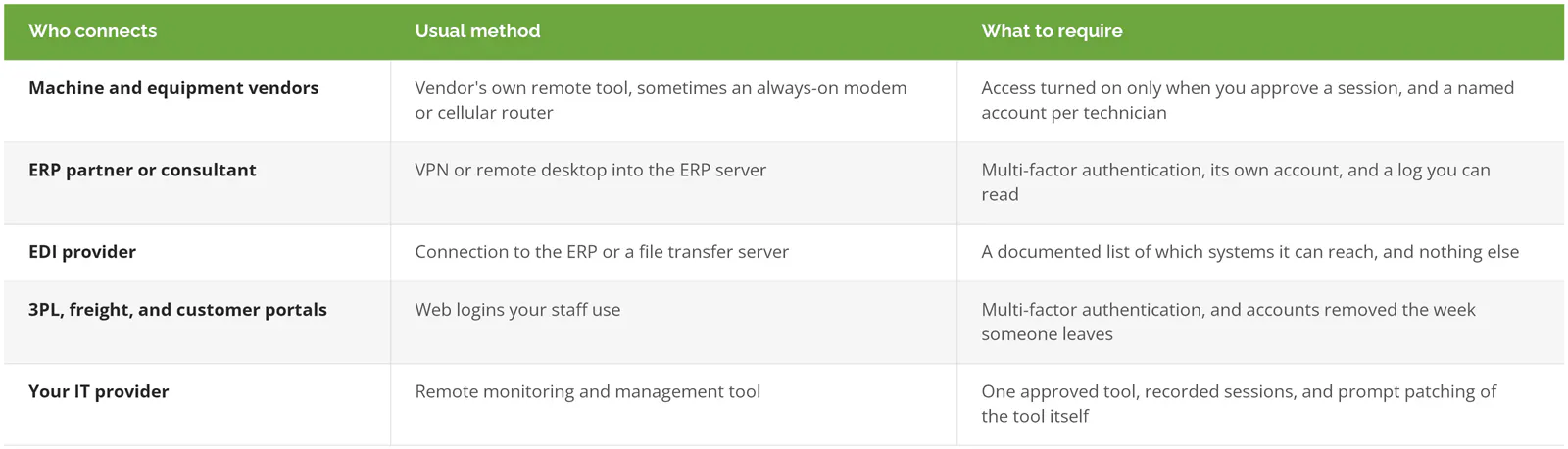
Then separate the shop floor and warehouse from the office. Handheld scanners, label printers, and machine PCs shouldn't share a network with the accounting laptops, so a compromised scanner can't reach the file server. That separation is called network segmentation, and our post on segmenting OT and IT networks in manufacturing walks through how it's laid out. For a fuller look at the vendor contracts behind all of this, see vendor risk management for manufacturing supply chains.
What should an Anaheim plant fix first?
Start with the controls that block the most common ways in, in roughly this order. None of them need new production equipment. An Anaheim company with one IT person can make real progress on the first three in a month.
- Turn on multi-factor authentication for email, remote access, and any admin account. If you're unsure what that covers, start with our MFA explainer.
- Patch everything that faces the internet, including the ERP web portal, the firewall, and the VPN. Check this list first when a new flaw makes the news.
- Put the payment controls above into writing and train accounts payable on them.
- Keep a backup copy attackers can't reach or delete, and test a restore of the ERP database, not just files.
- Build the vendor access inventory and turn off anything that isn't needed.
- Write the one-page downtime plan for orders, shipping, and invoicing.
- Get 24/7 monitoring on servers, laptops, and email sign-ins, so an intrusion found at 2 a.m. on a Saturday gets handled before Monday. The managed IT cost guide for Orange County shows what that tier usually costs.
The money side is real too. Sophos found the mean recovery cost for manufacturers, not counting any ransom, was $1.3 million, and 51% of victims still paid. Your cyber insurer will also ask about most of this list at renewal, and our cyber insurance requirements checklist maps the usual underwriting questions.
Plant-floor controls, like protecting the PLCs (programmable logic controllers, the small computers that run individual machines) and the engineering workstations that program them, come after this list for most Anaheim shops. When you get there, our manufacturing cybersecurity solutions page covers that layer.
What about CMMC and other compliance requirements?
They're a separate project. If you machine parts for defense primes, CMMC and NIST SP 800-171 decide what controls you need and how you prove them, and the paperwork goes well past this list. Consilien sells compliance work as its own service, not as part of managed IT. Where those requirements stand after the CMMC Phase II suspension is laid out in IT compliance for OC manufacturing and aerospace firms.
Where does Consilien fit?
Consilien's IC24 Managed Cybersecurity service runs a 24/7 security operations center (a team watching alerts around the clock) with managed SIEM, the system that collects logs from servers, laptops, and firewalls in one place, and it pairs with our IC24 managed IT for patching, backups, and help desk support. Joel Poindexter, IT Manager at Hixson Metal Finishing in Newport Beach, a client since 2010, wrote on Consilien's Clutch profile that "Consilien has a great depth of knowledge and experience throughout their team."
You may not need us. If you already have an in-house security team with its own around-the-clock monitoring, a written incident plan, and an ERP patch schedule someone owns, keep it. A company with one IT generalist who wants help with the security side can look at co-managed IT instead, and the distribution IT page covers how we support warehouse-heavy operations.
If you'd like a second set of eyes on your vendor access list or your ERP patch status, speak to an Anaheim IT expert and bring what you have.