Cybersecurity Assessment Cost in Los Angeles: What's Included and What You'll Pay
A cybersecurity assessment in Los Angeles typically costs $3,000 to $15,000, takes 2 to 6 weeks, and ends with a risk-ranked report and a remediation roadmap. Scope decides where you land: systems covered, compliance obligations, and testing depth.
Table of Contents
Last updated: October 6, 2026
The assessment is the cheap part. What it finds, and what you decide to fix first, is where the real money goes.
A cybersecurity assessment looks at your technology, your people, and your processes, then answers one question for leadership: where are you exposed, and what happens to the business if someone walks through that gap? It's a business risk exercise that happens to involve a lot of technical work. Treat it as an IT checkbox and you'll get a 90-page scan export nobody reads.
What Does a Cybersecurity Assessment Cost in Los Angeles?
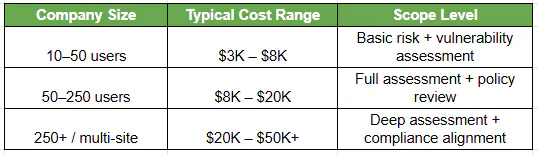
There's no published rate card for this work, and two quotes for the "same" assessment can be $10,000 apart. They're rarely quoting the same thing. One firm is pricing an automated scan with a branded cover page. The other is pricing interviews with your controller, a review of who can approve wire transfers, and a written plan with owners and dates.
What pushes the price up
- Users, devices, and cloud accounts in scope. More laptops, servers, Microsoft 365 or Google Workspace tenants, and AWS or Azure subscriptions means more to inventory and test.
- Locations. A firm with a head office in Torrance, a warehouse in Ontario, and remote staff in three states has three networks to review, not one.
- A compliance framework. Scoring against CMMC, PCI DSS, SOC 2, or NIST SP 800-171 adds documentation review and control-by-control mapping.
- Testing depth. A vulnerability scan, a full assessment, and a penetration test (a hired attacker actually trying to break in) are three different price points.
- Missing basics. No asset inventory and no network diagram? Discovery takes longer, and you pay for it.
What you shouldn't pay much for
An external vulnerability scan on its own. The federal Cybersecurity and Infrastructure Security Agency runs free Cyber Hygiene scanning of internet-facing systems for government bodies and critical infrastructure organizations, and manufacturing is one of those sectors. If a quote's main deliverable is a scan report, ask what you're getting beyond what CISA would send you every week for free.
The cost after the assessment
Budget for remediation before you sign. The report will tell you to turn on multi-factor authentication (a second login step, usually a phone prompt) for every account, replace a firewall that's out of vendor support, or rebuild backups so ransomware can't reach them. Some of that is an afternoon of configuration. Some of it is a capital purchase. A good assessor ranks the list so you can spread it across quarters instead of buying everything in month one.
What's Included in a Cybersecurity Assessment

Whatever the price, these are the pieces a real assessment covers:
- Asset discovery, meaning a list of every device, application, user account, and cloud service you actually have (it's almost never the list IT thinks it has)
- Vulnerability testing of internal and internet-facing systems
- Identity and access review: who has admin rights, who still has a login after leaving, and which accounts skip multi-factor authentication
- Network and firewall configuration review
- Endpoint protection check across laptops, desktops, and servers
- Cloud security review of Microsoft 365, Google Workspace, AWS, or Azure settings
- Backup and recovery check, including whether a restore has ever actually been tested
- Policy gap review against a framework like the NIST Cybersecurity Framework 2.0 or the CIS Critical Security Controls
Then ask what you get in writing. You want an executive summary a CFO can read in ten minutes, findings ranked by business impact rather than by how many there are, and a roadmap with an owner and a target date on every item. If the deliverable is only a technical findings export, you've bought a scan.
How the Assessment Process Works
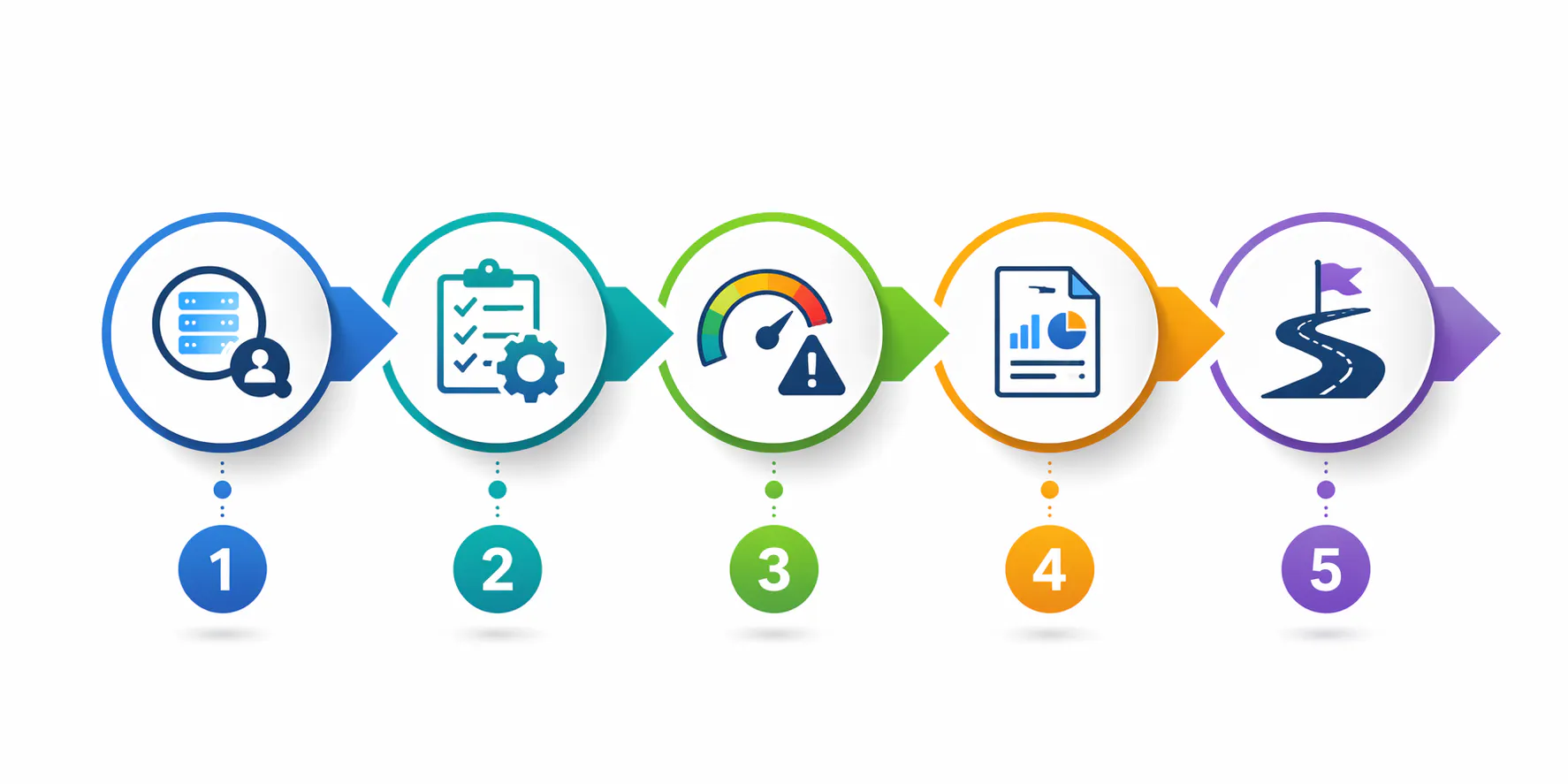
- Discovery (week 1). Inventory systems, users, and where your data actually flows.
- Analysis (weeks 1 to 3). Test for weaknesses and misconfigurations, interview the people who run finance and operations.
- Risk scoring. Rank every finding by likelihood and business impact, using a method like the one in NIST SP 800-30, the federal guide to risk assessments.
- Report. Findings in business language. "An attacker with one stolen password could approve payments" lands. "MFA not enforced on 14 accounts" doesn't, at least not with your board.
- Roadmap. Fixes in priority order, with timelines.
Small, single-site environments finish closer to 2 weeks. Multiple locations or a compliance framework push it toward 6.
Cybersecurity Assessment vs Penetration Testing vs IT Audit

People use these three words interchangeably. They shouldn't, because they answer different questions and carry different price tags.
An assessment asks where you're exposed and what to fix first. It's broad, it covers people and process as well as technology, and it ends in a prioritized plan.
A penetration test asks whether a skilled attacker can actually get in, and how far they get once inside. It's narrow and deep. Our breakdown of penetration testing vs vulnerability scanning covers where each one fits.
An IT audit asks whether your controls match a written standard, and somebody independent signs off on the answer. That independence matters more in California now. Under the California Privacy Protection Agency's CCPA cybersecurity audit regulations, in effect since January 1, 2026, covered businesses need an annual audit by an objective, independent professional. First certifications are due April 1, 2028 for businesses over $100 million in revenue, April 1, 2029 for $50 million to $100 million, and April 1, 2030 for everyone else covered.
Running an assessment first is how you avoid failing that audit. It's also cheaper.
Why Los Angeles Businesses Get Assessed
California led every state in cybercrime losses in 2025. The FBI's 2025 Internet Crime Report logged 116,414 complaints from California and $3.67 billion in reported losses, both first in the country. Business email compromise, where a criminal impersonates a vendor or executive to redirect a payment, cost victims nationwide more than $3 billion on its own.
Those numbers aren't abstract in LA. Firms here tend to run several sites across the county, lean on hybrid staff logging in from home, and hold data that makes them a target: manufacturing drawings, client financials, tenant records, defense contract details.
And then there's the insurance carrier. Renewal applications now ask point-blank about multi-factor authentication, backups, and endpoint detection, and a "no" can raise your premium or void a claim. Our cyber insurance requirements checklist lists what carriers ask for. An assessment tells you how you'd honestly answer before you sign the application.
What a Good Assessment Actually Finds
Findings matter when they connect to a business consequence. A short list of chains a decent assessment should trace:
- Weak or missing multi-factor authentication → stolen email login → fake invoice paid to a criminal's bank account
- Unpatched server → ransomware → a week of halted shipping plus recovery costs
- Former employee's account still active → client data walks out the door → notification letters and a regulator asking questions
- Backups on the same network as everything else → encrypted along with the rest
The cost of skipping that work is well documented. IBM's 2026 Cost of a Data Breach study puts the global average breach at $4.99 million, up 12% from the prior year. In the US it's $11.5 million, the highest of any region. Even a fraction of that dwarfs a five-figure assessment.
When to Schedule One
- Before a cyber insurance renewal
- Before a compliance audit or a customer security questionnaire you can't answer
- After an acquisition, a new location, or a jump in headcount
- After any security incident, even a "minor" one
- Once a year as a baseline, because your environment changed more than you think
How Consilien Runs a Cybersecurity Assessment
A virtual CISO (a part-time, outsourced chief information security officer) leads every assessment, not a junior technician running a scanner. The work is built on the NIST and CIS frameworks, and the deliverable is a ranked roadmap tied to business risk.
If you already have an internal IT team, we work alongside it. Your people keep ownership of the environment; the assessment fills in the security depth they haven't had time to build. If the roadmap points to a framework like CMMC or SOC 2, compliance readiness is a separate engagement, scoped on its own. For ongoing monitoring after the assessment, see our managed cybersecurity services in Los Angeles.
One limit worth knowing. If you need the independent CCPA cybersecurity audit, the firm that manages your security shouldn't be the one certifying it. Keep those two roles separate. A smaller first step is a mini cybersecurity risk assessment, which surfaces the biggest gaps before you commit to a full scope.