Gartner Magic Quadrant for PAM 2026: What Changed and Who It Fits
The 2026 Gartner Magic Quadrant for PAM is dated October 21, 2026. BeyondTrust, Delinea, and Palo Alto Networks (which now owns CyberArk) are the Leaders, no vendor was placed as a Visionary, and four vendors are new to the report.
Table of Contents
The report's analysts are Paul Mezzera, Shubham Gera, Tarun Rohilla, and Scott Brinker, and the first vendor announcements of their Gartner PAM Magic Quadrant 2026 placements appeared on October 23.
If PAM (privileged access management) is new to you, our explainer on what privileged access management is covers the vault, password rotation, and session recording basics, and Consilien's identity and access management services page shows where PAM sits next to single sign-on and MFA.
Key Takeaways
- Leaders: BeyondTrust, Delinea, and Palo Alto Networks, which has owned CyberArk since February 2026.
- Visionaries: none, after One Identity moved to Challenger and WALLIX to Niche Player.
- ManageEngine fell from Challenger to Niche Player, while Imprivata, Xage, Akeyless, and IBM entered.
- Gartner now weighs AI agents and machine accounts alongside human admins.
- For a company with two IT people, fit still comes down to price, Microsoft integration, and who runs the tool.
Who are the Leaders in the 2026 Gartner Magic Quadrant for PAM?
BeyondTrust, Delinea, and Palo Alto Networks are the 2026 Leaders, and all three say this is their eighth straight Leader placement. BeyondTrust says it placed highest on Ability to Execute, Gartner's measure of how well a vendor sells and supports its product today. Palo Alto says it placed furthest on Completeness of Vision, the roadmap axis, as CyberArk did in every earlier edition.
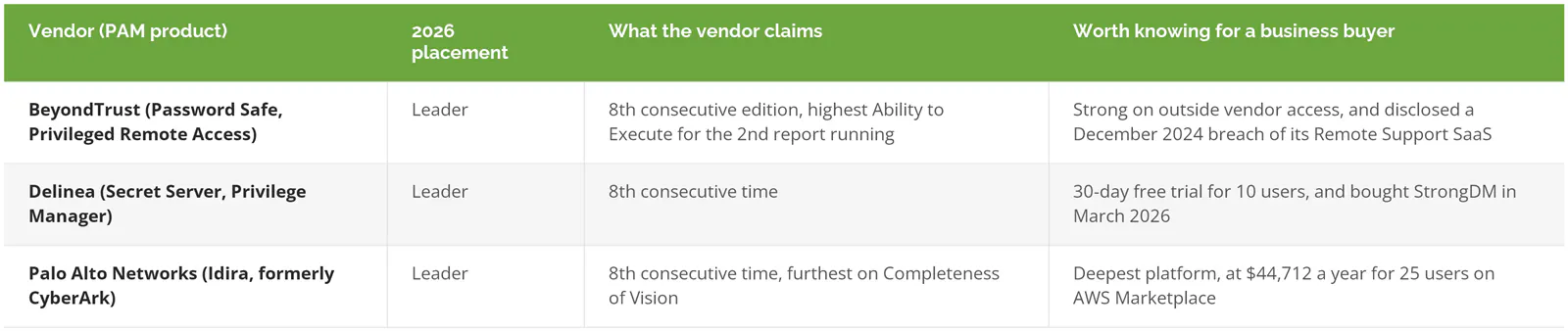
The placements come from each vendor's own announcement: BeyondTrust, Delinea, and Palo Alto Networks. The price is Palo Alto's AWS Marketplace listing for 25 Standard Privilege Cloud users. BeyondTrust's breach affected 17 customers, according to Cybersecurity Dive.
The CyberArk name is the part that confuses people. Palo Alto Networks closed its $25 billion purchase of CyberArk on February 12, 2026, and in May relaunched the identity products as Idira. Palo Alto's post calls 2026 "the first report to carry the Palo Alto Networks name." The product line and its Leader position carried over, and only the name on the invoice changed.
What changed from the 2025 Magic Quadrant?
The Leaders held, but the rest of the chart moved. The 2025 report, dated October 13, 2025, had Visionaries. The 2026 report has none. One Identity, WALLIX, and ManageEngine all changed quadrants, StrongDM disappeared into Delinea, and four vendors joined the report for the first time.
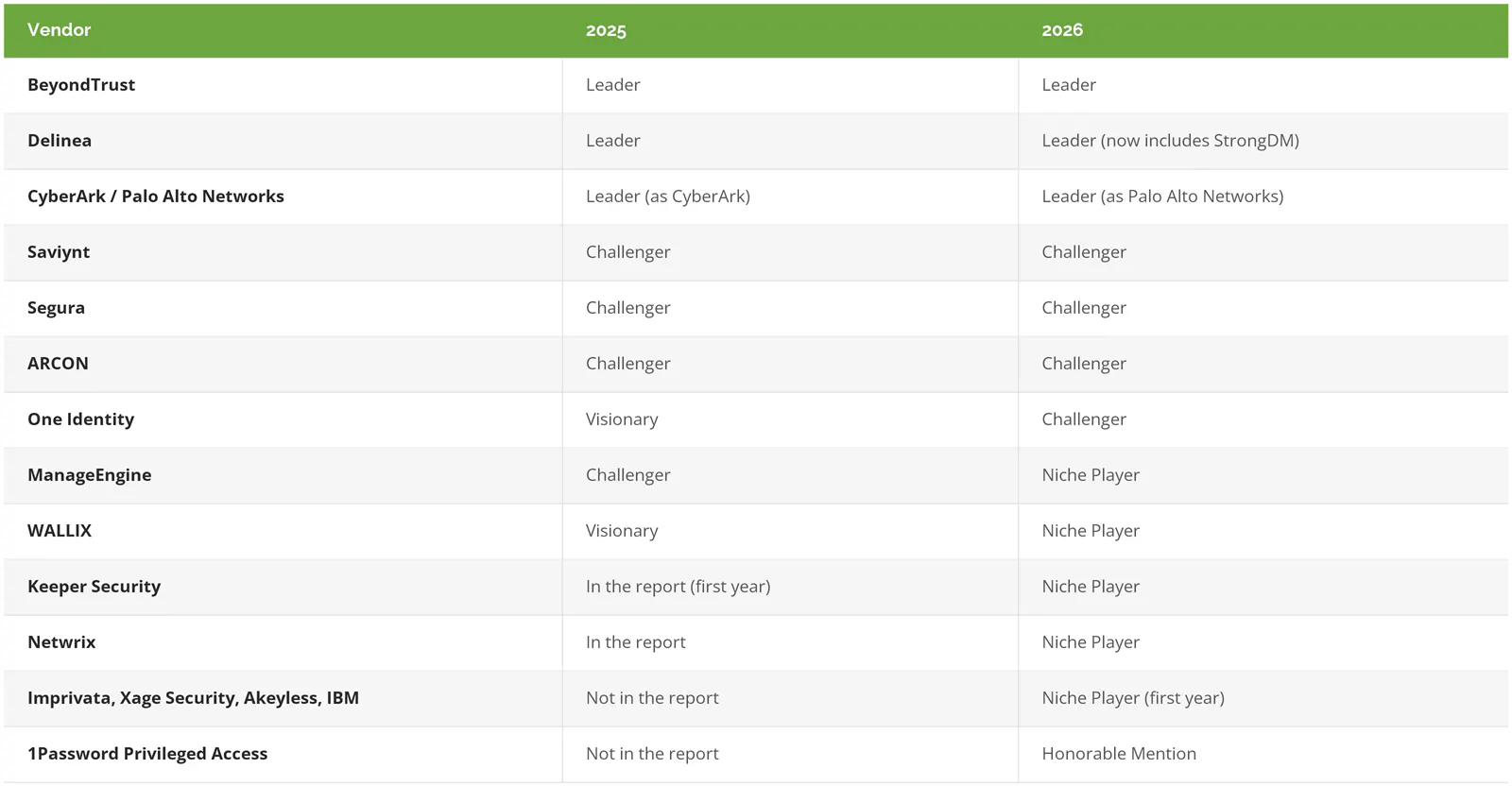
Gartner keeps the full chart behind its paywall. The 2026 Challenger and Niche Player list comes from Segura's description of the quadrant graphic, which names 15 vendors, matching the 15 that BeyondTrust says Gartner evaluated. The 2025 placements come from the vendors' own releases, including ARCON, One Identity, and WALLIX. Saviynt, Keeper, Akeyless, Netwrix, and 1Password published their own 2026 announcements.
Two of those moves deserve a second look.
ManageEngine's drop matters for budget buyers, because PAM360 is one of the few PAM products with a public price list, starting at $7,995 a year for 10 administrators. A Niche Player placement doesn't make the product worse than it was in September. It means Gartner now sees it serving a narrower slice of the market, so read the cautions section before treating last year's Challenger dot as a reason to buy.
The four newcomers come from different corners of security. Imprivata built its business on clinical access in hospitals, Xage on industrial control systems, Akeyless on secrets management for developers, and IBM on large-enterprise identity. Their arrival in a single report suggests Gartner's idea of a privileged account now reaches well past the Windows domain admin.
Why is Gartner now scoring AI agents and machine identities?
Gartner's public summary of the 2026 report says the PAM market has to cover privileged access for machines, AI agents included, on top of the human administrators it was originally built for. On the machine side, that covers service accounts, API keys, scheduled scripts, and AI tools that run with admin rights, often on passwords that haven't changed in years.
Backup software is the usual example. It needs an account that can read every server, and in a lot of Active Directory domains that account sits in Domain Admins with the password set on the day the software was installed. The same goes for the API key your accounting system uses to pull bank transactions, or the Azure service principal (a login for an app rather than a person) a consultant created in 2022 and never documented. Palo Alto Networks puts the ratio of machine identities to human ones at 109 to 1, which is its own figure and not Gartner's.
AI agents add to that count quickly. In a June 2026 survey, 1Password found that 40% of developers had granted AI agents persistent access, and Netwrix reported in 2026 that 66% of organizations still have standing, always-on admin access.
The vendors' answer goes by the name zero standing privilege, where no account keeps admin rights by default, and access is granted for one task or a set time window and then removed. Delinea completed its StrongDM purchase in March 2026 to add that kind of on-demand authorization, and Palo Alto, Saviynt, and Netwrix all used the term in their 2026 announcements.
In a Microsoft 365 tenant with five permanent Global Administrators and an automation account last reviewed in 2022, one stolen password reaches email, SharePoint, Teams, and every user's MFA settings. Microsoft's 2025 Digital Defense Report says more than 97% of identity attacks are password attacks, so the number of accounts holding admin rights at any given hour matters more than which vendor's vault stores them.
Which PAM tier fits which kind of business?

Match the tier to the people you have. Leaders fit companies with someone who runs PAM as part of the job and an auditor or insurer asking for proof. Challengers fit buyers who also want identity governance. Several Niche Players fit a plant floor or a lean IT team better than a Leader would.
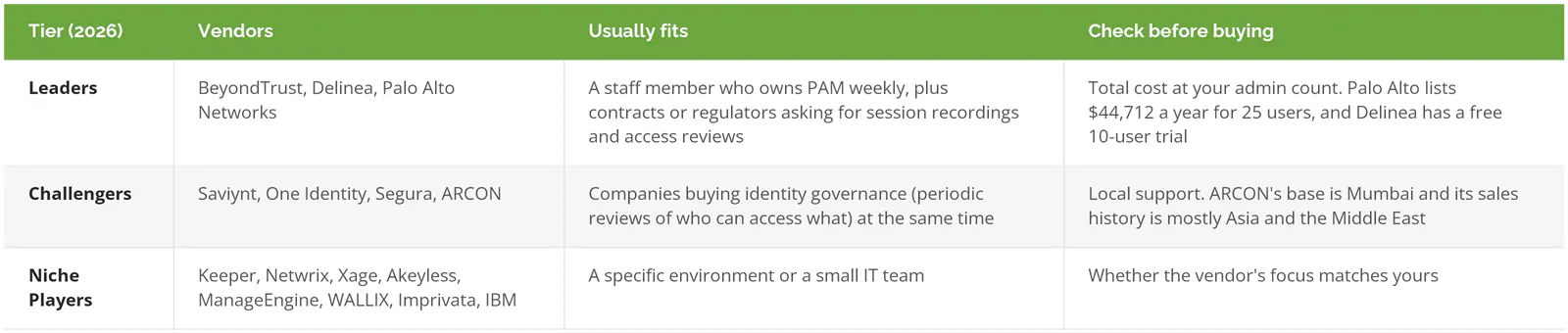
Among the Leaders, Delinea offers a free 30-day trial for 10 users and ranked first in our scored list of the best PAM solutions for 2026. BeyondTrust's strength is controlled access for outside vendors and contractors. Saviynt, in its own materials, describes its Challenger placement as sitting near the Leaders line.
Five of the Niche Players are worth a closer look from a business buyer's chair:
- Keeper Security is cloud-based, and its non-human identity tier is free for up to 24 annual active machine identities, which suits an IT team of one to three people.
- Netwrix offers self-service checkout to organizations with up to 150 employees and Netwrix says the product was designed around removing standing admin rights rather than only vaulting passwords.
- Xage Security covers operational technology, meaning the controllers, operator screens, and SCADA control systems that run a production line. A manufacturer with networked equipment on the floor should evaluate Xage's XPAM before settling on an IT-only tool.
- Akeyless focuses on secrets management, the API keys and certificates applications use, so it belongs on the list of a company that writes software, and probably not one that mainly runs Microsoft 365.
- ManageEngine PAM360 publishes its prices, has a free edition for one admin, and runs on your own servers.
A company on Microsoft 365 with four or five admins and no auditor asking for session video can usually wait on every vendor in this report. Microsoft's Privileged Identity Management (PIM), which grants admin roles for a set number of hours and can require approval first, is included in Entra ID P2 at $10 per user per month, and Windows LAPS, built into Windows since the April 11, 2023 update, rotates each machine's local administrator password and backs it up to Entra ID or Active Directory. Combined with Conditional Access policies in Microsoft 365, those two cover the basics until a customer contract or a cyber insurance renewal asks for more.
What does the Magic Quadrant leave out for a business buyer?
The quadrant grades vendors on Ability to Execute and Completeness of Vision. It doesn't grade price, the staff hours needed to run the product, how well it works with Microsoft Entra, or whether it suits a company without a security team. Those four questions usually decide the purchase.
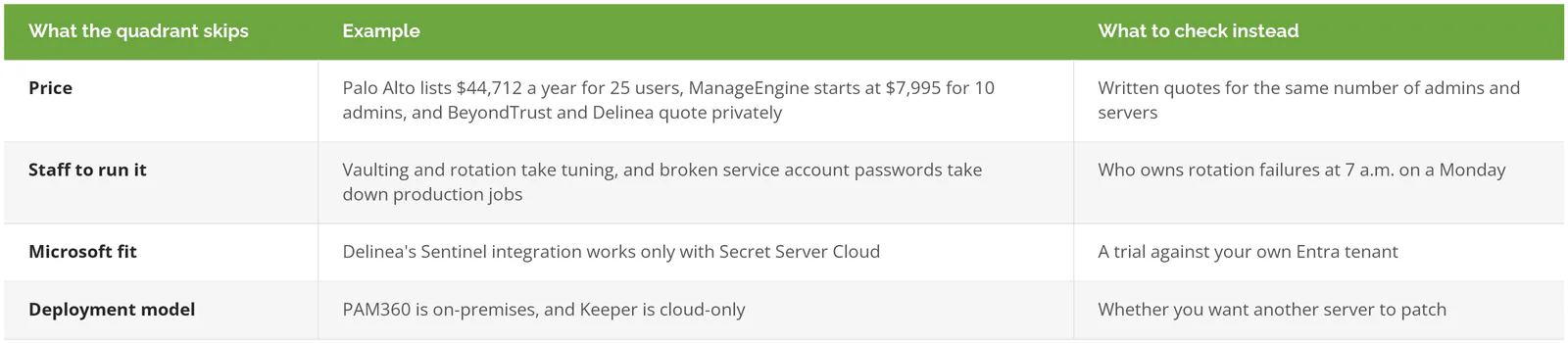
Sources for that table are the Palo Alto AWS listing, ManageEngine's pricing page, and Delinea's Sentinel documentation.
For a second opinion that does reflect smaller companies, filter Gartner Peer Insights for PAM by company size and industry. The Magic Quadrant is analyst opinion. Peer Insights is verified customer reviews, and a 4.5 from a 60-person firm tells you more about fit than a dot on a chart does.
Gartner's own disclaimer, printed with every reprint, says it "does not advise technology users to select only those vendors with the highest ratings or other designation." It's worth reading before the chart itself.
Should you buy PAM or have it managed?
Buy the software if someone on staff will review its activity every week, and have it managed if nobody will. The value of a PAM platform comes from the routine work around it (approving elevation requests, reviewing recorded sessions, and fixing a password rotation that broke a scheduled job), and a vault nobody looks at mostly just stores passwords.
Its logs also need somewhere to go. A checkout of a domain admin password at 2 a.m. is the kind of event a SIEM (security information and event management, the system that collects security logs and flags suspicious activity) should raise to an analyst, and integration support varies by product. Microsoft's Sentinel connector list includes CyberArk's audit data and its endpoint privilege management (EPM) data, which covers admin rights on laptops and servers, Delinea's Sentinel integration works only with Secret Server Cloud, and BeyondTrust's documentation says its EPM Cloud Sentinel integration is deprecated from version 26.2. Ask for the connector by name during the trial.
If you're choosing on that side too, our read on the Gartner SIEM Magic Quadrant and the SIEM pricing guide cover the tools, and managed SIEM is how Consilien routes those alerts to an analyst.
On sequence, the order of work matters more than the vendor: inventory every admin and service account, remove the ones nobody can explain, put the remaining ones behind a vault, and then size the PAM tool to the number left, which usually comes in smaller than the count behind the first quote.
Not sure which tier your business actually needs? Speak to an Identity Security Expert.