How Much Do Managed IT Services Cost in Orange County?
Managed IT services in Orange County cost about $150 to $250 per user per month for full coverage. Help desk-only plans run $100 to $150. Security-heavy 24/7 plans start near $250. Onboarding, compliance, and hardware are billed separately.
Table of Contents
Get a managed IT quote for a 25-person office near the Irvine Spectrum, then get one for the same office in Century City. Compare the per-user rates. They'll land within a few dollars of each other. Owners in Orange County are often surprised by that. They shouldn't be.
Look at the name of the labor market. The Bureau of Labor Statistics files Irvine, Santa Ana, Newport Beach, and Anaheim under the Los Angeles-Long Beach-Anaheim metro, and anyone quoting managed IT services in Orange County hires technicians out of that one pool at that one pay scale.
Geography isn't the variable. The type of business is. A wealth manager on Newport Center Drive, a CPA firm in Tustin, and an escrow office in Santa Ana all carry rules or fraud exposure that a general office doesn't, and each of those shows up as a line on the proposal.
What does managed IT cost in Orange County?
Full managed IT for an Orange County business usually runs $150 to $250 per user per month. For a 25-person firm, that's $3,750 to $6,250 a month before onboarding, hardware, or compliance work.
A per-user rate is one monthly price per employee that covers every device that person uses, laptop and phone included. It's how most IT support pricing in OC gets quoted for office-based firms, though you'll still see per-device proposals from shops that grew up servicing warehouses and flat monthly fees from smaller outfits. Alone, the rate means little. You have to read it next to the list of what it buys.
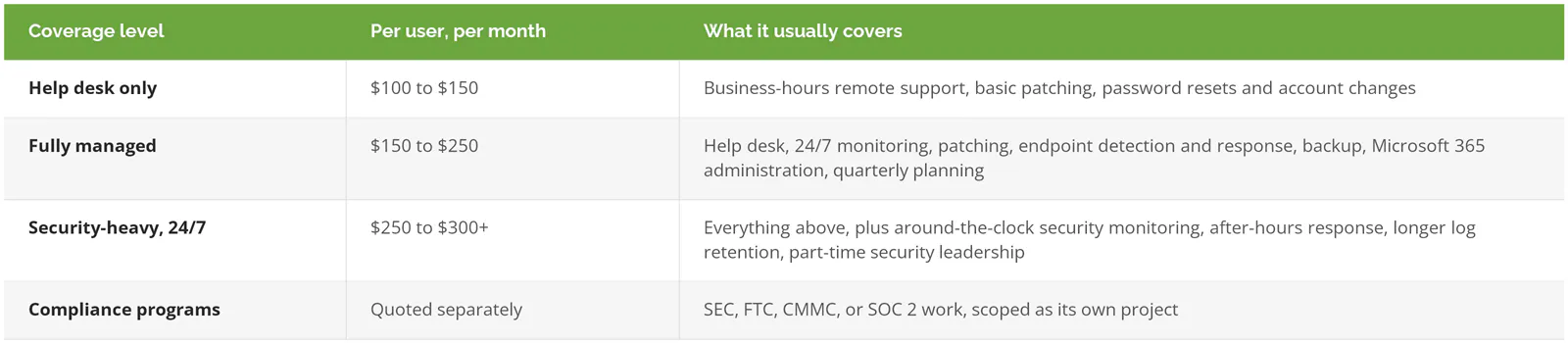
Endpoint detection and response is software on every laptop and server that watches for attacker behavior and can pull a machine off the network by itself. Log retention is how long the record of who signed in, from where, and what they opened gets kept. An investigator asks for it first.
Lower numbers exist. Kaseya's 2023 Global MSP Benchmark Survey found the most common per-user band was $50 to $100 a month, chosen by 22% of the 1,091 providers who responded, and only 16% charged above $150. That's national data from three years ago, and it counts shops that sell help desk and nothing more. In Orange County, a quote in that band is light on scope, light on technicians, or both.
Usually both.
Does an Irvine address cost more than a Los Angeles one?

No. BLS doesn't publish a separate wage figure for Orange County technicians. They're counted in the Los Angeles-Long Beach-Anaheim metro, where IT support pay sits 21% above the national median, so OC and LA quotes start from the same labor floor.
The BLS occupational wage tables for May 2025 put the median computer user support specialist in that metro at $75,070 a year. Nationally, the same job pays a median $61,860. Add benefits and payroll taxes using the BLS employer compensation data for June 2026, where wages are 70.0% of private-industry compensation, and one Orange County technician costs an employer about $107,200 a year.
Spread that person across 75 users and the help desk labor alone comes to roughly $119 per user per month. No tools, no backup storage, no senior engineer, no margin. At national wages the same math lands near $98.
That $21 gap is in every OC quote. Whoever writes it.
We've laid out the full ratio table in outsourced IT support cost per user, and the same labor math runs through managed IT cost in the South Bay, which shares this metro. Before you sign, ask any provider how many users each technician carries. A provider quoting $90 per user is answering it, whether they say the number out loud or not.
Which Orange County businesses pay at the top of the range?
Firms with a regulator or a wire transfer in the picture. Registered investment advisers, CPA and tax firms, and real estate, escrow, and title offices land higher because their quotes need incident response, email security, and documentation that a general office skips.
OC has plenty of all three. That's a big part of why a Newport Beach quote and a Fullerton quote can look so different for the same headcount, even when both firms run the same Microsoft 365 setup, the same laptops, and the same handful of business apps.
Wealth managers and RIAs in Newport Beach and Irvine
The SEC rewrote Regulation S-P, its customer-data rule for investment firms, in 2024. Larger firms had to comply by December 3, 2025. Smaller ones, including advisers with less than $1.5 billion under management, had until June 3, 2026, per the SEC's small entity compliance guide.
That deadline has passed. The rule now expects a written incident response program, notice to affected customers within 30 days of certain breaches, and oversight of service providers, which includes whoever runs your IT. Your managed IT provider becomes part of your compliance file. Literally. And they need to tell you within 72 hours when something goes wrong on their side.
So ask two things. Will the provider put breach notification terms in writing? And will they hand over the evidence your compliance officer needs for an exam? A provider who's never heard of Reg S-P will charge less. Not for long. Our guide to IT compliance for financial services firms covers what the exam side looks like.
CPA and tax firms
Tax preparers count as financial institutions under the FTC's Safeguards Rule. Size doesn't change that, though firms with fewer than 5,000 customers skip a few of the paperwork requirements. The FTC's own guide to the rule requires a written information security program, a named Qualified Individual who owns it, multi-factor authentication (a second sign-in step beyond the password), and encryption of customer data. Since May 2024, a breach exposing unencrypted data on 500 or more customers has to be reported to the FTC within 30 days.
Your managed IT plan can run most of the technical controls. It can't be your Qualified Individual unless the agreement says so. Read that clause twice. Support for that role is often the line item that pushes a small Tustin practice toward the top of the range. Firms in this bucket can start with IT for professional services firms.
Real estate, escrow, and title offices

Follow the wire transfers. The FBI's 2025 Internet Crime Report logged $275.1 million in real estate fraud losses, up from $173.6 million the year before, and $3.05 billion lost to business email compromise, where a criminal gets into or fakes an email account to redirect a payment. California led every state in reported losses at $3.67 billion.
An escrow office in Santa Ana can send six-figure wires on an ordinary Tuesday. Its IT quote should include stronger email filtering, impersonation alerts, sign-in monitoring on every mailbox, and a callback rule for any change to wiring instructions. Some providers fold those into the security tier. Others sell them as add-ons. Price both. The two types of business email compromise explains what those controls catch, and IT for real estate firms covers the rest.
Anyone with a cyber insurance renewal coming up
This one isn't industry-specific. Carriers now ask for multi-factor authentication everywhere, endpoint detection and response on every machine, and backups that have actually been restored in a test. If your quote is help desk only, none of that is in it, and you'll pay for it separately or answer the renewal questionnaire with a no and then explain that no to an underwriter who has a stack of other applications to get through. The cyber insurance requirements checklist lists what underwriters want to see.

Is compliance included in the monthly rate?
It shouldn't be. Reg S-P asks an adviser for a written incident response program and a file showing how it oversees vendors. The Safeguards Rule asks a tax practice for a written security program and a named person who owns it. Managed IT supplies a lot of the proof behind those documents, like the MFA logs, patch records, and backup restore tests, but it doesn't write them, and Consilien sells compliance as a separate service for that reason.
A $175 per-user quote that claims to cover SEC or FTC compliance usually means a few policy templates and a quarterly report. The risk assessment comes later, on its own invoice.
None of that applies to a firm with no regulator, no card data, and no customers sending security questionnaires. Skip it.
What costs sit outside the monthly number?
Five, usually. Ask about each before comparing two rates, because one proposal may include something the other leaves out.
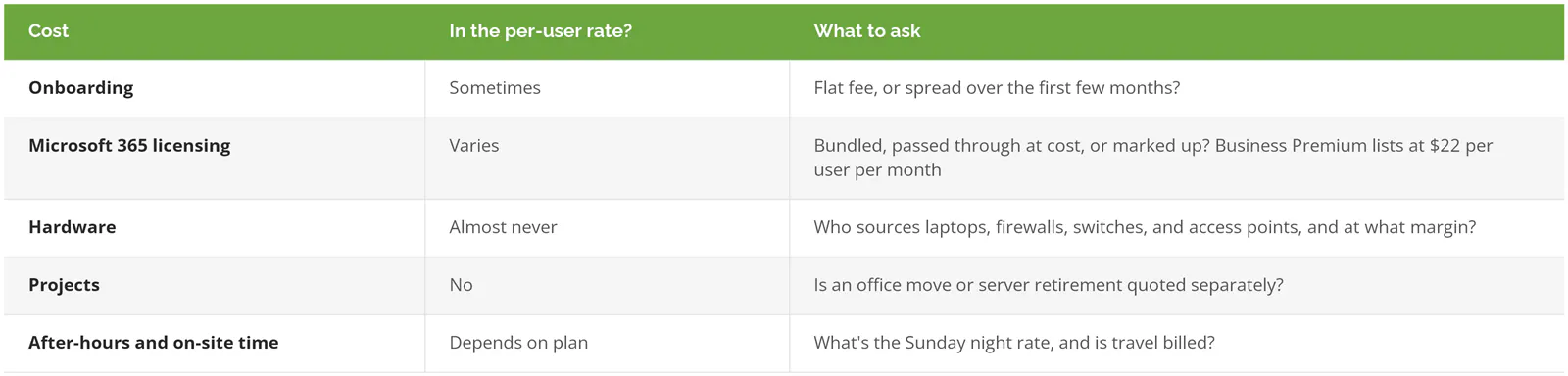
Licensing trips up more comparisons than the other four rows combined. Check it first. Microsoft lists Business Premium at $22 per user per month on an annual plan. For 25 people, $6,600 a year can hide inside one quote and sit outside the other.
On-site time matters more in Orange County than people expect. We're up in Torrance, on Hawthorne Boulevard, and our techs drive down when a remote session can't fix it. Lots of OC firms work with someone based in LA or the Inland Empire, and that's fine, honestly. Just don't sign until the contract says how many visits you get, whether the drive is on your dime, and when a human shows up in Irvine on a Monday at 8 with the 405 crawling.
Managed IT vs. break-fix vs. one in-house hire: what does each cost?
For a 25-person Orange County firm, managed IT runs about $45,000 to $75,000 a year. One in-house technician costs about $107,200 loaded, before tools. Break-fix looks cheapest until the month a server dies.

Fifteen hours a month is a guess. A kind one, probably. Break-fix bills arrive in lumps. A quiet spring, then a ransomware scare in the middle of tax season, and one week's invoice erases a year of savings. The full managed IT vs. break-fix comparison walks through where the two costs cross.
In-house has its own catch. One person is a single point of failure with a vacation schedule. If you already employ a strong IT manager, though, you probably don't need fully managed IT. A co-managed partner for an internal IT team fills the gaps around that person for less money.
How do you compare two Orange County managed IT quotes?
Lay the proposals side by side and get each of these answered in writing.
- How many users does each of your technicians support?
- Is endpoint detection and response included, and who looks at an alert at 2 a.m.?
- What's excluded? Hardware, projects, after-hours work, and Microsoft 365 licensing are the usual four.
- If we're SEC- or FTC-regulated, will you sign breach notification terms and produce evidence for an exam?
- How many on-site visits are covered, and is travel billed?
- What's the term, what's the notice period, and what do we get back when we leave?
Watch the first answer. A provider who dodges it has told you plenty. If you're still building a shortlist, our ranking of IT support services in Orange County compares 6 providers, and there are city pages for managed IT in Anaheim and IT support in Fullerton. For the statewide view, see what California businesses pay for managed IT.
Turning a range into your number
Pricing pages have to stop at a range. They can't know your firm. Your real number comes from your user count, how many offices you run, which regulator reads your files, and how much money leaves your accounts by wire every week. No web form can work that out.
Consilien is a managed IT and cybersecurity provider founded in 2001, based in Torrance, and serving businesses nationwide, with compliance offered as its own service. A technology assessment takes 2 to 4 hours and turns the range on this page into a real quote. If you'd rather start by talking through what you're paying now, speak to an IT expert.