How to Choose a Managed IT Provider in 2026
Choosing a managed IT provider in 2026 comes down to one question: does this provider reduce your risk, or add to it? Seven things decide that. Their own security posture, the strategic layer they bring, their ability to produce compliance evidence, contract exit terms, SLA enforceability, fit with your size and industry, and whether they will still be the same company in 2 years. Price is the last question, not the first.
Table of Contents
Most companies pick an IT provider the same way they picked the last one. Three proposals, a spreadsheet comparing monthly rates, a reference call or two, and a decision made mostly on cost and gut feel.
That process was always weak. In 2026 it's a liability. The provider you hire holds administrative access to your laptops, your email, your servers, and your backups. Attackers understand that better than most buyers do. Whoever you choose isn't just supporting your environment anymore. They're part of your attack surface, part of your compliance posture, and part of whether your cyber policy pays out.
This guide walks through how to run that decision properly. It assumes you're evaluating managed IT services for a company somewhere between 20 and 500 users, you've been burned or nearly burned before, and you'd like the next agreement to last.
What actually changed since your last IT decision
If your current agreement is 3 years old, it was signed in a different market. Three shifts matter.
Your provider became a target
Attackers stopped writing custom malware and started borrowing credentials. The tool your MSP uses to manage your endpoints, the RMM platform, is now one of the most actively exploited pieces of software in the channel. Dark Reading documented waves of exploitation against remote management platforms this year, with attackers pivoting from the provider straight into downstream customers.
The numbers are worse than most executives assume. A 2026 survey of 350 providers found roughly 3 in 4 had been breached in the preceding year, and more than half had been breached more than once, according to analysis compiled by CloudSecureTech. Verizon's 2026 breach report logged a sharp year over year rise in threat actors abusing legitimate remote management tooling.
Read that again. These are the companies hired to keep other businesses safe.
Breaking into your network gets an attacker one company. Breaking into the firm that manages 60 companies like yours gets them 60. That math is why your provider's internal security is now a primary evaluation criterion instead of a footnote.
Ownership consolidated
The provider you sign with may not be the provider serving you in year 2. Managed IT has become one of the most actively acquired service categories in the country. Industry M&A tracking put 2025 at 466 North American deals, a 20% jump over the prior year, with more than $4.3 billion in disclosed value. Private equity appeared in roughly 7 out of 10 disclosed transactions.
Consolidation isn't automatically bad. Scale can fund better tooling and a real security operations capability. But the pattern after an acquisition is predictable: ticketing systems merge, engineers get reshuffled, service models standardize, and the account manager who knew your business leaves. Your named engineer becomes a queue.
Nobody puts that in the proposal. You have to ask.
Proof replaced attestation
Cyber insurance used to be a questionnaire. It's now closer to an audit. Consolidated 2026 broker data shows the overwhelming majority of carriers requiring enforced multi-factor authentication across every privileged access path, with endpoint detection and response required on servers as well as workstations, and a majority of small and mid-sized businesses failing their assessment outright.
The failure mode that costs the most isn't a missing control. It's a control you claimed to have and couldn't prove was running on the day of the incident. That's a coverage denial, and it happens after the loss, when you have no options left. We covered the specifics in our 2026 cyber insurance requirements checklist.
California added a second layer. The California Privacy Protection Agency finalized regulations that took effect January 1, 2026, introducing mandatory cybersecurity audits, privacy risk assessments, and rules governing automated decision-making. Ropes & Gray called it the first framework of its kind among state privacy laws, with certification deadlines staggered by revenue.
Your provider is now your evidence production function. Most can't do it. Ask early.
Decide what you're buying before you take a sales call
Half of bad provider relationships start with the wrong model, not the wrong company. Sort this out internally first.
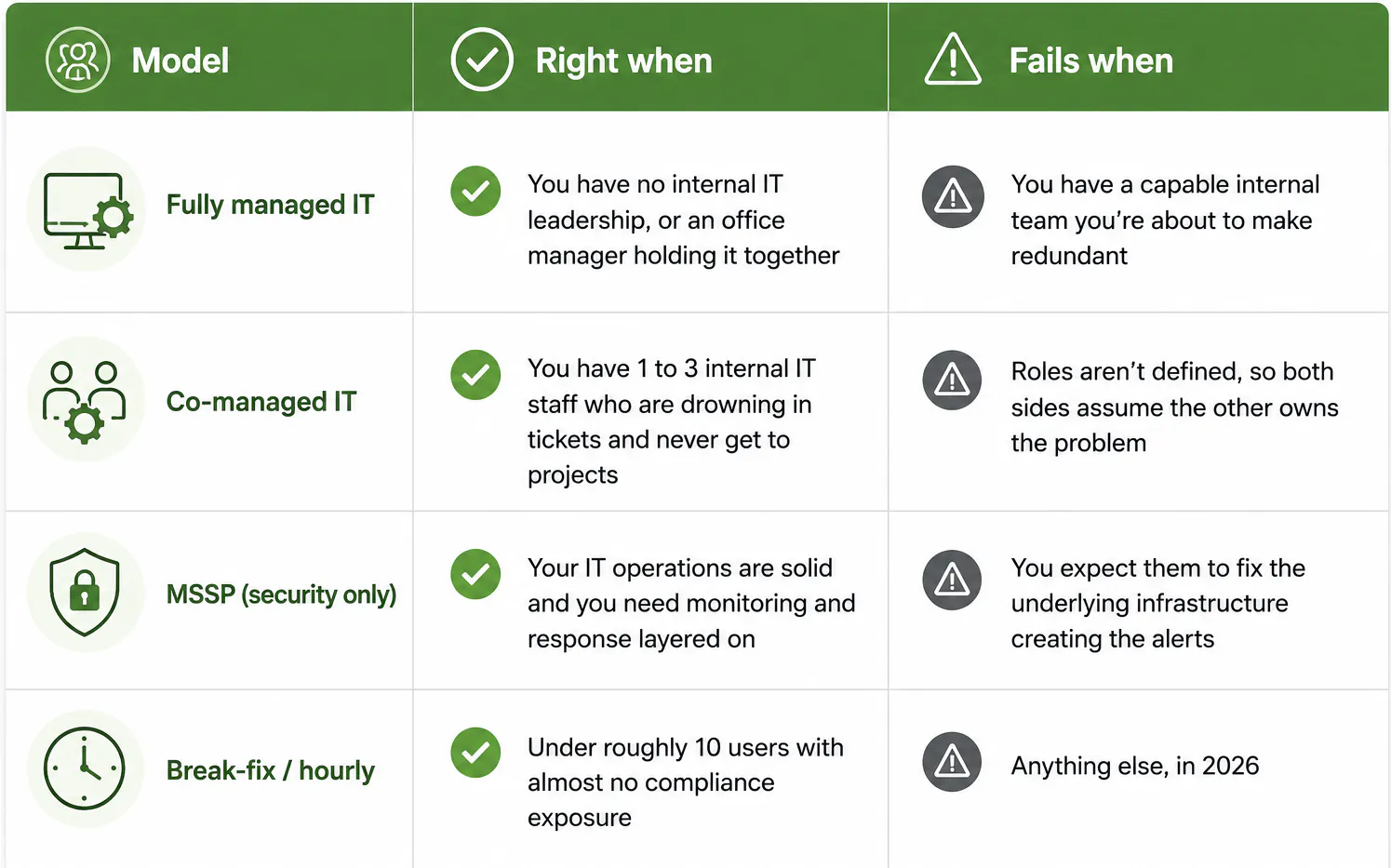
The co-managed IT conversation is the one people get wrong most often. It isn't cheaper fully managed IT. It's a division of labor, and it only works when someone writes down who owns patching, who owns identity, who owns the escalation path, and who's accountable when a control silently stops running. We wrote about the practical gap between break-fix and managed IT if you're still weighing that step.
The 7 criteria that actually predict outcomes
After 25 years of running these engagements, and inheriting a lot of environments from providers that didn't work out, the failures cluster. They almost never come from the thing buyers spend the most time comparing, which is price. Here's how we'd weight the decision.
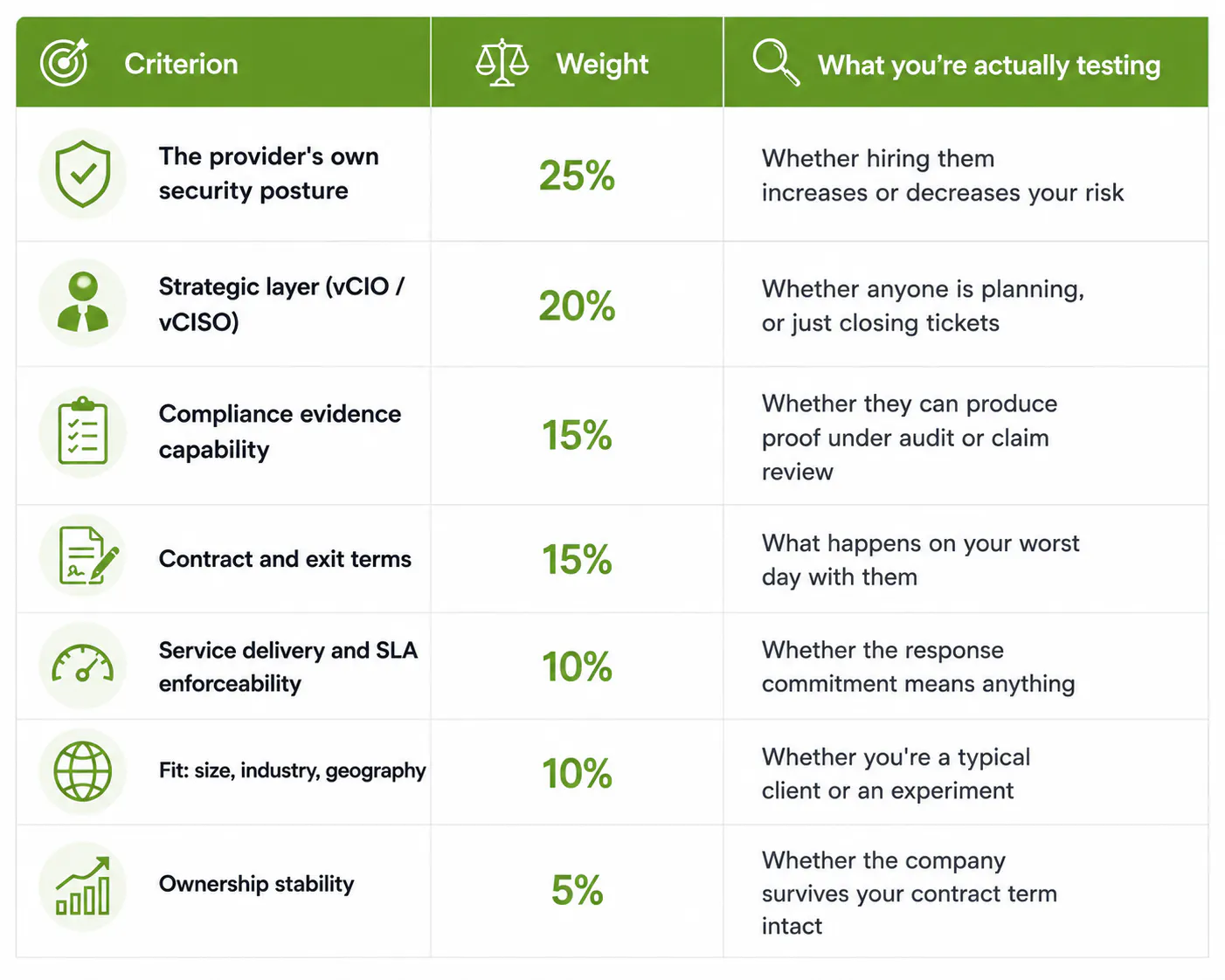
Notice what's missing. Tooling. Every provider in your shortlist will name the same handful of vendors, and the logos tell you almost nothing about whether the tools are configured, monitored, and actually running. Strategy drives tools. Not the reverse.
12 questions, and what the answers tell you
Bring these to the second meeting, after the capabilities pitch and before the proposal. You're not grading the answer. You're grading whether the answer is specific.
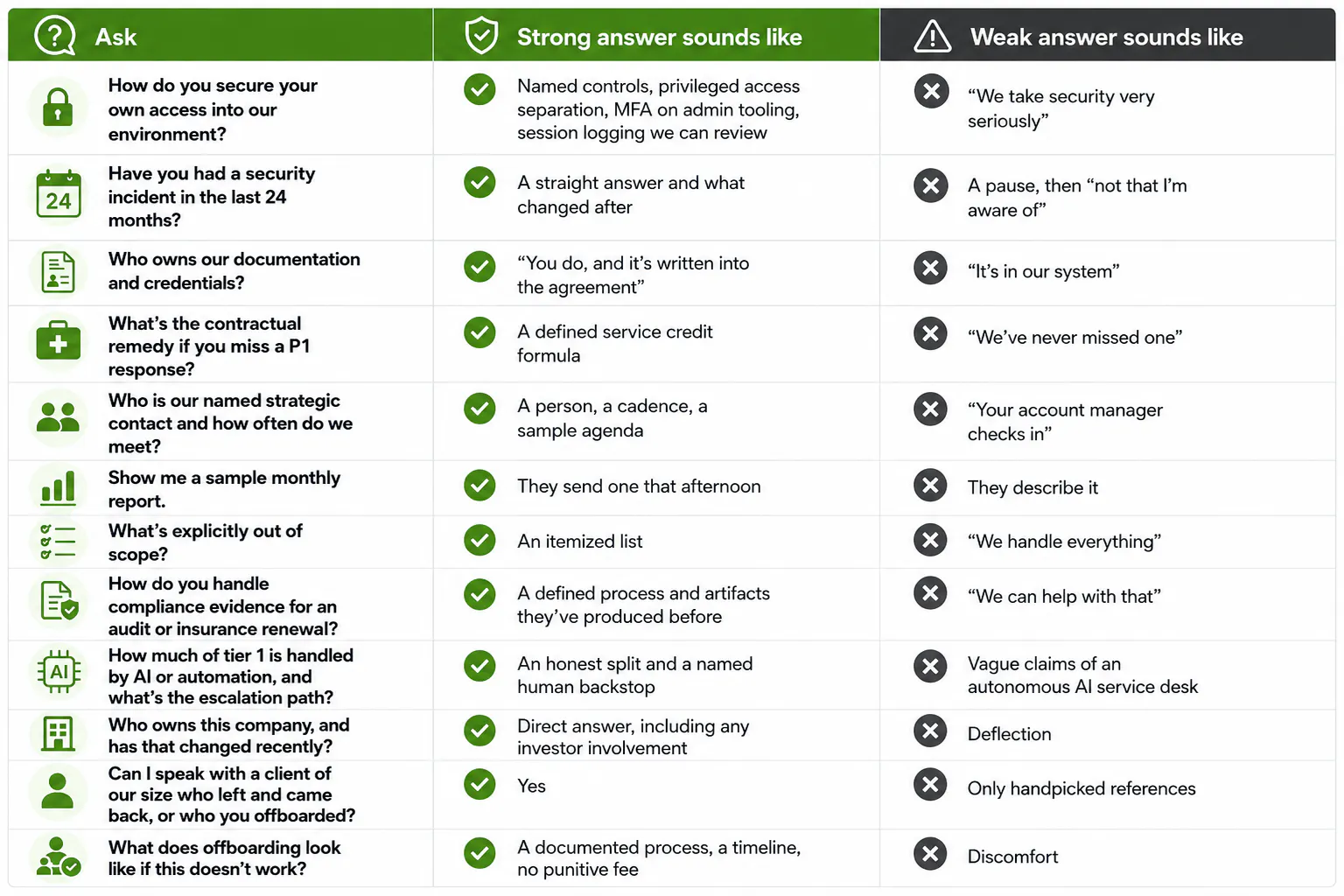
That last one is the tell. A provider confident in delivery has no reason to make leaving expensive.
How to vet a provider's own security
Almost nobody does this. It's the highest-leverage 30 minutes in the whole evaluation.
You're handing this company privileged access to everything. Apply the same standard you'd apply to any vendor with that reach, because regulators and insurers increasingly will. Ask for:
- How privileged access to client environments is granted, logged, and revoked, and whether technicians share credentials
- Whether MFA is enforced on their RMM, PSA, and documentation platforms, not just their email
- Their patching cadence for their own management tooling, given the active exploitation of those platforms
- Whether they hold, or are working toward, an independent attestation such as SOC 2, and what the scope covers
- How they'd notify you if they were breached, on what timeline, and what's in the contract about it
- Whether their security operations run 24/7, in-house or through a partner, and where
If a provider gets defensive here, that's your answer. Any firm doing this properly will be glad you asked, because most prospects don't. This is the same lens we apply to our own managed cybersecurity practice, and it's the standard we'd want a client holding us to.
Contract terms that matter more than the monthly rate

A lot of published advice tells you to demand month-to-month. That's simplistic. Short terms push providers toward thin staffing and shallow investment in your environment, and the good ones will decline the work.
Term length isn't the risk. Exit rights are.
A 3-year agreement with a genuine opt-out is a better deal than a 1-year agreement that auto-renews for 3 more if you miss a 90-day notice window. Our own standard agreement runs 3 years with a 1-year opt-out at 60 days notice, because a client who wants to leave in year 1 is a client we failed. Locking them in doesn't fix that.
Read these clauses before anything else:
- Auto-renewal and notice window. Note the exact date. Put it in a calendar with a 120-day warning.
- Documentation and credential ownership. This is where the real damage lives. Some agreements assign network diagrams, configurations, and runbooks to the provider. Reported handover fees run well into 5 figures when that language is in place.
- Scope definition. Vague scope turns predictable monthly cost into a project-fee faucet. Demand an itemized in-scope list and a defined trigger for anything billable.
- Price escalation. Cap it, tie it to CPI, or require renegotiation.
- SLA remedies. An SLA without a defined remedy isn't an SLA. Language like best efforts or industry standard creates no obligation at all. You want response targets by priority tier and a credit formula when they're missed.
- Termination for cause. A right to exit without penalty after documented SLA failure across 2 consecutive months.
Negotiate the exit in month 1, while they want the deal. Not in year 3, when they don't.
What managed IT costs in 2026
Published benchmarks put mid-sized organizations of 50 to 250 users at roughly $150 to $250 per user per month, with a national midpoint closer to $142 across metro markets. Coastal California metros sit toward the upper half of that range. Labor costs what it costs here.
Those are planning numbers, not quotes. What moves you inside the band:
- Security depth, particularly whether 24/7 monitoring and response is included or sold separately
- Compliance obligations, since CMMC, SOC 2, and PCI work carries real labor
- After-hours and on-site coverage
- How much cleanup year 1 requires, which is usually more than anyone estimates
- Whether strategic leadership is bundled or billed as consulting
The proposal comparison that actually works: normalize every quote to the same scope before you compare rates. When one bid comes in 30% under the others, it's almost always missing something, and the missing thing is usually security or strategy. If you want a number to anchor the conversation internally, our downtime cost calculator gives you the other side of the ledger.
6 red flags
- They quote before they assess. A firm price for an environment nobody has examined means either padding or a surprise later.
- Security is a line item, not a foundation. If it's an optional add-on tier, security isn't how they think.
- The strategy conversation is an upsell. vCIO time billed separately usually means it never happens.
- They promise compliance certification. No provider can certify you. They can get you ready, remediate gaps, and support governance. Anyone promising more is selling something they can't deliver, which matters for compliance readiness work specifically.
- Overstated AI claims. Automation genuinely helps with tier 1 volume, but most organizations experimenting with agentic systems haven't scaled them. A provider describing a pilot as an autonomous service desk is telling you how they'll handle other claims.
- Reluctance around references and offboarding. Covered above. It's the strongest signal you'll get.
California-specific considerations
If you operate here, 3 things change the calculus.
The CPPA regulations apply to you sooner than you think. The cybersecurity audit and risk assessment obligations phase in by revenue, and the preparation window is longer than the deadline suggests. Building the documentation and control evidence takes quarters, not weeks. A provider who hasn't read the rules will find out alongside you.
Defense and aerospace manufacturers need current CMMC guidance. Phase 1 has been live since November 2025, requiring self-assessments at award. The Phase 2 third-party certification milestone, originally set for November 2026, was suspended pending review as of July 2026, while self-assessment and SPRS requirements continue to apply. Any provider still quoting the old deadline as fixed isn't tracking this closely enough to guide you through it. Our vCIO services exist partly to keep that kind of moving target in front of leadership.
On-site response is a real constraint. A provider 40 miles away in Friday afternoon traffic is a provider who isn't coming today. If you run production lines, a warehouse, or multiple sites, ask for same-day on-site commitments in writing and check where their engineers actually sit. We publish coverage across Los Angeles, Torrance, El Segundo, Long Beach, and the rest of the cities we serve for exactly this reason.
Run the evaluation in 30 days
This doesn't need to take a quarter. It needs to be sequenced.
Week 1. Define the decision internally. Which model you need, what's driving the change, who signs, what your compliance exposure is, and when your current agreement's notice window closes. Get that last date right before anything else.
Week 2. Shortlist and screen. Three providers, no more. Short discovery conversations to confirm they serve companies your size in your industry. Most disqualification happens here and it should take 30 minutes each.
Week 3. Technical assessment. Let finalists into the environment. A real assessment takes a few hours, not a walkthrough, and what they find tells you more about them than the proposal will. If a provider will quote without this step, note it.
Week 4. Proposals, contract review, and references. Normalize scope, run the 12 questions against the paper, and call references you selected rather than the ones offered. Ask them one question: what's the worst week you've had with this provider, and how did they handle it?
That structure mirrors how we run our own onboarding, from a short discovery session through strategy alignment and a technology assessment before anyone presents a solution. It exists to surface mismatches early. Fewer mid-contract surprises, on both sides.
Where to start
If your current setup feels reactive, if nobody can tell you what your top 3 technology risks are, or if an audit or insurance renewal is coming and you're not sure you can produce the evidence, that's the signal. You don't need a new vendor. You need a clearer picture of where you actually stand.
That's what an assessment is for. Speak to an IT expert and we'll tell you what we find, whether or not we're the right fit.