IT Consulting in Pasadena: When a Project Needs a Consultant, Not an MSP
Hire an IT consultant in Pasadena when the work has a finish line, like retiring a Windows Server 2016 machine, moving offices, or getting an outside opinion on your current provider. Hire an MSP when the work never ends.
Table of Contents
The Census Bureau's QuickFacts for Pasadena lists 6,309 employer firms in its 2022 count, and the IT calls from them that end up on my desk usually concern a single project with a date on it, such as a server Microsoft stops patching on January 12, 2027, or a lease on Lake Avenue that ends in March. Ongoing support is a different decision, covered on our page about managed IT services in Pasadena.
Key Takeaways
Hire a consultant for a project you could check off as done, and an MSP for work that repeats every month. Three dates drive most Pasadena projects right now. Windows Server 2016 loses security updates after January 12, 2027, Windows 10 extended updates have cost $122 per PC since October, and California's CCPA cybersecurity audit certifications start April 1, 2028. If you've already written the spec, buy the install and skip the advice.
What does an IT consultancy deliver that an MSP doesn't?
A consultant is paid for a finished thing (a plan, a migrated system, a written assessment) and the engagement closes when it's delivered. An MSP, short for managed service provider, is paid per user each month to keep things true every day, like patched machines, working backups, and a help desk that picks up at 7:45 on a Monday. The broader version of this decision, with rates and the ways each model fails, is in our comparison of IT consulting vs. managed IT services.
Which projects on the 2026-2027 calendar are consultant work?
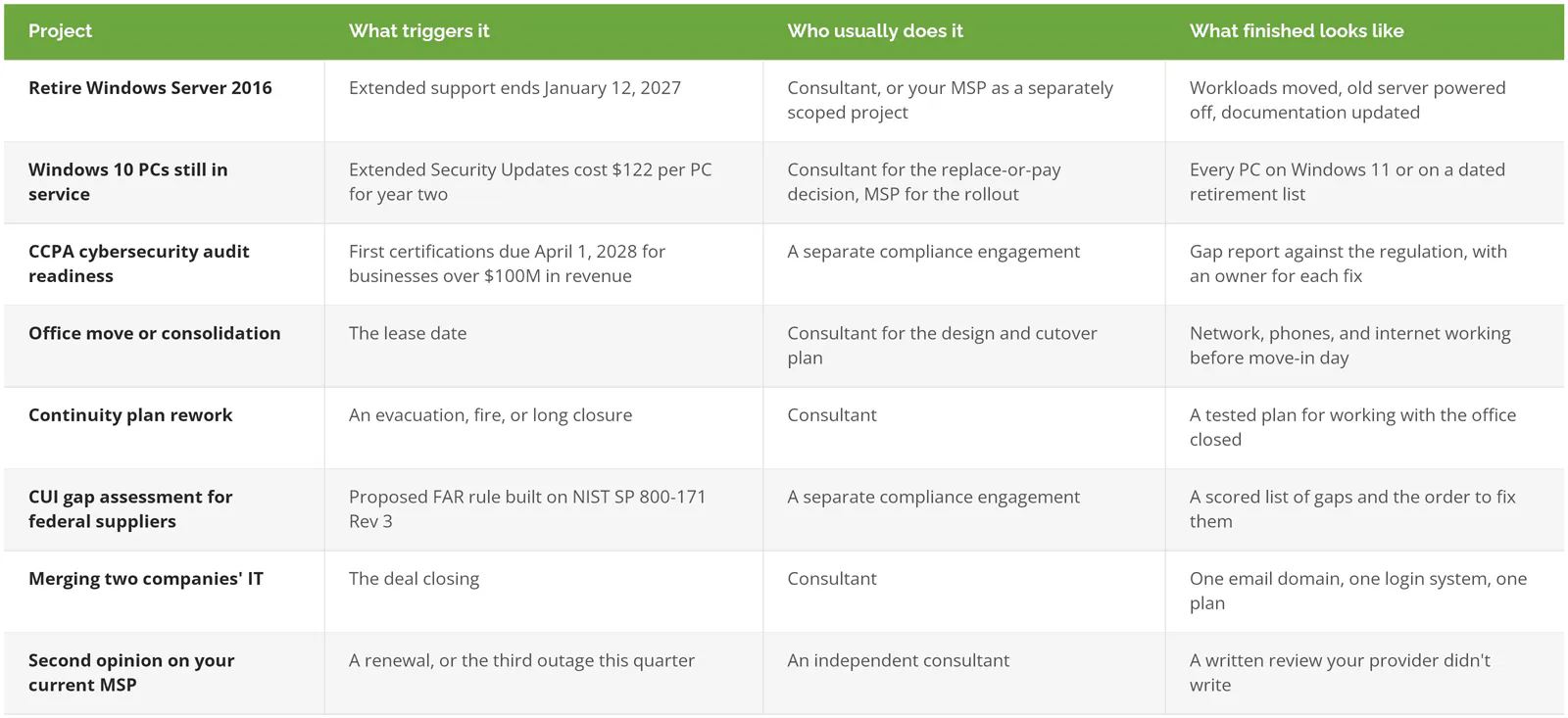
Anything with a deadline and a finished state you could check off, which over the next 14 months means Windows Server 2016 before January 12, 2027, Windows 10 PCs on paid extended updates, and CCPA cybersecurity audit prep for businesses large enough to need it.
Federal work adds one more for the engineering and manufacturing suppliers around JPL. The FAR Council's June 2026 proposal would require contractors handling controlled unclassified information (sensitive but unclassified government data) to meet NIST SP 800-171 Revision 3, according to Hunton's summary of the proposed rule. It isn't final yet, but a gap assessment against it is a bounded project with a clear deliverable. The third column below is what usually works for each project, not a rule.
Windows Server 2016 has a hard stop
Microsoft's lifecycle page for Windows Server 2016 prints the extended end date as 1/13/2027 6:59:59 AM, a timestamp in universal time (UTC) that works out to the end of January 12 here in California. After that there are no more security fixes unless you pay for extended updates, which buys time but doesn't give you a plan.
The slow part of a retirement is rarely the new server, because the real work is finding out everything the old one quietly does. In a small office, a 2016 server tends to carry more roles than anyone remembers assigning it.
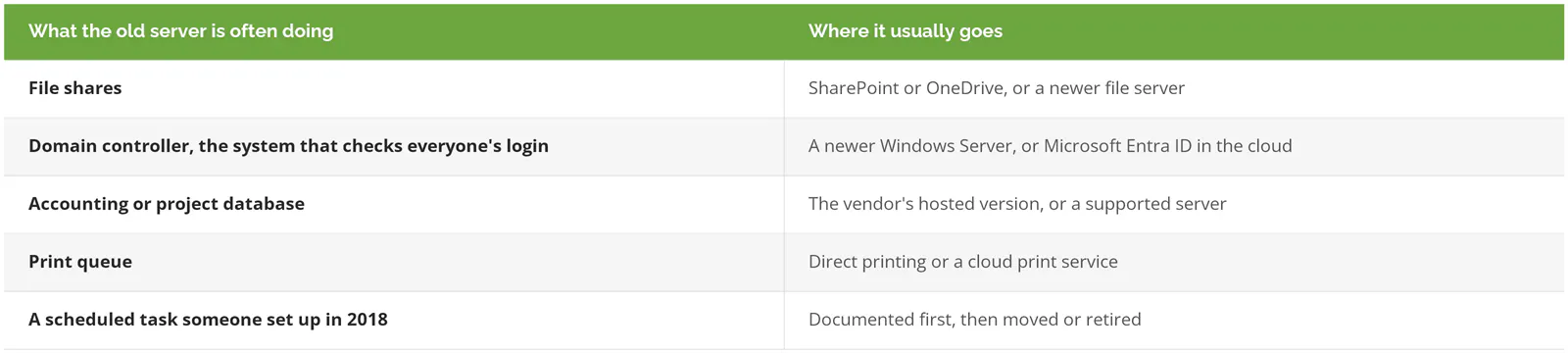
Building that list, deciding where each piece goes, and writing the cutover order (the sequence for switching each piece from old to new) is the part a consultant earns money on, and with about nine weeks left before January 12, it's the part to start this month.
Windows 10 now has a per-PC price
Windows 10 reached end of support in October 2025, and any business that kept those PCs on the network has been paying Microsoft for Extended Security Updates since. The commercial pricing Microsoft published starts at $61 per device for year one and, in Microsoft's words, "will double every consecutive year, for a maximum of three years," which puts year two (the one that began in October 2026) at $122 per PC.
ESUs are cumulative, Microsoft adds, so a 25-person office that skipped year one pays $4,575 to get current ($3,050 if it enrolled on time) for PCs it plans to replace anyway.

CCPA cybersecurity audits arrive in stages
The California Privacy Protection Agency announced on September 23, 2025 that its cybersecurity audit rules had been approved, effective January 1, 2026, with "additional time for businesses to comply" on the audits themselves. They apply to businesses whose handling of personal information counts as significant risk, which, per Shook, Hardy & Bacon's summary of the rules, roughly means meeting the CCPA revenue threshold while processing data on 250,000 or more consumers (or sensitive data on 50,000 or more), or earning half your revenue from selling or sharing personal information.

An executive signs that certification under penalty of perjury, and the auditor has to be independent of the work being audited, which means your MSP can help fix what the audit finds but can't be the one grading its own setup. That's reason enough to treat it as a separate engagement, and at Consilien it is one, since compliance work is its own service and isn't part of managed IT. If you're still sorting out which California privacy law applies to you, our explainer on CCPA vs. CPRA for California businesses is the place to start.
A week with the office closed
After the Eaton Fire in January 2025, the City of Pasadena's Economic Development Division surveyed local businesses, noting that 23% of all licensed businesses in the city sat inside the evacuation order or do-not-drink water areas. Of the 557 that had answered by February 19, 68% "reported closures, with most of those closures lasting less than a week," and 47% reported significant revenue losses, according to Colorado Boulevard's report on the survey.
A week is a short closure by disaster standards. It's a long one for a firm whose files sit on a server in a closet nobody can get to, so the useful question for a continuity plan is simple enough to test (could everyone work from home on Monday if the building stayed closed, with email, files, and the main software the business runs on reachable and the backups stored somewhere other than the building?). Rewriting the plan around that question and running the test is a project with a start and an end, while keeping the backups checked every month afterward belongs with whoever manages backup and disaster recovery for you.
When is an MSP the better call?
An MSP is the better call when the work repeats on a calendar. Monthly patching, the help desk, checking that last night's backup actually finished, setting up laptops for new hires and shutting off accounts on someone's last day, and reviewing security alerts never reach an end date, so buying them as a project just means buying the same project again next quarter.
If you're pricing that side, our look at what's included in a managed IT plan for Pasadena businesses walks through what a monthly fee covers and what lands outside it. Firms with their own IT staff can split the difference with co-managed IT, where your people keep ownership and the provider adds coverage and depth.
Skip both if the project is already defined
Picture a 15-person architecture office on Colorado Boulevard with a capable in-house admin who has already written the spec for a new firewall, down to the model number and the rule list. That firm doesn't need an advisory engagement, because the advice is already on paper. It needs the hardware and someone to install it on a Saturday, and the reseller or integrator selling the firewall can usually do both for less than a consultant would charge to tell the admin what the admin already wrote down.
Consulting earns its fee when you don't yet know what to buy, what order to do things in, or whether your current setup is sound. Once those answers exist in writing, what you're buying is execution, and it's fair to shop for it the way you'd shop for any installation job.
How do you scope a consulting project so it actually ends?
Before anyone starts billing, write down the deliverable, the end date, who owns the documentation, and who runs the result afterward. A project missing those four things tends to roll into an open-ended retainer that nobody ever decided to buy.
In the statement of work (the document that defines the job), the difference between a weak line and a strong one looks like this.
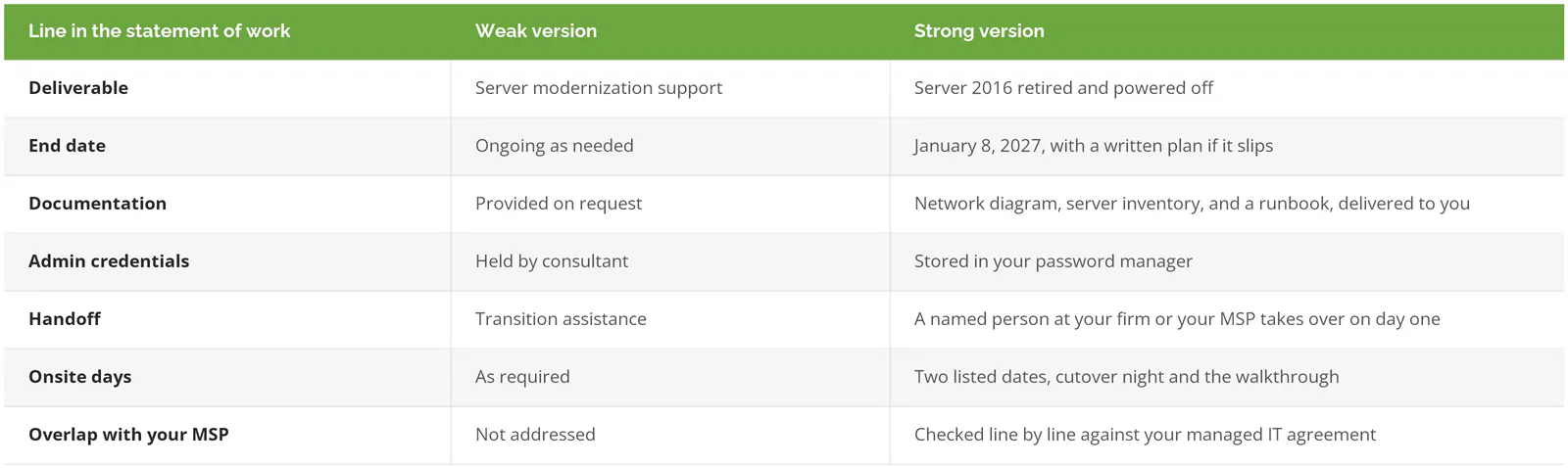
A runbook, in that table, is just step-by-step instructions for the routine tasks on whatever got built, so the next person isn't reverse-engineering it.
The last row gets skipped more than any other, and when it does the outcomes are predictable enough to plan around, because either you pay twice for the same work or each side assumes the other one has it until something breaks in month four.
Does your IT consultant need to be in Pasadena?
For assessments, planning, and cloud migrations, no, because that work runs comfortably over video calls, remote sessions, and shared documents. Hardware work is different, and the days someone has to be physically in your office belong in the statement of work with dates next to them.
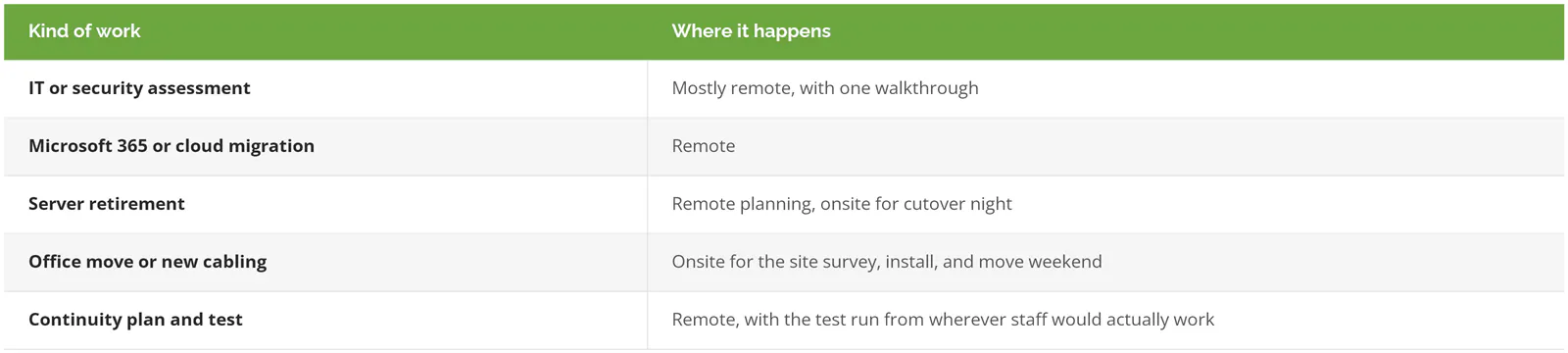
Distance matters less for a project than it does for daily support, since a project's onsite days get scheduled weeks ahead rather than called in the same morning. Consilien is based in Torrance, roughly 30 miles from Old Pasadena. The more useful question is whether the engineer who shows up on cutover night is the same senior person who did the planning, or someone meeting your network for the first time, so ask who will do the work and not only who will run the meetings.
What a Consilien IT consulting engagement looks like
Consilien is a security-first managed IT and IT consulting firm based in Torrance, California, and it works with businesses nationwide, Pasadena included. The situation it's usually called into is an environment that grew one reasonable decision at a time (a server added for one project, a cloud app for another, a firewall rule nobody remembers asking for) until nobody in the building can explain how it all fits together.
The steps before any contract are published, and they add up to somewhere between 6 and 8.5 hours of your team's time, spread over a few weeks.
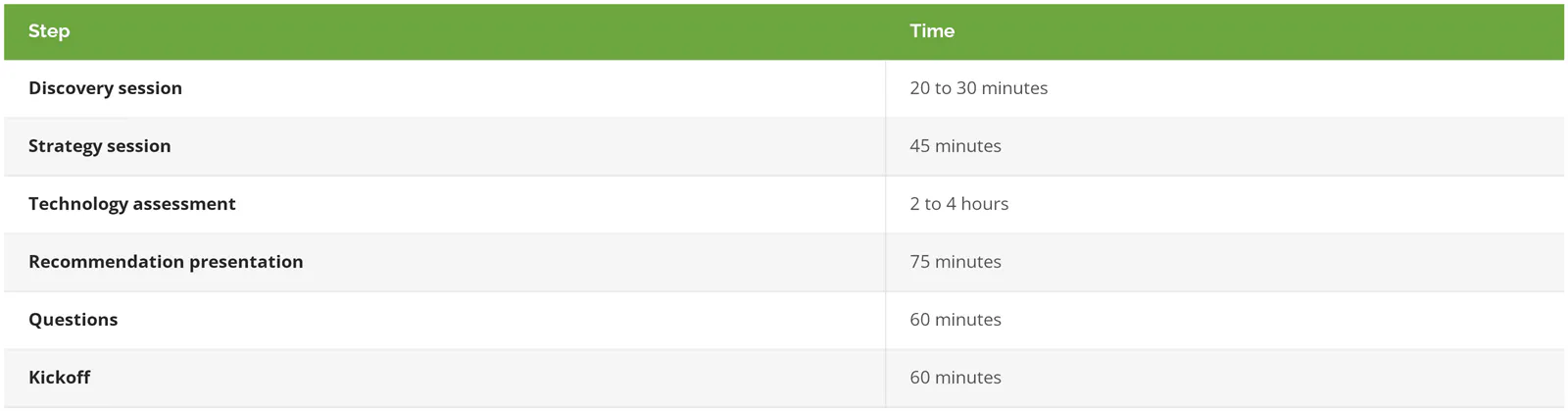
Recommendations are scored against CIMS, Consilien's internal maturity model for security, performance, compliance, governance, and resilience.
Short, time-boxed projects are a normal part of that. Eagle Print Dynamics, a print and promotional products company in Orange, brought Consilien in for cloud consulting and systems integration on a project that ran from November 2017 to February 2018, according to its review on Consilien's Clutch profile. Its Director of Finance, Jodee Gonzalez, put it simply. "They were great to work with."
More on how engagements are structured is on the IT consulting services page. If a project with a date on it is sitting on your desk, speak to a Pasadena IT expert and bring the date with you.