IT Consulting vs Managed IT Services: Which Do You Actually Need?
Two proposals land on your desk in the same week. One is an IT consulting engagement scoped at 60 hours. The other is a managed services agreement priced per user, per month, starting the first of next quarter. Both firms sound competent. Both quote roughly the same hourly rate. Neither proposal tells you which problem you actually have. That isn't their job. It's yours.
Table of Contents
IT consulting buys a decision or a completed change, with an end date. Managed IT services buy an ongoing condition, with no end date. Buy consulting for a deliverable. Buy managed services for operations somebody else runs.
That distinction sounds obvious written down. It stops being obvious the moment a salesperson uses both words in the same sentence, which happens constantly, because plenty of firms sell both and have no particular reason to help you separate them before you sign.
Clutch's September 2026 IT services pricing data puts managed service providers and IT strategy consulting in the identical hourly band, $100 to $149. Same rate. Different purchase entirely. The number on the invoice tells you almost nothing about what you're getting.
What IT Consulting Actually Buys You
IT consulting is scoped, time-bound advisory work. You hire someone to answer a defined question, they answer it, and the engagement closes. What you keep is a document and a decision.
What you're buying is the deliverable. A migration plan. A vendor selection. A current-state assessment with a ranked risk register and a roadmap you can put in front of a board. Clutch reports that most IT services projects fall between $10,000 and $49,999, which is about right for a mid-market assessment or a scoped migration design.
Typical reasons companies buy it. An acquisition closes and two networks need to become one. A compliance requirement shows up in a customer contract and nobody internally knows what the gap is. Or the ERP vendor announces end of support, which means they stop issuing patches and stop answering the phone, and now somebody has to decide what replaces it, what it costs, what order the pieces move in, and whether any of that can happen during the busy season.
Consulting is also what you buy when you already have IT staff who are perfectly capable of running the environment but have never done the specific thing in front of them. A 300-person distributor with two systems administrators doesn't need a provider to take over. It needs someone who has done 40 warehouse cutovers to spend six weeks telling them what breaks on cutover night. That's a different problem, and a different thing to buy.
The engagement ends. That's the feature and the flaw.
What Managed IT Services Actually Buy You
Managed IT services are recurring operations with no end date. Monitoring, patching, service desk, backup verification, endpoint security. The deliverable isn't a document. It's a condition that stays true.
Here you're buying a user or a device, billed monthly. Not hours. Not an outcome document. You're buying the state of the environment, held steady, indefinitely, by a team that answers the phone at 6:40am when the shipping floor can't log in.
Scope is what people argue about. A managed IT agreement covers the steady state. Anything that changes the environment materially, a new location, a Microsoft 365 tenant migration, a firewall replacement across six sites, generally lands outside the monthly fee as project work. That's not a provider being slippery. It's the model working as designed. But it rarely gets explained before signing, so the first change order lands like a bait and switch.
Response speed is the thing buyers underrate until they've lived without it. I know a consumer products company in Long Beach where a user got a ticket number and a written description of her issue inside 3 minutes, a live technician on the phone within 15, and a full resolution before the call ended. The technician also showed her how to fix it herself and left the steps on her machine. That's not a consulting deliverable. You can't scope it into a statement of work. It's what an operating relationship produces on a Tuesday.
Nothing about that shows up on a rate card.
The Rate Is the Same. The Unit Isn't.
Put an MSP's rate card next to a consultant's and both land at $100 to $149 an hour in Clutch's data. Compare on rate and you'll conclude they're interchangeable. They aren't even close.
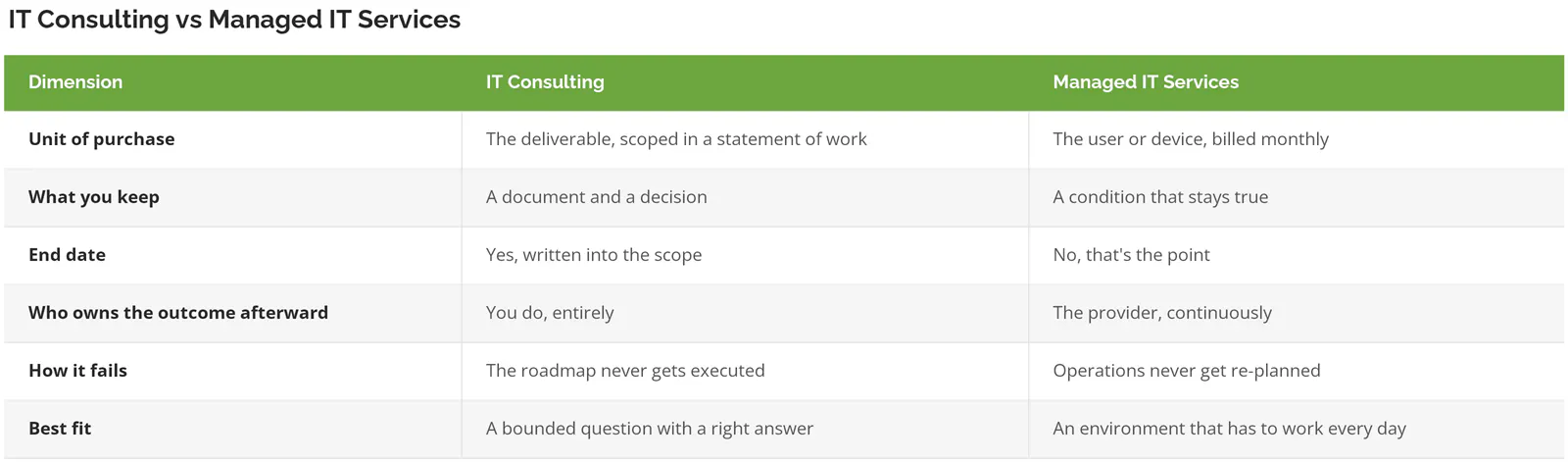
Read the last two rows again. Those are the two failure modes, and almost nobody selling either model will walk you through them before you sign, because the failures don't show up for eight or ten months.
Where Each Model Fails
Consulting fails when the roadmap gets delivered and nothing happens to it.
Document's good. Findings are correct. Sequencing is defensible. And then the CFO who commissioned it gets pulled into a refinancing, the IT manager who was supposed to own phase one leaves in March, and by the time anyone opens the file again the license counts are stale and half the recommendations reference a product tier that no longer exists. The engagement cost $38,000. So what did it buy? A correct answer to a question nobody stayed around to act on. Excellent work. Zero outcome.
Managed services fail the opposite way. The environment runs. Tickets close inside SLA. Green report, every month, two years running. And nothing improves, because nobody's job is to ask whether a design chosen for a 110-person single-site company still fits the same business after it added 90 employees, a second facility, and a customer contract with security requirements attached to it.
That's the quieter failure and the more expensive one. Stability without direction is just a well-maintained version of a decision you made in 2023.
Both failures have the same root. Somebody assumed the other model's job was included in what they bought.
Nobody Owns the Roadmap by Default
A standard managed services agreement covers operations. A consulting statement of work covers a deliverable. Neither one covers ongoing strategy, and unless somebody writes that ownership down, it belongs to nobody.
This isn't a contract-drafting quirk. It's a governance gap, and the standards bodies caught up to it before the industry did. When NIST released Cybersecurity Framework 2.0, it added a sixth function called Govern alongside Identify, Protect, Detect, Respond, and Recover. Govern covers organizational context, risk strategy, roles and responsibilities, policy, oversight, and supply chain risk. Read the framework document itself and the reason for the addition is plain enough. Every other function assumes somebody already decided what matters, what the tolerance is, and who escalates. That deciding is continuous. Not a deliverable you buy once.
CISA lands in the same place from a different angle. The Cross-Sector Cybersecurity Performance Goals are written as a baseline of practices to maintain, not a project to finish. Maintained practices need an owner with a calendar. A closed engagement doesn't have one. Nobody does, by default.
Which is why advisory work sold on a retainer exists at all. A vCIO engagement is consulting delivered continuously instead of in a block, and its whole reason for existing is that the roadmap needs a standing owner. If you already have a full-time CIO who sets direction and holds vendors accountable, skip that line item entirely. You're paying for a seat you've already filled.
The Problem With Buying an Assessment From Your Own Provider
Ask your managed services provider to assess your managed services provider and you'll get a report. You will not get an independent one, and that's true even when the firm is honest, because no assessment names its author as the top risk.
This matters more on security than anywhere else. IBM's 2026 Cost of a Data Breach Report puts the global average breach at $4.99 million, and found that one in four malicious breaches were AI-enabled, up 56% year over year, averaging around $6 million each. A security assessment that quietly avoids the incumbent's architectural decisions isn't a cheap mistake. It's a $5 million blind spot with a cover page on it.
So separate them deliberately when the stakes justify it. Buy the maturity assessment from a firm with no operational stake in the answer. Buy remediation from whoever is best positioned to execute. Those can be the same company on a network refresh where the incentives are aligned. On a security posture review where the finding might be that your current stack was built wrong, they shouldn't be.
Not every engagement needs this treatment. A cloud migration design and a compliance gap assessment sit at opposite ends of the independence question, and treating them identically wastes money on one end and buys you a comfortable answer on the other. Pick your battles.

Four Questions That Route the Decision
Before you take a proposal from anyone, answer these four in writing. Consulting or managed services, the model follows from the answers. It does not work in the other direction.
- What has to exist when this is over? A document, a migrated tenant, a signed vendor contract? That's consulting. A help desk that answers, a patch cycle that runs, backups that get tested? Managed services.
- Does it have an end date? If you can't name the week it finishes, you're describing operations, and buying it as a project means buying it again next year.
- Who owns it in month seven? Write down a name. If the honest answer is nobody, you have a governance problem, and no amount of either model fixes it on its own.
- Who gets paid to find the problem, and who gets paid to fix it? Same firm on both sides is fine on execution work. It's a conflict on assessments.
Four questions. Ten minutes. They'll save you from the two most common procurement mistakes in this category, which are buying operations when you needed a project, and buying a project when what you needed was somebody to run the thing every day. Both are expensive. Only one is obvious at the time.

What It Looks Like When Both Run Together
Companies between 20 and 1000 users almost always end up needing both, in sequence. Consilien is a security-first managed IT and advisory firm built around exactly that pattern, for organizations that have outgrown reactive support but don't have executive IT leadership in the building. Manufacturing, distribution, food processing, professional services, media. The problem it solves is a common one. IT works well enough that nobody escalates it, and badly enough that growth keeps stalling on it.
Assess, align, implement, manage, optimize. Real durations, not a slide. A discovery session takes 20 to 30 minutes. Strategy alignment runs 45. The technology assessment itself takes 2 to 4 hours on site. Solution presentation is 75 minutes, Q&A is another 60, kickoff is 60. That's roughly one working day of the client's time spread across a few weeks, and the whole reason it's built that way is so the argument about what's in scope happens before anybody signs a contract instead of four months into one.
Afterward, a maturity standard holds it together. Consilien runs environments against CIMS, an internal model that defines current state, target state, and the sequence between them across security, performance, compliance, governance, and resilience, which is the piece that keeps a managed services relationship from quietly drifting into a green monthly report that nobody in the building has actually read since the second quarter. Somebody re-runs the comparison on a schedule. That's the whole trick.
One step gets skipped almost universally. Reconcile the consulting statement of work against the managed services agreement, line by line, before either starts. The same work shows up in both documents more often than you'd expect, and when it does, you either pay twice or discover in month four that each side assumed the other had it. Neither one is fun to explain to a CFO.
For companies with internal IT that need depth rather than replacement, co-managed IT splits the difference. Your team keeps ownership. The provider adds security operations, after-hours coverage, and the specialist bench you can't justify hiring. Worth reading alongside how IT support compares to managed services, which covers the reactive-versus-proactive axis this post deliberately skips.
Contract Terms Worth Arguing About
Which model you pick matters less than how you get out. Ask for the opt-out before you negotiate the rate.
Consilien's standard agreement runs three years with a one-year opt-out at 60 days' notice. That term exists for a reason worth saying plainly. A provider confident in delivery doesn't need a three-year lock to keep you. And if the firm across the table won't put any early exit in writing at all, you've just learned something useful about how they expect the relationship to go, which is that they expect to need the contract more than you'll want the service.
Two other terms to pin down. What specifically falls outside the monthly fee and becomes project work, written as a list rather than a category. And who owns the technology roadmap, by name and title, with a review cadence attached.
Then there's the option nobody puts in a proposal. Hiring. BLS puts the median wage for computer and information systems managers at $175,140 as of May 2025, growing 16% through 2035. That's one person, before benefits, before the security tooling, before the after-hours coverage they can't personally provide. Sometimes it's still the right call. Price it honestly, though.
If you're holding two proposals and can't tell which problem you're solving, name the deliverable first and let the model follow. Speak to an IT expert and walk through the four questions above before you sign either one.