The Real Cost of IT Downtime in Semiconductor Manufacturing

Semiconductor fab downtime costs $1M-$3.8M per hour. Mid-market electronics manufacturing downtime runs $100K-$500K per hour. General manufacturing averages $260K per hour. But those are just the production loss numbers. The actual cost, including scrap, labor, contractual penalties, customer trust, and compliance fallout, runs 2-3x higher than what most companies track. This piece breaks down the real math, identifies the IT-related causes most electronics manufacturers undercount, and explains what separates companies that lose hours from companies that lose weeks.
Table of Contents
Ask an electronics manufacturing executive what downtime costs them, and you'll get a rough answer. Maybe $50K an hour. Maybe $200K. They know it's expensive. They can feel it when a production line goes down.
Ask them to calculate it precisely and most can't. The production loss is visible. The hidden costs aren't.
Two-thirds of manufacturing plants surveyed by Siemens and Senseye reported experiencing unplanned downtime at least once a month. Among companies that tracked their outages, 82% reported events lasting an average of 4 hours, costing roughly $2M per incident (Siemens/Senseye True Cost of Downtime, 2024).
That $2M includes more than just lost production. It includes the costs most companies don't measure until someone asks.
The Benchmarks: What Downtime Actually Costs by Segment
The numbers vary enormously by what you're manufacturing and how your production environment is structured.
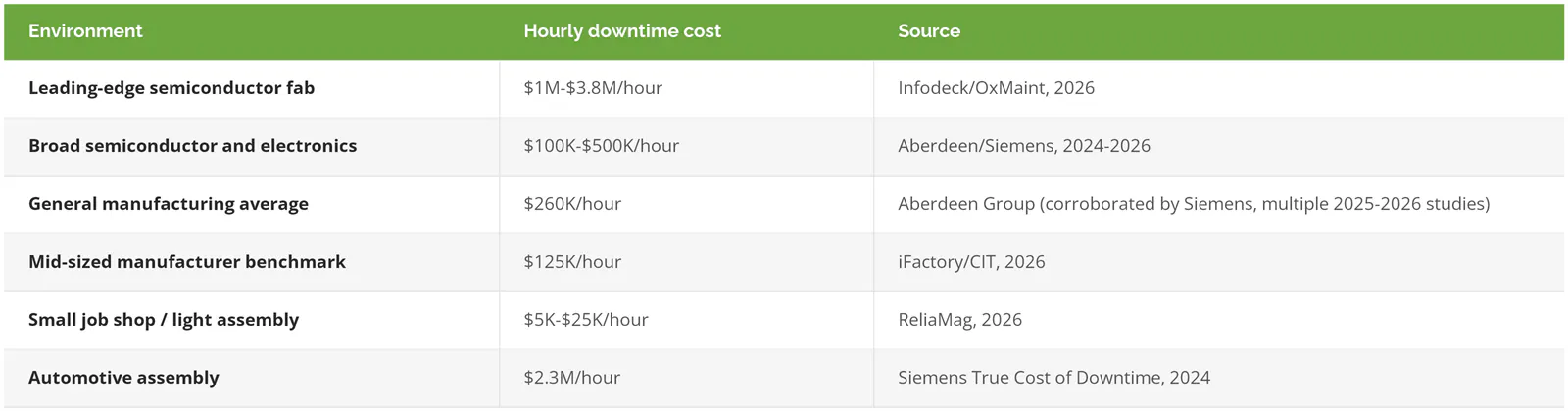
A 150-person PCB fabricator isn't losing $3.8M an hour. But they're almost certainly in the $100K-$300K range once you account for all the costs. And they're probably experiencing unplanned downtime more often than they think.
The Visible Costs vs. the Hidden Costs
Most plants track the visible costs. Lost production output. Direct repair or recovery expenses. Those numbers are real, but they're typically 30-40% of the total impact. The hidden costs, which Siemens and multiple 2025-2026 studies confirm run 2-3x higher than direct losses, are where the real damage accumulates.

Scrap and rework. When a production line stops mid-run, work-in-progress may be unsalvageable. PCBs mid-reflow when the oven shuts down. Components partially placed. Test sequences interrupted. The material isn't just wasted. It has to be scrapped, documented, and replaced.
Idle labor. Your production staff doesn't disappear during downtime. Operators, technicians, and QC personnel are on the clock, waiting. At $25-$50/hour loaded cost per worker across a 30-person production team, idle labor alone runs $750-$1,500 per hour. That adds up fast during a 4-hour outage.
Contractual penalties and expediting costs. Missed delivery windows trigger penalties in OEM contracts. Expedited shipping to recover schedule adds cost. Air freight to replace a ground shipment can multiply logistics costs by 5-10x.
Customer trust erosion. This is the cost nobody puts on a spreadsheet. A missed delivery or a quality escape caused by a rushed restart doesn't show up as a line item. It shows up 6 months later when the customer awards the next contract to someone else.
Compliance exposure. If the outage was caused by a cybersecurity incident, compliance notification obligations kick in. DFARS 252.204-7012 requires DoD notification within 72 hours. ITAR has its own reporting requirements. The compliance remediation cost after an incident is separate from the operational recovery cost.
Recovery labor and overtime. Getting back to normal doesn't happen on a standard shift. Overtime for IT, engineering, and production staff during recovery adds 1.5-2x labor costs for days or weeks after the incident itself.
The IT-Related Downtime Causes Most Electronics Manufacturers Undercount
When manufacturers think about downtime, they think about equipment failure. A motor burns out. A conveyor jams. That's the traditional cause, and it's still the biggest category.
But IT-related downtime is the fastest-growing cause, and it's the one most electronics manufacturers are least prepared for.
A 2026 study of 100 midsize-to-large manufacturers found that while cyberattacks directly account for only 5% of production outages, the majority of downtime comes from IT infrastructure failures: network errors (16%), configuration loss (16%), and planned maintenance gone wrong (18%) (Advanced Manufacturing, March 2026).
Network, infrastructure, and configuration failures account for roughly half of all unplanned downtime. Not equipment. IT.
Here's what that looks like in an electronics manufacturing environment.
ERP goes down. Your production team can't see job schedules, BOM data, or material availability. They're standing at machines with no instructions. Even a 30-minute ERP outage cascades into hours of catch-up.
Network switch failure on the production floor. Pick-and-place machines lose connection to the MES. AOI systems can't send inspection data to the server. The line doesn't crash. It just stops moving product.
Backup or patch that breaks something. A Windows update restarts a server that controls production scheduling. A backup job runs during peak production and saturates the network. These aren't attacks. They're IT operations without coordination.
Ransomware. When it hits, everything stops. Communication. Shipping. Receiving. Manufacturing. Data I/O, a semiconductor programming systems manufacturer, filed with the SEC after ransomware disrupted all four of those functions simultaneously in August 2025.
Credential or access failure. A password policy change locks out the production manager's account. A VPN update breaks remote access for the engineering team. A firewall rule change blocks the MES from reaching the database server. Configuration errors that take minutes to create and hours to diagnose.
How to Calculate Your Real Downtime Cost
Most manufacturers use a simple formula: lost production per hour times hours of downtime. That captures maybe a third of the actual cost.
Here's a more complete calculation.

Direct production loss. Units per hour × margin per unit × hours of downtime. This is the number most companies already know.
Scrap and rework. Value of work-in-progress lost during the outage. Include material cost, labor already invested, and disposal cost.
Idle labor. Number of employees idle × loaded hourly cost × hours of downtime. Include production, QC, engineering, and warehouse staff.
Recovery labor. Overtime hours for IT and production staff to restore operations. Multiply standard rate by 1.5-2x.
Contractual exposure. Late delivery penalties. Expedited shipping. Emergency procurement for replacement materials.
IT recovery costs. Forensics (if cyber-related). Hardware replacement. Software reinstallation. Vendor emergency support fees.
Insurance impact. Premium increase after a claim. Deductible on the current claim.
If you run this calculation honestly for a single 4-hour outage, the number will be higher than you expect. That's normal. Companies that calculate it for the first time typically find their actual cost is 2-3x what they assumed.
What Separates Companies That Lose Hours From Companies That Lose Weeks
The research is clear on this. The difference isn't budget. It's preparation.
Companies that recover fast have these in common.
Validated, tested backups with documented recovery time. They know how long a restore takes because they've done it. Immutable or offline copies that ransomware can't encrypt.
Network segmentation between OT and IT. An incident on the corporate side doesn't reach production. The blast radius is contained.
24/7 security monitoring. A managed SOC catches anomalies before they become outages. The difference between a contained incident and a full-environment lockout is detection speed.
Documented, tested incident response plans. The team knows who does what. Decisions aren't made in panic.
Proactive IT management with change control. Patches are tested before deployment. Maintenance windows are coordinated with production schedules. Network changes go through a review process. The "IT operations causing downtime" category shrinks dramatically with basic change management discipline.
Companies that lose weeks are typically missing all of these. No validated backups. Flat network. No monitoring outside business hours. No incident response plan. IT changes made without coordination. Each missing element extends recovery time. All of them missing together is how a 4-hour outage becomes a 4-week recovery.
What This Means for Electronics Manufacturers With Lean IT Teams
If you have 1-2 IT people managing your entire environment, they're doing their best. But they can't run 24/7 monitoring. They can't test backups every month. They can't implement network segmentation while also managing the help desk and keeping the ERP running.
The gap between what a lean IT team can cover and what's needed to prevent and recover from downtime is the gap that co-managed IT fills. Your team keeps doing what they do. An outside provider adds the monitoring, the security, the backup validation, the change management, and the strategic oversight that reduces both the frequency and the impact of downtime events.
Consilien has been managing IT for manufacturers for 25+ years. We've seen what causes downtime, what prevents it, and what determines whether recovery takes hours or months. MSP 501 for 2025 and 2026.
For electronics manufacturers facing cybersecurity-driven downtime risk specifically, read our guide on what happens when ransomware hits an electronics manufacturer or explore our approach to managed cybersecurity.