The IT Needs of Boutique Professional Services Firms in Beverly Hills
Boutique law, accounting, and wealth advisory firms in Beverly Hills need IT that protects client confidentiality, stops wire fraud by email, and produces the written security plan their regulators expect. Basic help-desk support covers none of that.
Table of Contents
A nine-person law firm on Wilshire Boulevard can hold more sensitive data than a 300-person distributor in the Inland Empire. Settlement numbers. Trust account details. The divorce file of someone whose name sells magazines. Small office. Big blast radius.
That's the honest starting point for IT services for professional services firms in Beverly Hills. The headcount says small business, while the data, the clientele, and the regulators all say something else, and the gap between those two readings is where boutique firms get hurt. It's also why IT for professional services firms has to start with what the firm is obligated to protect, not with a count of laptops.
By boutique I mean a specific kind of office. Entertainment litigators. Estate planners. Business management firms that pay bills and file returns for people in the music business. CPA practices, and registered investment advisers with a few hundred households. Partner-run, no IT department, and usually one office manager who looks after the computers on top of everything else.
Every one of those professions now carries a written security duty. Different regulator, different paperwork, different clock. None of them cares how many people you employ.
What makes a boutique firm's IT different from a typical small business?
A boutique firm's IT has to satisfy a regulator and a demanding client, not just keep the computers running. Few clients, each worth a lot, plus highly sensitive data and a legal duty to protect it, make it a security job first.
Picture a 20-person flooring distributor and a 20-person entertainment law firm. Same laptops, probably. They don't carry the same risk. If the distributor loses a week of email, it's annoying. If the law firm leaks a client's settlement terms, the client is gone, and at a boutique where three relationships pay half the bills, that's not a bad quarter. That's a different firm. Maybe a closed one.
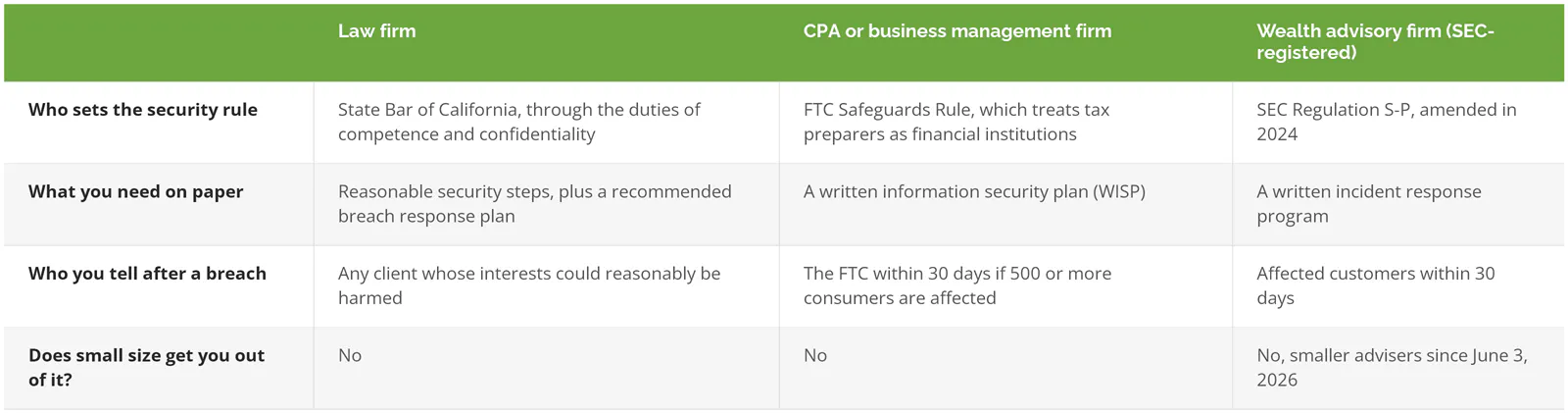
The bottom row is the one partners argue with. It doesn't change.
On top of all three, California's own breach law got stricter this year. Since January 1, 2026, a business that suffers a breach of residents' personal information has 30 calendar days to notify them, and 15 more to tell the Attorney General if more than 500 people are affected. That clock runs fast when nobody at the firm can tell which files were touched.
Beverly Hills adds one more layer. A lot of clients here are public, or adjacent to someone who is. Their data has value beyond fraud. It can be sold, leaked, or held over someone's head, so attackers have a reason to aim at the small office holding it rather than the studio or the bank with a 40-person security team. The broader list of IT challenges professional services firms face in 2026 covers the general version. The local version is sharper.
What does California expect from a small law firm's security?
California expects lawyers to understand the security risks of their own devices and systems, take reasonable steps against unauthorized access, and notify any client whose interests could reasonably be harmed by a breach. Firm size doesn't lower that bar.
That comes from the State Bar's Formal Opinion No. 2020-203, which ties data security to the duty of competence (rule 1.1) and the duty of confidentiality (rule 1.6 and Business and Professions Code section 6068(e)). It's advisory, technically. Not binding. But it's the clearest written statement of what reasonable looks like in this state, and reasonable is the standard you'd be measured against.
One of its examples should feel uncomfortably familiar. Law Firm C is a four-lawyer corporate practice. Late in the day, the receptionist gets a genuine-looking email that claims to come from the firm's IT provider and asks the receptionist to open an attachment for routine server maintenance. The receptionist opens it. Ransomware locks every computer in the office.
Four lawyers. One click.
Its advice is practical. Lawyers aren't expected to become technologists, but if they can't assess their own security, they're expected to consult "someone who possesses the necessary knowledge, such as an information technology consultant." And some safeguards are so easy that skipping them looks bad on its own. The opinion names the ability to locate and lock a lost laptop or phone as one where "failure to implement them could be deemed unreasonable."
In plain IT terms, a boutique firm trying to meet that standard needs a short list of things done well.
- Every laptop and phone that touches client files enrolled in device management, the system that lets IT locate, lock, and erase a device remotely. In the opinion's first example, a stolen laptop is wiped almost immediately. That's the version you want.
- Full-disk encryption on every laptop. Boring. Non-negotiable.
- Public Wi-Fi needs a rule. Attorney D in the opinion checks email at a coffee shop on a fake network, and a hacker gets into a client's patent files. A VPN (an encrypted tunnel back to the firm's systems) would have stopped it.
- Write a one-page breach plan. It should name who calls the cyber insurance carrier. The opinion flags that those policies have short notice windows, and that Lawyer's Professional Liability coverage usually won't pick up the slack.
- Training for whoever opens the shared inbox. In Law Firm C's case, that was the receptionist, not a partner.
If client security questionnaires are already landing on your desk, our page on IT services for law firms covers that side of the work in more detail.
Why does a CPA or business management firm need a written security plan?
Because federal law requires one. Under the FTC Safeguards Rule, tax and accounting professionals count as financial institutions regardless of size, and they must keep a written information security plan, or WISP, describing how client data is protected.
No wiggle room there. The IRS doesn't soften it. Publication 5708, its WISP guide for tax and accounting practices, says that under the Gramm-Leach-Bliley Act and the Safeguards Rule, tax and accounting professionals "are considered financial institutions, regardless of size." A few lines earlier it puts it even more plainly. "The law requires you to have one."
Business management firms in Beverly Hills tend to sit right in this zone. If the office prepares returns, pays a client's bills, and holds logins to their bank accounts, it's likely doing the kind of work the FTC treats as a financial institution, whether or not anyone calls it that.
What does the rule actually demand? The FTC's own guidance spells out the technical floor. Multi-factor authentication (a second proof of identity, like a code on your phone, on top of the password) for anyone accessing customer information. Encryption. A named person who owns the program. And since 2024, a report to the FTC within 30 days of discovering a breach that involves 500 or more consumers. Firms holding information on fewer than 5,000 consumers are exempt from some of the paperwork, but not from having the plan or the controls.
No WISP at all is one problem. A stale one is worse. Picture a WISP nobody has opened since the day it was downloaded. The template says multi-factor is on for every account. It isn't, because two partners complained and someone turned it off for them in March. A plan describing controls that don't exist isn't a security program. It's a signed statement that's false, and it'll be read back to you after an incident.
Publication 5708 also says something about your IT provider that's easy to skim past. An IT support company may see client data in the course of its work, and any third party with access has to meet the standards in your WISP at a minimum. Your IT vendor is inside your plan, not outside it. Have you ever asked yours to show you how they meet it? If you're comparing providers built for this work, our breakdown of MSPs for accounting and CPA firms lays out who does what.
What changed for wealth advisors in 2026?
June 3, 2026 changed it. That's the date smaller SEC-registered entities, including investment advisers with less than $1.5 billion under management, had to comply with the amended Regulation S-P. Larger firms had been on the hook since December 2025.
Two requirements matter most for a boutique RIA. I'm compressing a long rule here, but these are the parts that bite. According to the SEC's fact sheet on the amendments, firms need a written incident response program reasonably designed to detect, respond to, and recover from unauthorized access to customer information. And when sensitive customer information is, or is reasonably likely to have been, accessed without authorization, affected customers have to be notified as soon as practicable, but not later than 30 days after the firm becomes aware of it.
Writing that program is compliance work, and at Consilien it's a separate engagement from managed IT, handled through our compliance services. The IT side is what makes the program true. You can't notify the right customers in 30 days if your systems can't tell you whose records were opened. Logging, backups, and account controls are what turn a 30-day deadline into something a small firm can actually meet.
Why is email the biggest risk for a Beverly Hills firm?

Email is where the money leaves. Business email compromise, where a criminal impersonates a client, vendor, or colleague to redirect a payment, cost victims more than $3 billion in 2025, and California led every state in reported cybercrime losses.
Exact number? $3,046,598,558, according to the FBI's 2025 Internet Crime Report, the second-largest loss category the Bureau tracked. California filed 116,414 complaints, more than any other state, and reported about $3.67 billion in total losses. First place. Not the good kind.
Someone at a client's office, or at a vendor, has their mailbox taken over. The attacker reads the thread for a few weeks, learns who pays whom and when, and then sends updated wire instructions on a Friday afternoon from the real account. The email is polite. The signature is right. The bank details are new. Who's going to question a polite email from a client's real address?
Business managers and estate attorneys are prime targets because moving large sums on a client's behalf is the normal course of business for them. Nobody blinks at a $400,000 wire.
The fixes are unglamorous, and they work.
- Call back. Any change to payment instructions gets verified by phone, using a number you already had on file, never the one in the email.
- Multi-factor authentication on every mailbox, including the partners who find it annoying.
- Filtering that catches impersonation and lookalike domains (think smith-law.com showing up as smith1aw.com), with a banner on anything from outside the firm.
- DMARC. It's an email setting that stops criminals from sending mail that appears to come from your own domain, and plenty of small firms have never switched it on.
Cheapest fix on the list? The phone call. It costs nothing and stops the most money. Our email security services handle the technical layers, and this explainer on the two types of business email compromise the FBI warns about is worth five minutes with whoever approves wires.
And if the hijacked mailbox held client records, the breach clocks from the first section start running too. IBM's Cost of a Data Breach Report 2026 puts the global average breach at $4.99 million. A boutique's number will be smaller. Measured against revenue, it's often worse.
Which IT basics matter most for a firm without an IT department?
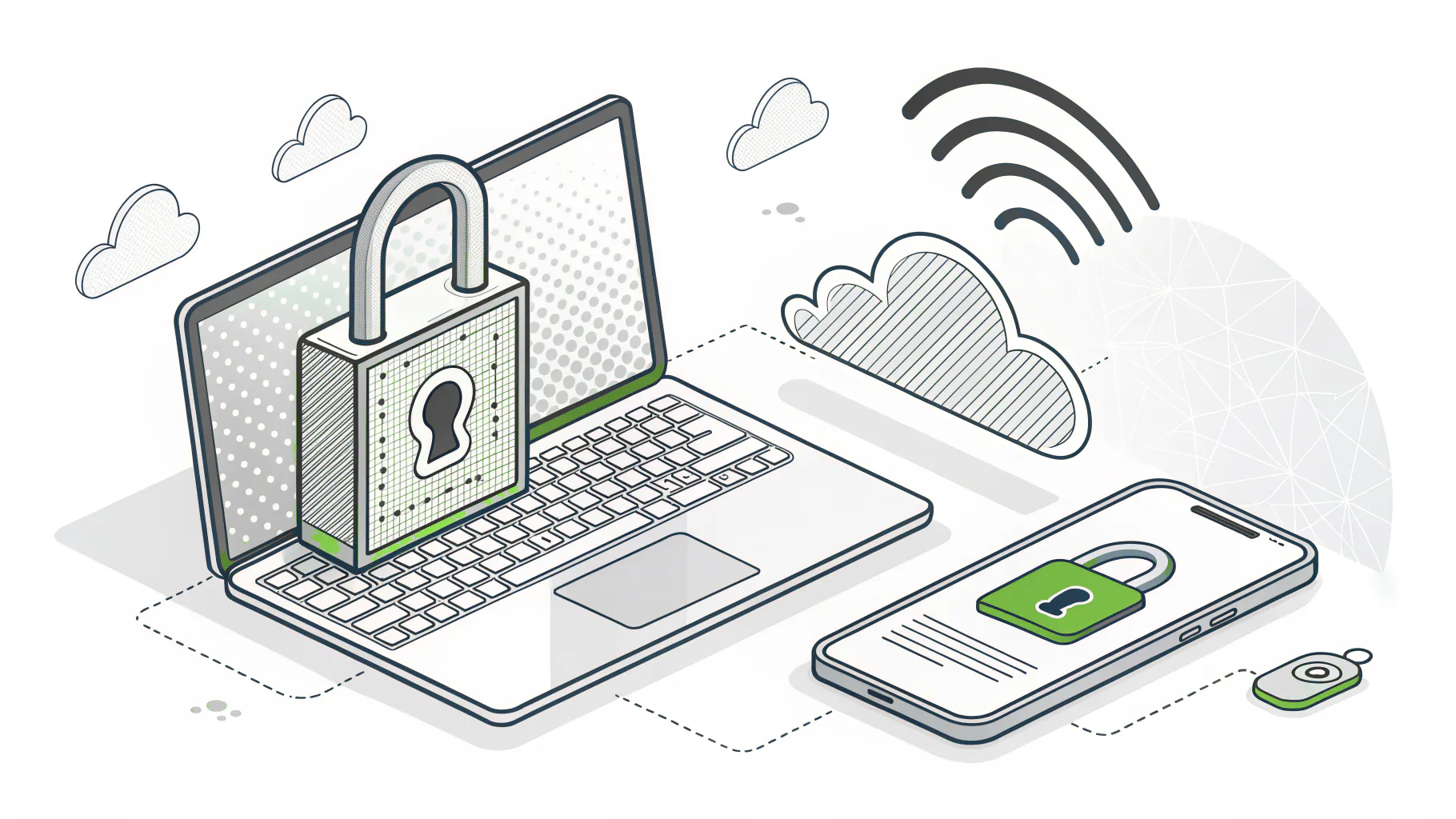
Six controls cover the bulk of what the rules above expect. Multi-factor everywhere, managed and encrypted devices, filtered email with a call-back rule, tested backups, same-day offboarding, and a written policy on AI tools.
Multi-factor is the floor for sign-ins. Above it, Microsoft 365 can enforce conditional access policies, rules that check who is signing in, from where, and on what device before letting them near client files. A login from an unmanaged laptop in another country at 3 a.m. should simply fail.
Then backups. Law Firm C paid the ransom. Whether it had to came down to one question, which was whether a clean copy of the data existed somewhere the attackers couldn't reach. An untested backup is a guess. Test it. Our backup and disaster recovery service tests backups daily for exactly that reason.
Offboarding is the one that slips. Publication 5708's sample plan says a departing employee's logins, email, remote access, and even tax software download access get shut off at termination. Same day. Not Friday. The associate who left in August shouldn't still have mail syncing to their phone in October.
AI tools need a written policy too. The ABA's Formal Opinion 512 from July 2024 warns that client data typed into some AI tools may be kept and used to train them. Lawyers need informed client consent before putting client information into those tools, and the opinion says general, boilerplate language in an engagement letter isn't enough. Accountants and advisers don't answer to the ABA, but their clients will ask the same question. Pick approved tools, block the rest, and write it down.
Your cyber insurance application will ask about almost all of this anyway. This cyber insurance requirements checklist shows what carriers are checking in 2026.
In-house IT, managed IT, or co-managed: which fits a boutique firm?
For a firm with no IT lead, managed IT usually fits best, because one hire can't cover the help desk, security monitoring, documentation, and after-hours response at once. If you already have a capable IT manager, co-managed IT fills the gaps around them.
Skip outside help if you already employ a full-time IT manager who owns security, keeps the WISP current, and has restored a backup in the last quarter. You're covered. Spend the money elsewhere.
Look at co-managed IT if you have someone good who's stretched thin, or who's great with the practice management software and less sure about security monitoring at 2 a.m.
Go fully managed if the person handling IT today is your office manager, a partner's nephew, or a break-fix tech you call when something stops working. That arrangement works fine right up until a regulator, a client questionnaire, or an insurer asks for evidence. Then it doesn't. Fast.
Whichever way you go, ask two local questions. How fast can a technician physically be in your office in Beverly Hills, and is that number in the contract? Our page on managed IT services in Beverly Hills lays out how we handle on-site work here.
Consilien is a managed IT and cybersecurity provider headquartered in Torrance that serves businesses nationwide, with professional services firms among its core industries. A partner at a consulting firm in Irvine that has worked with us since 2018 described 100% uptime and smooth hardware changeovers in a Clutch review, which is roughly what a boutique wants to be able to say about its own IT.
If you're not sure which of these rules applies to your firm, or whether your current setup would hold up if someone asked to see it, speak to an IT expert before a client or a regulator asks first.