NIST Cybersecurity Framework Implementation: A Practical Guide
NIST cybersecurity framework implementation means setting up governance first, building a Current and Target Profile, closing the highest-risk gaps in phases, and reviewing the profile at least once a year. It's an ongoing program, not a certification or a software purchase.
Table of Contents
A realistic first pass takes 6 to 12 months for a business with an IT lead and some outside help. You don't need to touch all 106 outcomes in the framework on day one. Pick 15 to 25 that matter most, assign each one an owner, and expand from there once those are actually working.
NIST cybersecurity framework implementation usually starts with a sentence from someone outside IT. A customer questionnaire asks whether you align to NIST CSF. An insurance renewal asks the same thing, a little more pointedly. Somebody says yes. Or "we will." And the project begins.
What happens next tends to follow a pattern. A tool gets purchased, because buying something feels like progress. A policy template gets downloaded and renamed. And a year later, when someone asks to see the profile, the honest answer is that nobody owns it. Each of those steps was reasonable on its own. Together they produce a program that exists on paper and nowhere else, with a dashboard nobody logs into, a policy folder nobody has opened since the week it was created, and a questionnaire answer that gets a little less true every month.
Order fixes most of it. Decide who owns the work, write down what you're protecting and why, and only then start changing systems, because every change made before those two decisions exist is a guess about priorities that someone will eventually have to undo. That's the same approach behind any compliance program that holds up over time.

What does implementing the NIST CSF actually involve?
Implementing the NIST CSF means choosing which of its cybersecurity outcomes apply to your business, documenting how well you meet each one today, setting a target, and working the gap down. The framework says what to achieve. You decide how.
Put simply, the NIST Cybersecurity Framework is a set of security outcomes published by the National Institute of Standards and Technology. CSF 2.0, released in February 2024, is written for any organization "regardless of its size, sector, or maturity," and it deliberately doesn't prescribe specific products or controls.
It's organized in 3 layers. 6 functions (Govern, Identify, Protect, Detect, Respond, and Recover) break into 22 categories, which break into 106 subcategories. A subcategory is a single outcome, like "backups of data are created, protected, maintained, and tested." That's the level you actually work at.
There's no certificate at the end. Nobody issues you a NIST CSF badge. So what are you producing? A documented profile, a set of working controls behind it, and evidence that both are maintained.
Implementing and assessing are also different jobs. An assessment measures where you stand. Implementation is the work of moving. If you haven't measured yet, our NIST CSF assessment guide covers scoring and fieldwork, and the two fit together naturally. You can start implementation without a formal outside assessment, though, as long as someone honest builds the Current Profile.
Before you start, decide why you're doing this
Why you're doing it shapes the scope more than anything else. Four drivers come up repeatedly.
- A customer or prime contractor sent a security questionnaire. Scope tightly to the systems and data that customer touches, and expect them to ask for evidence, not just answers.
- Your cyber insurance carrier wants proof of specific controls. They'll care about multi-factor authentication (a second login step beyond the password), backups, and endpoint protection far more than governance documents.
- A regulator points to it. Banks and credit unions are the clearest case right now, covered further down.
- Leadership simply wants to know whether the environment is sound. That's the broadest scope, and honestly the healthiest reason.
Write the reason down in one or two sentences. It sounds trivial. It isn't, because 6 months in, when someone asks why you're spending time on supplier reviews, the answer should already be on paper.
Check the contract language, too. One that names NIST SP 800-171 instead of the CSF is pointing at a different, much more prescriptive standard, usually tied to defense work. The NIST 800-171 vs. NIST CSF comparison explains which one actually applies. And if several frameworks are circling at once, start with which compliance standards apply to you before committing to any of them.
Phase 1: Set up governance first (weeks 1 to 4)
Govern comes first because it decides who owns cybersecurity risk, how much risk leadership will accept, and which suppliers matter. Without those answers, every later phase stalls waiting on decisions nobody is authorized to make.
CSF 2.0 added Govern as a sixth function, and it's not small. It accounts for roughly 30% of the framework's subcategories, covering organizational context, risk strategy, roles, policy, oversight, and supply chain. Teams tend to treat it as paperwork to finish later. That instinct is understandable. It's also where implementations quietly go wrong.
Name an owner and a sponsor
Two people. The owner runs the program week to week, usually an IT manager, an operations lead, or an outside security advisor. The sponsor is an executive who can approve spending and settle disagreements between departments. One person can't really be both, because the owner needs someone to escalate to when a department head refuses MFA on a shared mailbox or asks for an exception nobody else is willing to approve.
Write a risk statement leadership will actually sign
Keep it to one page. What data would hurt most if it leaked? Which systems, if they went down for 3 days, would stop revenue? How much disruption is tolerable? A distribution company might decide its warehouse management system can't be down longer than 8 hours, while email can survive a full day. That single decision shapes backup design, monitoring, and recovery testing later on.
Bring vendors into scope early
Supply chain risk now has its own category under Govern, and NIST published a supplier risk quick-start guide just for it. Start with a list of the vendors that hold your data or can log into your systems. Your payroll provider, the company hosting your ERP (the system that runs orders and inventory), your outsourced accounting firm. Rank them by how much damage a breach on their side could do to you, starting with anyone who holds customer records, processes payments, or keeps a standing remote login into your network. A third-party risk management program grows out of that list, but the list comes first.
Phase 2: Build your Current and Target Profile (weeks 3 to 8)

A profile is a spreadsheet. That's less glamorous than the word suggests, and it's useful to know, because it lowers the barrier to starting.
NIST's quick-start guide for Organizational Profiles lays out 5 steps. Scope the profile. Gather the information you need. Create the profile. Analyze the gaps and build an action plan. Implement the plan and update the profile. Nothing exotic. NIST also publishes an Excel template with the Current and Target columns side by side, so nobody has to build the structure from scratch.
Your Current Profile records what you actually do today for each outcome you've included, with a status and a rating. Be specific. "MFA enabled" is weaker than "MFA enforced in Microsoft 365 for all users, not yet on the VPN or the accounting system." The second version tells you where the gap is, which systems still accept a password alone, and what the next ticket should say, and that level of detail saves weeks when the action plan gets written.
Setting the Target Profile is a business decision, not an IT one. It records where you want each outcome to land and how important it is, which is why the Phase 1 risk statement matters so much. IT can tell leadership what a stronger backup setup costs. Leadership decides whether 3 days of downtime is acceptable.
Tiers sometimes get mixed into this step. CSF Tiers, described in NIST's quick-start guide on Tiers, run from Tier 1 (Partial) through Tier 2 (Risk Informed) and Tier 3 (Repeatable) to Tier 4 (Adaptive). They describe how rigorous your risk governance is overall. They aren't a score to maximize. Rigor, not coverage. A 40-person professional services firm landing at Tier 2 with clean, working controls is in better shape than a company claiming Tier 3 on the strength of policies nobody reads. Big difference.
How do you choose which of the 106 outcomes to address first?
Start with the outcomes that shut the easiest doors attackers use and that every recovery depends on. Identity, backups, patching, asset inventory, logging, and an incident plan come first. Use CISA's Performance Goals and the CIS Controls' first tier to confirm the list.
Trying to address all 106 subcategories at once is the most reliable way to stall a NIST cybersecurity framework implementation, because every outcome competes for the same handful of people and nothing ever reaches done while 106 things sit half-finished. The framework doesn't ask you to do them all at once. And the federal government has already done much of the prioritizing for you.
CISA, the federal cybersecurity agency, published version 2.0 of its Cross-Sector Cybersecurity Performance Goals on December 11, 2025. They're a short list of high-impact practices organized under the same 6 CSF functions, written partly to help small and mid-sized organizations get started. The Center for Internet Security makes a similar cut with Implementation Group 1 of the CIS Controls, 56 safeguards it calls an emerging minimum standard for every enterprise. Useful shortcut.
Where the two lists overlap is a sensible first pass. Mapping those practices back to CSF subcategory IDs gives you something like the table below. NIST's Informative References and the CSF 2.0 reference tool show how each subcategory maps to CIS, ISO 27001, and other standards if you want to check the work.
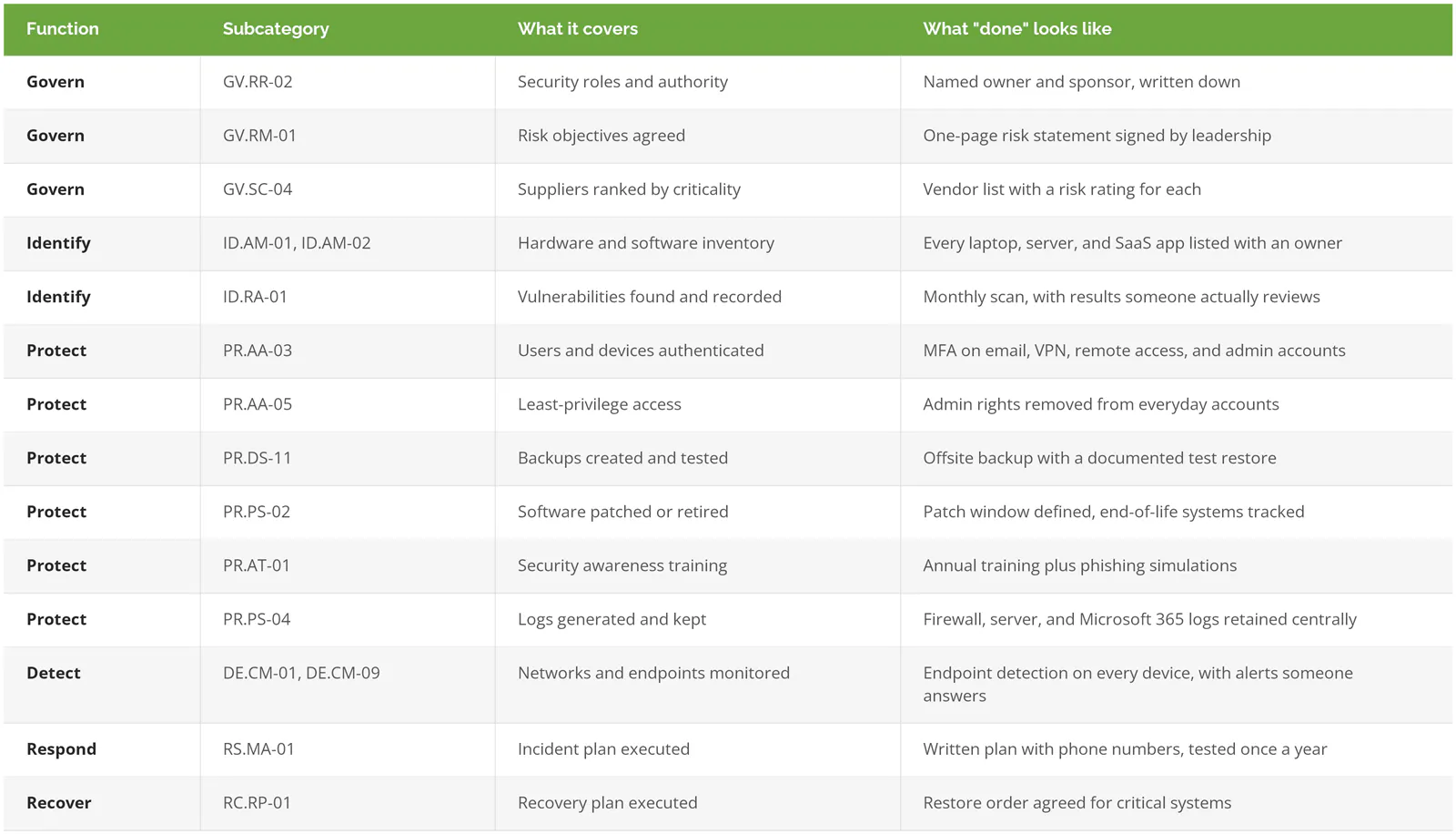
That's 16 outcomes. Plenty for the first 6 months, and every one of them is something an auditor, insurer, or customer will eventually ask about. Once these are stable, expand toward the rest of your Target Profile.
Phase 3: Close the gaps in priority order (months 2 to 9)
Order matters here more than speed. Some fixes depend on others. Skip ahead, and you redo work.
Identity usually goes first. Multi-factor authentication and removing everyday admin rights close off the easiest ways into an environment, and they're relatively cheap. The SSO vs. MFA vs. IAM breakdown is useful if those terms are blurring together.
Backups go second, or alongside identity. They're the outcome everything else falls back on when something fails. A backup that's never been restored is a hope, not a control, so the first test restore belongs in this phase. If yours hasn't been tested in a year, backup and disaster recovery is the place to start.
Asset inventory and patching come next, because you can't patch or monitor a device you don't know exists. Picture a 70-person manufacturer that discovers, during inventory, a Windows Server 2012 box still running the label printers on the shipping dock. Nobody planned for it to stay. It just never got replaced, because the printers worked, the vendor who set them up had moved on, and nobody wanted to be the person who broke shipping on a Friday afternoon. That server becomes a line item in the action plan, with an owner and a date.
Monitoring and response come last in this phase, and for a reason. Detection tools generate alerts, and alerts only help if someone is watching them at 2 a.m. on a Sunday. A business that installs endpoint detection on 80 laptops without anyone assigned to read the alerts has mostly bought a detailed record of what happened, delivered after the fact to an inbox nobody checks on weekends. Not ideal. Many businesses don't staff that internally, which is where a managed cybersecurity service with a security operations center usually fits.
Document as you go. Every closed gap should leave behind a screenshot, a configuration export, or a ticket. That evidence is what turns "we did it" into something you can hand a customer. Keep it boring, and put a date on everything.
Who owns each function when you don't have a CISO?
Ownership gets split across roles, with one person coordinating. A business without a chief information security officer can still run the CSF well if every function has a named owner and the coordinator has authority to follow up.
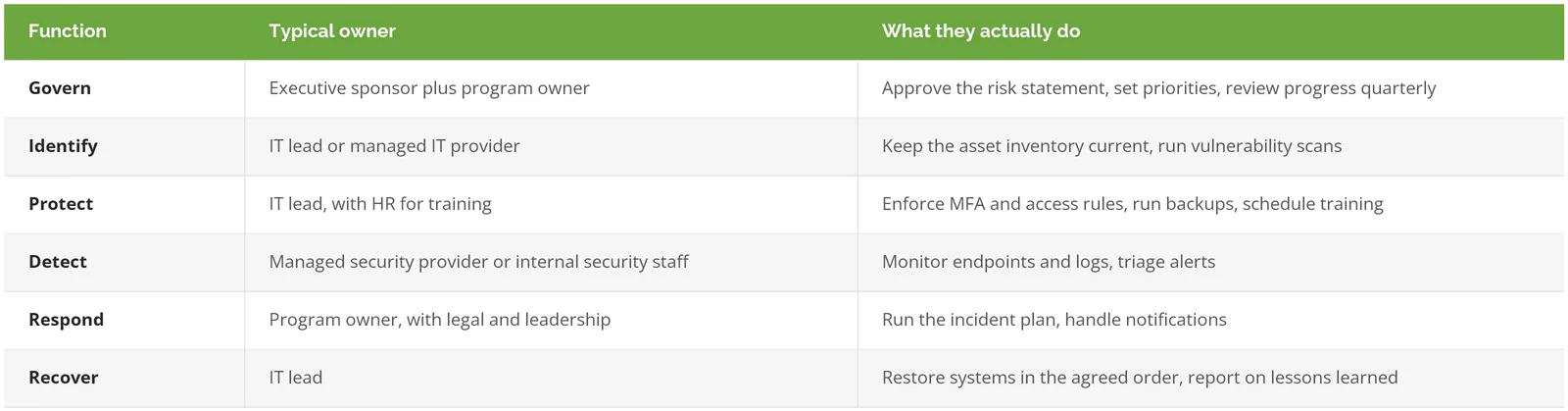
Finance and legal also show up more than people expect. Finance owns insurance and vendor contracts. Legal owns breach notification decisions. Leave them out, and they find out about the program for the first time during an incident, usually at the exact moment someone needs a decision about notifying customers or calling the insurance carrier's breach hotline.
If nobody internal has the time or background to coordinate, a fractional security leader is a common answer. A virtual CISO covers the Govern work and program oversight for a few days a month. With a full-time CISO and an in-house security team, you'd skip this and assign the coordinator role internally.
Phase 4: Measure, review, and keep the profile current
Review the profile at least once a year, and again whenever something material changes. An acquisition. A move to a new ERP. A merger of 2 offices onto one network. A security incident, even a small one.
Quarterly check-ins on the action plan work well for most teams. 30 minutes, the sponsor in the room, and 3 questions. What closed? What slipped, and why? Has anything changed that moves a priority? That's it.
Test the incident plan once a year with a tabletop exercise, where leadership talks through a realistic scenario like ransomware on the file server. The NIST incident response lifecycle is a useful structure for that conversation. Expect the first tabletop to surface at least one surprise, like nobody knowing who calls the cyber insurance carrier.
Profiles go stale quietly. That's the failure mode. Nothing breaks, the spreadsheet simply stops matching reality, and the next questionnaire gets answered from memory by someone who wasn't in the room when the original decisions were made, which is how a company ends up attesting to a control it retired 2 years earlier.
Does following NIST CSF give you any legal protection?
In some states, yes. Ohio and Utah give businesses a legal defense in some data breach lawsuits, and Connecticut bars punitive damages, if they maintained a written security program that reasonably conforms to a recognized framework such as NIST CSF. California's new audit rules name CSF 2.0 directly, but they offer no safe harbor.
Each state's law works a little differently. Ohio's Data Protection Act and Utah's Cybersecurity Affirmative Defense Act provide an affirmative defense against certain breach claims, while Connecticut's 2021 law only bars punitive damages, according to a Wilson Elser summary of the safe harbor statutes. Each one expects the program to be maintained, not just written down.
California went a different direction. Its CCPA cybersecurity audit regulations took effect January 1, 2026, with the first audit certifications due April 1, 2028 for the largest covered businesses and phasing in through 2030 for smaller ones. In the final text, NIST CSF 2.0 is the only framework cited by name as an example of an existing audit a business can build on. Regulators declined to make it a safe harbor, so treat it as a head start rather than a pass.
Banking regulators moved too. The FFIEC retired its Cybersecurity Assessment Tool on August 31, 2025 and pointed institutions toward NIST CSF 2.0 and the CISA Performance Goals instead.
None of this replaces legal advice. A documented CSF program won't stop a lawsuit from being filed, but it changes what your attorneys can put in front of a judge, an insurer, or a regulator when one arrives, and that record is far easier to build before an incident than after one.
Where implementations usually stall
Almost none of these problems are technical. They're structural, and they usually started as sensible shortcuts.
First, the checklist trap. Someone treats the 106 subcategories as boxes, marks them yes or no, and calls it done. The CSF was never meant to work that way, and a yes without evidence behind it doesn't survive the first customer audit.
Govern done on paper only is close behind. The policies exist, but no executive has read the risk statement, so priorities get set by whoever shouts loudest that month.
Then there's buying tools before writing the profile. I'd argue this one causes the most waste. A business buys an expensive detection platform, rolls it out to every device in the old spreadsheet, and learns months later that the spreadsheet was missing the warehouse PCs, the conference room machines, and 2 servers in a rack nobody had opened since the office move. Same tool, half the coverage.
And finally, never re-profiling. The environment changes every year. The spreadsheet doesn't. Eventually the two describe different companies.
Why bother with any of it? IBM's 2026 Cost of a Data Breach study put the global average breach at $4.99M, and the US average is higher still. A working profile won't make that number zero. It does make it much less likely that the breach starts with something you already knew was broken.
Consilien is a managed IT and cybersecurity company headquartered in Torrance, California, working with businesses nationwide. NIST CSF implementation is part of its compliance practice, which runs separately from managed IT. That work covers governance setup, Current and Target Profiles, remediation plans tied to specific subcategories, and ongoing reviews alongside your internal team.
If you're not sure where your first 16 outcomes stand, or who should own them, speak to a NIST expert.