Security Awareness Training Services: What’s Included and How to Choose
Security awareness training services are a managed solution aimed at reducing human-caused cybersecurity risk through continuous education, phishing simulations, and measurable behavioral change.
Table of Contents
This is different from training classes, which are one-time events. Security awareness training services come with program management, reporting, and compliance (e.g., NIST, CMMC).
When choosing a security awareness training provider, you should look beyond just training. A strong provider goes beyond training but manages risk, tracks employee behavior, and integrates with your existing security strategy to support your internal IT team.
What Are Security Awareness Training Services?
Security awareness training services are a type of managed cybersecurity service that focuses on employee education, real-world threats, and measuring human risks in an organization.
Most companies think “training” means videos and quizzes. That’s incomplete.
A true service includes:
- Ongoing program management
- Continuous phishing simulations
- Behavior tracking and reporting
- Compliance alignment
- Executive-level visibility
This is the difference between checking a box and actually reducing risk.
Why Security Awareness Training Matters for Risk and Compliance
Human behavior is still the primary attack surface.
- The Verizon DBIR (2024) found the human element in ~68–74% of breaches
- The IBM Security report (2024) estimates average breach costs at ~$4.45M globally
Limitations:
- These are global averages
- Enterprise-heavy datasets
- Your actual exposure depends on the industry and controls
Still, the direction is clear: users are the entry point
Compliance Pressure Is Increasing
Frameworks are explicit:
- National Institute of Standards and Technology (NIST CSF – PR.AT) suggests training and development at the role level
- The US Department of Defense (CMMC 2.0) specifies awareness programs for contractors
- Cybersecurity and Infrastructure Security Agency (CISA) emphasizes phishing resilience
Cyber insurance providers are also tightening requirements:
- Proof of training completion
- Phishing simulation metrics
- Documented programs
No standard dataset exists across insurers, but underwriting expectations are clearly rising.
What’s Included in Security Awareness Training Services
Core components typically include:
- Training content (role-based modules)
- Phishing simulations
- Reporting and analytics
- Compliance mapping (NIST, CMMC)
- Program management
Training Content (Role-Based)
- General employee awareness
- Executive-specific risk training
- Developer or IT-specific modules
- Short, frequent sessions (not annual dumps)
Phishing Simulations
- Realistic attack scenarios
- Ongoing campaigns (not one-time tests)
- Behavior tracking (clicks, reporting, failures)
Reporting & Metrics
- User risk scoring
- Department-level trends
- Executive dashboards
- Audit-ready reports
Compliance Alignment
- Mapping to NIST PR.AT controls
- Support for CMMC readiness
- Documentation for audits
Program Management (Most Overlooked)
This is where most vendors fall short.
A real service includes:
- Campaign planning
- Continuous tuning
- Employee follow-up workflows
- Reporting to leadership
Without this, tools sit unused.
Managed vs Self-Service Training Platforms
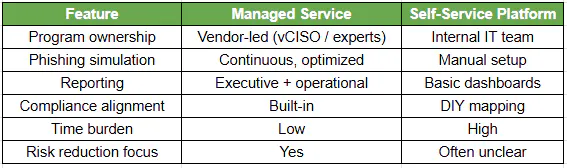
Key takeaway: Self-service platforms shift the workload to your already overloaded IT team.
How to Choose a Security Awareness Training Provider
7 Key Evaluation Criteria
Managed vs DIY: Who runs the program day-to-day?
Behavior Tracking: Do they measure real behavior or just completion rates?
Reporting Depth: Can leadership see risk trends?
Compliance Mapping: Does it align with NIST, CMMC, or audit needs?
Integration with Security Stack: Does it connect to your broader security program?
Executive Visibility: Are reports usable at the board level?
Continuous Improvement: Is the program actively optimized?
Common Mistakes to Avoid
- Treating training as a once-a-year requirement
- Prioritizing content over outcomes
- Ignoring phishing simulations
- Lacking reporting and metrics
- Failing to align with compliance frameworks
How Consilien Approaches Security Awareness Training
Most organizations don’t fail because they lack tools. They fail because no one owns the program. Consilien addresses that gap.
Co-Managed Model
- Supports internal IT teams instead of replacing them
- Reduces operational burden
vCISO-Led Strategy
- Aligns training to real business risk
- Connects awareness to broader security controls
Continuous Lifecycle Approach
- Train → Simulate → Measure → Improve
- Not a one-time rollout
Compliance-Ready by Design
- Built around NIST and CMMC expectations
- Audit-ready reporting
Outcome Focus
- Reduced phishing susceptibility
- Improved reporting behavior
- Measurable risk reduction