Why Orange County Professional Services Firms Are Adopting Security-First IT
Security-first IT means security controls decide how your systems get built and supported, instead of getting bolted on later. Orange County law, CPA, and advisory firms are moving to it because clients, cyber insurers, and 2026 rules now want proof.
Table of Contents
Your cyber insurance renewal shows up in March, and page 4 asks whether multi-factor authentication is turned on for every account that can reach client data. Not most accounts. Every one. You forward it to your IT provider. The answer comes back 3 days later with a question mark in it.
That question mark is why security-first IT for professional services firms is spreading across Orange County, and why plenty of firms already paying for managed IT services in Orange County are learning their setup was built to keep people working, not to produce evidence. Law offices in Irvine, CPA practices in Tustin, and wealth managers on Newport Center Drive keep getting the same request from clients, carriers, and regulators. It's 2 words long.
Show us.
A help desk that resets passwords in 4 minutes can't answer that. It was never built to.
What does "security-first IT" actually mean?
Security-first IT is an operating model where sign-in, email, device, and backup controls get designed first, and support, projects, and new software have to fit inside them. Security sets the rules. The help desk works within them.
IT-first runs the other way. A provider gets measured on tickets closed and uptime, and security arrives as a few line items on the invoice: antivirus, a firewall, a spam filter. Each one gets installed during onboarding, renewed every year, and then left alone until something breaks, a client sends a questionnaire, or the insurance renewal asks a question nobody in the building can answer.
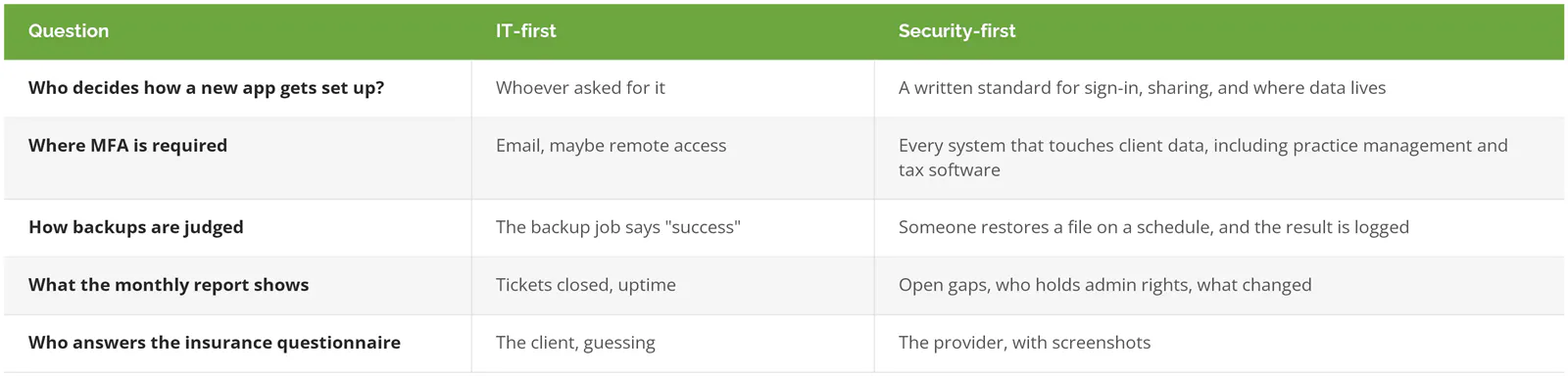
Take a new hire. Under an IT-first setup, the account gets created, the laptop ships, and multi-factor authentication (the second code or phone prompt after a password, usually called MFA) gets set up "once they're settled in." Under a security-first setup, the laptop arrives already enrolled in device management, which is the system that lets IT lock or wipe it remotely. MFA is on before the first sign-in. And access is limited to the client folders that person's work actually needs, instead of the whole file share.
Same hour of work. Different order.
You can't buy security-first as a product. A provider who adds the phrase to a proposal without changing how its help desk works has changed the brochure.
Why is Orange County's professional services market moving first?
Orange County packs in an unusual number of small professional offices. Legal services employment there is 45% more concentrated than in the US overall, and the average law, accounting, or consulting office employs 4 to 7 people. At that size, nobody's full-time job is security.
Those figures come from the BLS Quarterly Census of Employment and Wages, which counts every employer paying into unemployment insurance. The first quarter of 2026 is the newest release. It shows 21,097 private professional, scientific, and technical establishments in the county employing 136,701 people.
Read the location quotient column first. It compares an industry's share of local jobs to its share nationally, so 1.00 means average and 1.45 means 45% denser than average.
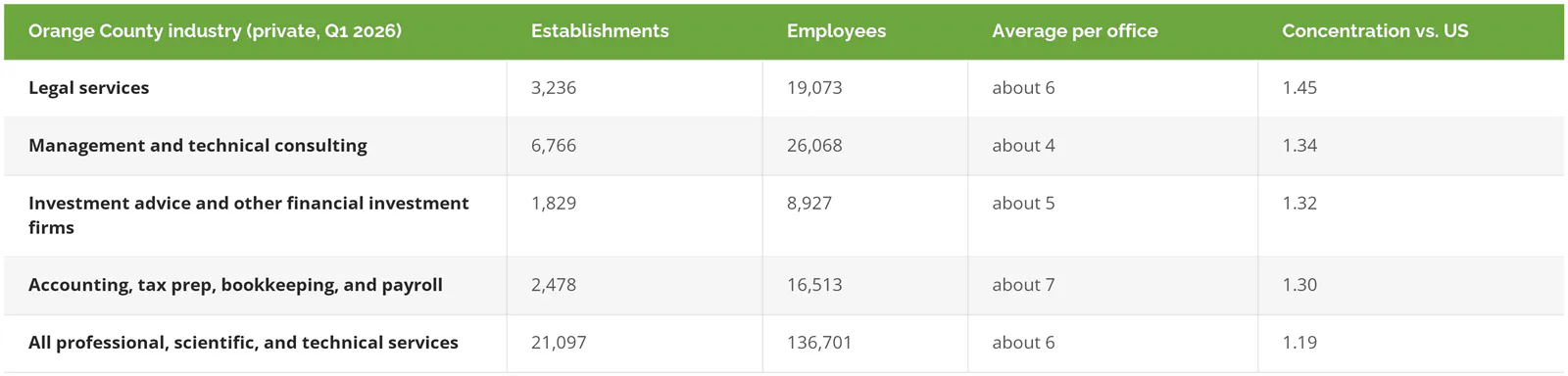
Lots of firms. Small ones. Every one of them holding Social Security numbers, tax returns, deal documents, or brokerage statements for somebody else.
Size changes who does the security work. A 300-lawyer firm has a chief information security officer and a team, while a 6-person firm off Von Karman has a managing partner who also approves the IT invoice, reads the cyber insurance renewal, and signs every engagement letter. The ABA's 2021 legal technology survey put that gap in numbers. Among firms with 100 or more lawyers, 80% had an incident response plan, against 21% of firms with 2 to 9. The same survey found a quarter of firms had been breached at some point. Old data, sure. But nothing about running a 6-person firm has made a written response plan easier to produce since.
So in a small firm, security ends up as the partner's side job, the IT provider's, or nobody's. Moving it squarely onto the provider, with evidence attached, is what IT and cybersecurity for professional services firms has to look like now.
Who is asking Orange County firms for proof?
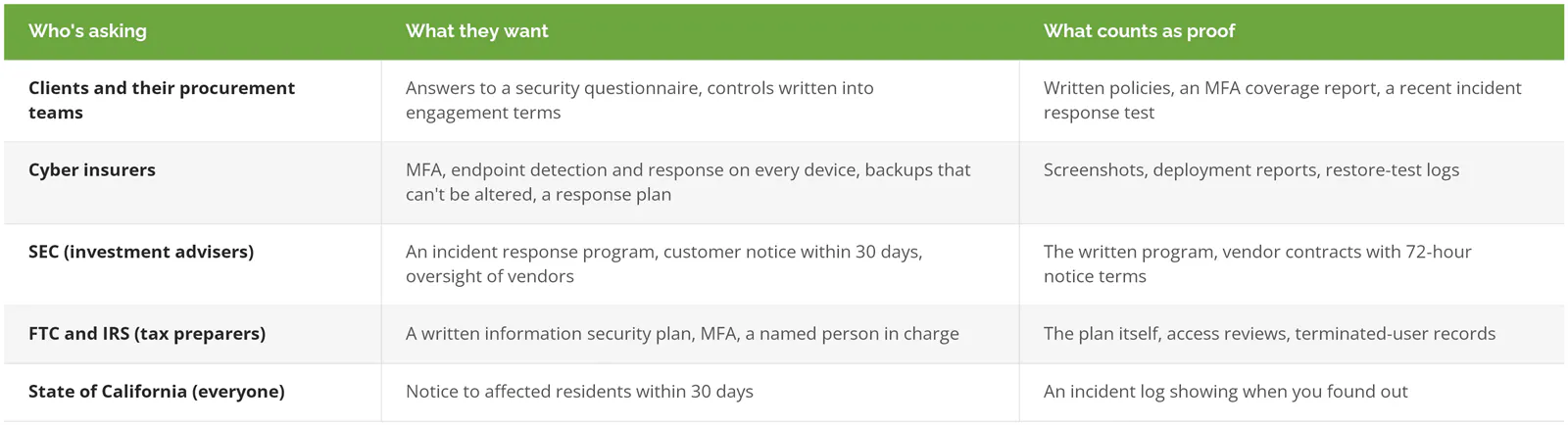
Clients, cyber insurers, and regulators. They ask in different formats, but each one wants written evidence that controls exist and work, and a confident "yes" from your IT provider no longer counts as an answer.
Clients
Client audits of outside firms aren't new, but they've been climbing for years. The ILTA 2019 Technology Survey, as reported by the New York State Bar Association, found a quarter of law firms had been audited by a client in the prior year, up from 16% in 2016. The same article describes questionnaires that often run 90 pages or more.
For an accounting firm doing work for a public company, or a consultant inside a bank's vendor program, the questionnaire usually arrives through procurement as a spreadsheet with a Friday deadline. Every "no" or "partial" turns into a follow-up call with the client's security team, a request for a written fix date, and sometimes a meeting the partner never planned an afternoon for. A few end in a lost renewal.
Cyber insurers
Carriers stopped taking checkbox answers. Renewal forms now ask about MFA on email, remote access, and admin accounts, endpoint detection and response (software on every laptop and server that watches for attacker behavior and can cut a machine off the network by itself), and backups that can't be changed or deleted, even by someone holding an admin password.
Then they ask you to prove it. An answer that doesn't match what's actually deployed can give the carrier grounds to dispute a claim later, which is the worst possible time to learn that MFA was never turned on for the scanner account. Our cyber insurance requirements checklist goes control by control.
Regulators
OC professional services firms answer to 4 rules right now.
- Investment advisers. The SEC's amended Regulation S-P required smaller entities, including advisers with under $1.5 billion in assets, to comply by June 3, 2026, per the SEC's small entity compliance guide. It expects a written incident response program, customer notice within 30 days, and oversight of service providers, including a requirement that they notify you within 72 hours of a breach. If your IT provider can reach customer data, it's one of them.
- CPA and tax firms. IRS Publication 5708 says tax professionals are financial institutions under the FTC Safeguards Rule regardless of size, and that the law requires a written information security plan. MFA too.
- Law firms don't have a statute like that. They have the State Bar. California Formal Opinion 2020-203 ties data security to the duties of competence and confidentiality and says failing to use remote lock and locate features "could be deemed unreasonable." It's advisory. It's also the clearest statement of what the State Bar expects from a firm that holds client data.
- Everyone holding Californians' personal data falls under SB 446, which, since January 1, 2026, gives you 30 calendar days to notify affected residents.
We went profession by profession in the IT needs of professional services firms in Beverly Hills. The rules don't change at the county line.
Where does the money actually leave a professional services firm?
Through the inbox, far more often than through ransomware. Coalition's 2026 claims report found business email compromise and funds transfer fraud made up 58% of the cyber incidents it handled in 2025, and the average fraudulent transfer cost $141,000.
Business email compromise, or BEC, is when someone takes over a real mailbox or fakes one well enough, then asks for money or changes where a payment goes. Coalition's 2026 Cyber Claims Report traced 52% of its funds transfer fraud claims back to BEC. Ransomware cost more per claim, $269,000 on average. It just happened less.
Professional services firms move other people's money all day. Settlement funds. Retainer refunds, estimated tax payments, and capital calls on a fund that closes Friday. Every one of those is a wire instruction sitting in somebody's email, waiting for a lookalike domain and a well-timed "please use the updated account below."
Nationwide, the FBI's 2025 IC3 report counted $3.05 billion in reported BEC losses. California led every state in total reported cybercrime losses, at $3.67 billion.
The security-first answer is boring, which is the point. Conditional access, meaning sign-in rules that block logins from unknown devices or unexpected countries, set up the way our conditional access guide describes. Email security that flags impersonation and alerts when someone quietly adds a rule that copies a partner's email to an outside address. And a call-back rule, written down, that says no payment detail changes without a phone call to a number you already had on file.
That last one costs nothing. A partner has to make one phone call. Our breakdown of the 2 types of BEC the FBI tracks explains why it works.
What does security-first look like in a 10-person firm?
It's an order of operations. Lock down sign-ins first, then email, devices, backups, and people, and keep evidence the whole way. Sign-ins come first because stolen credentials and unpatched software open the door in more than half of ransomware attacks.
Sophos is the source. Its State of Ransomware 2025 survey of 3,400 organizations hit by ransomware found exploited vulnerabilities behind 32% of attacks and compromised credentials behind 23%. Phishing and malicious email made up most of the rest.
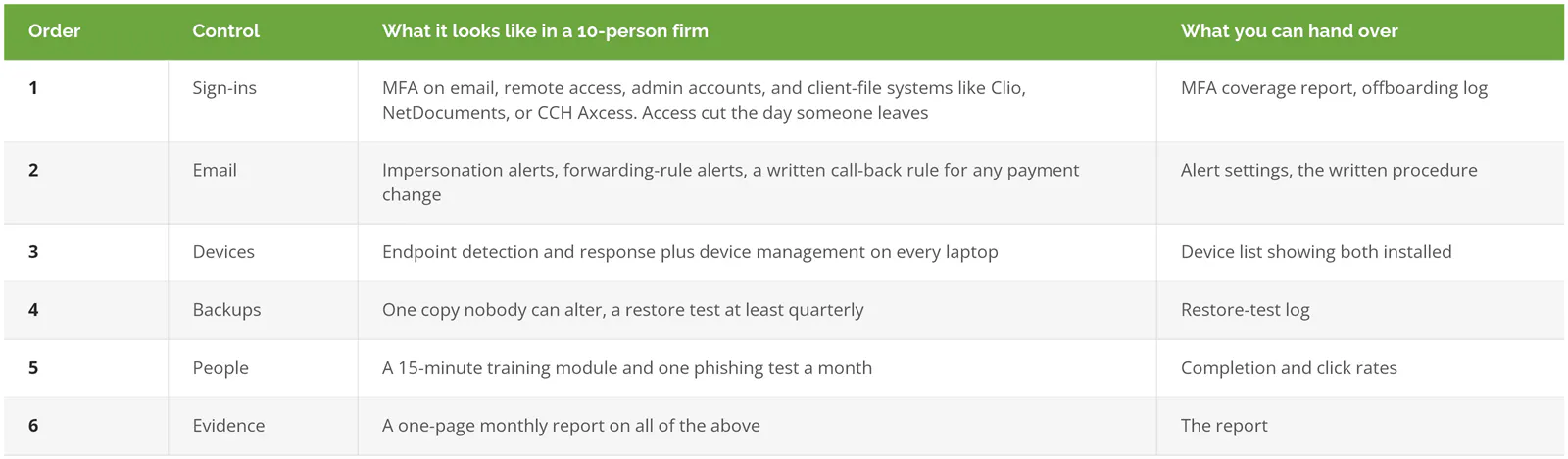
IRS Pub 5708 is blunt about row 1 for tax firms. A departing employee's access, tax software logins included, gets shut off at termination. Not at the end of the month.
Row 4 is where firms fool themselves. A green checkmark on a backup dashboard means the job ran, which isn't the same as the files coming back, and nobody wants to learn the difference during a ransomware recovery with a filing deadline two days out.
Row 3 is partly a geography problem. A laptop that rides between Irvine, Newport Beach, and a client's office in Anaheim spends a lot of hours in parking structures, and when one goes missing on a Tuesday night, device management lets somebody lock it from a browser before the police report is done.
Row 5 looks like the soft one. Phishing and malicious email still started 37% of the attacks in that Sophos survey, which is why security awareness training is in the table at all.
I'd bet a fair number of firms reading this already pay for part of that stack inside Microsoft 365. Never turned it on.
What security-first is not
Buying more security products won't get you there. I'd take a firm with 4 tools and 1 person reading the alerts every morning over a firm with a dozen that nobody watches, since an alert nobody reads only ends up as a timestamp for the insurance adjuster.
Compliance won't get you there either, though it helps. A written security plan or a clean SOC 2 report (an outside auditor's review of your security controls) shows an auditor that controls were documented and tested at a point in time. It won't stop a partner from approving a wire to a fake account on a Thursday afternoon in April. Consilien handles compliance work like SOC 2 and NIST readiness as a separate engagement from managed IT, scoped and priced on its own.
The trickiest version is a security vendor added on top of an old help desk. You end up with 2 contracts and 2 teams, and the alert that fires at 2 a.m. lands with one of them while the fix belongs to the other. Findings can sit in that seam for months. That's the case for managed cybersecurity services run by the same people who manage the systems.
If your firm already has an IT director and a security lead turning out that monthly evidence, none of this applies. A second opinion might. Smaller conversation.
Six questions that tell you whether your IT is security-first
Ask your current provider these, and ask for the answer on the call, not a promise to look into it.
Start with MFA. Can they show you, today, every account that signs in without it, including shared mailboxes, the scanner, and the login a summer intern used in 2024? Then backups. When did someone last restore a file, and where's the record of it?
Ask who holds admin rights in your Microsoft 365 tenant (the company's account that holds every mailbox and file), and why each of them needs it. Pause on that one. A name nobody in the room recognizes is an answer too.
A partner's laptop gets stolen out of a car tonight, so how many minutes until it's locked? And a client sends a 90-page security questionnaire on Monday. What would your provider need from you to finish it by Friday?
Last, the renewal. Who fills out your cyber insurance application, and will they put their name next to the answers?
Hear "we'd have to check" 4 times and you're running IT-first, whatever the contract says. Fixable. Just not with a faster help desk.
Shopping around? Our Orange County managed IT cost guide shows where security work turns up in a quote. The shortlist of IT support services in Orange County compares 6 local providers, and accounting firms can narrow it further with the best MSPs for accounting firms.
Consilien runs managed IT and cybersecurity for businesses nationwide, with on-site support across Orange County and compliance sold as its own service. If you'd like someone outside your current setup to put it through those 6 questions, speak to a cybersecurity expert.