How to Pass a Semiconductor Supply Chain Security Assessment
Semiconductor supply chain security assessments are becoming standard procurement requirements. The SSCA (Standardized Semiconductor Cyber Assessment) has 165 questions across 6 NIST CSF 2.0 functions. Your customers aren't asking whether you have security. They're asking you to prove it with evidence. This guide walks through the assessment structure, what assessors look for, and how to prepare without scrambling.
Table of Contents
If you supply into the semiconductor manufacturing ecosystem, you've probably already received a security questionnaire. Maybe two. Maybe ten.
Until recently, every fab and every OEM had their own format. Different questions. Different scoping. Different maturity models. Suppliers were spending dozens of hours per year filling out redundant questionnaires that asked roughly the same things in slightly different ways.
That changed in September 2025 when SEMI's Semiconductor Manufacturing Cybersecurity Consortium (SMCC) released the Standardized Semiconductor Cyber Assessment (SSCA), a unified security questionnaire designed to replace the patchwork (SEMI, October 2025).
One assessment. Shared results across multiple customers. 165 questions. Free and open-access.
The SSCA isn't a pass/fail exam. It's a maturity assessment. But your customers will use the results to decide whether your security posture meets their requirements. And if it doesn't, you're either remediating on a compressed timeline or losing the contract.
This guide is for electronics manufacturers, equipment suppliers, and component companies who need to prepare for their first SSCA or improve their score on the next one.
How the SSCA Is Structured
The assessment organizes 165 questions into 6 activity areas aligned with NIST Cybersecurity Framework 2.0.
Govern. Do you have a cybersecurity governance program? Who owns it? Is cybersecurity a board-level accountability? This is where the assessment checks whether security is a real organizational priority or an afterthought. If your "cybersecurity program" is one IT person doing their best without a budget, formal policies, or executive support, this section will be difficult.
Identify. Do you know what assets you have? Have you conducted a risk assessment? Do you understand your supply chain dependencies? Asset inventory sounds basic. In practice, I know companies with hundreds of endpoints where nobody can produce a complete, current list.
Protect. Access controls, data protection, security awareness training, information protection processes. This section maps closely to NIST SP 800-171 and SEMI E187's endpoint protection requirements. If you've already implemented controls for CMMC or ISO 27001, a lot of this section is already covered.
Detect. Do you have security monitoring? Can you detect anomalies? Do you have detection processes for unauthorized access? This is the SIEM/SOC question. If the answer is "we check the firewall logs when something seems wrong," that's not detection. That's incident investigation after the fact.
Respond. Do you have an incident response plan? Have you tested it? Do you have communication procedures for notifying affected parties? Most mid-market manufacturers have never written an incident response plan. Fewer have tested one. This section requires both.
Recover. Can you restore operations after an incident? Do you have backups? Have you validated them? Do you have a business continuity plan? Backup validation is the gap I see most often. Companies have backups. They haven't tested a restore in 2 years. A backup you haven't tested is an assumption, not a control.
What Assessors Are Actually Looking For
The questions themselves aren't the hard part. The evidence is.
The SSCA assessment process involves suppliers presenting evidence to support their claims. It's not enough to answer "yes" to a question about access controls. You need to show the access control policy. You need to show the configuration. You need to show that it's been reviewed in the last 12 months.
Here's what the evidence looks like across the 6 functions.

For Govern: Written cybersecurity policy. Risk management framework documentation. Board or executive-level review records. Role assignments (who owns cybersecurity).
For Identify: Asset inventory (current, complete). Risk assessment (dated, reviewed). Network diagrams. Data flow maps.
For Protect: Access control policies and configurations. Encryption settings. Training records. Patch management logs. Endpoint protection deployment records.
For Detect: SIEM deployment documentation. Monitoring coverage maps. Alert response procedures. Detection rule documentation.
For Respond: Incident response plan (written, dated, reviewed). Tabletop exercise records. Communication templates. Escalation procedures.
For Recover: Backup configurations. Restore test records. Business continuity plan. Recovery time objectives documented and tested.
If you're reading that list and thinking "we do most of this but haven't documented it," you're in the same position as 80% of mid-market manufacturers we onboard. The controls exist in pieces. The documentation doesn't. That's the gap.
How to Prepare: A Practical Approach
Don't try to answer all 165 questions cold. That produces panic, guesswork, and incomplete evidence packages. Here's a better sequence.
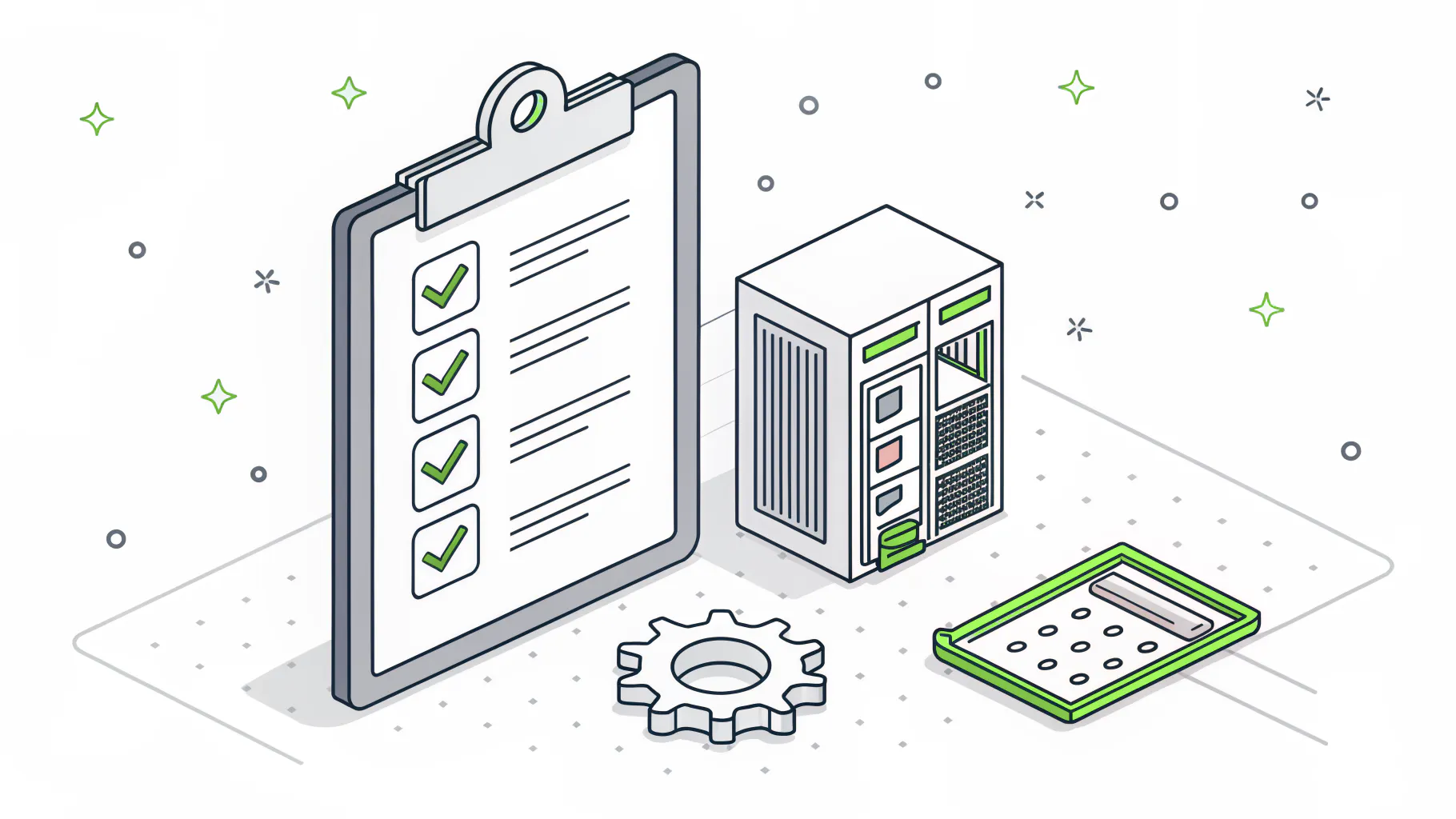
Start with a gap assessment against NIST CSF 2.0. The SSCA maps directly to the 6 NIST functions. If you know where your gaps are against the framework, you know where you'll struggle on the assessment. A gap assessment takes 2-4 hours for the initial review and produces a prioritized remediation list.
Build the evidence library before you need it. Don't wait until the questionnaire arrives. Start collecting policies, configurations, logs, training records, and test results now. Organize them by NIST function so they map directly to the SSCA structure.
Close the documentation gaps first. Documentation failures are the #1 reason companies score poorly. If you have access controls in place but no written policy, write the policy. If you have backups running but haven't tested a restore, run the test and document the results. If you have security monitoring but no formal detection procedures, formalize them.
Address the structural gaps next. Missing security monitoring? Deploy a managed SIEM/SOC. No incident response plan? Write one and run a tabletop exercise. No risk assessment? Conduct one. These are the gaps that take longer to close and require budget allocation.
Run through the SSCA yourself before a customer sends it. The questionnaire is free and publicly available from SEMI. Download it. Walk through it. Score yourself honestly. The self-assessment tells you exactly where you'll struggle and gives you time to fix it.
Where Companies Get Stuck
Govern function. If cybersecurity doesn't have executive sponsorship, a budget line, and a named owner, the governance section is going to be weak. This isn't a technical problem. It's an organizational one. A vCISO engagement solves it by providing the strategic leadership function externally.
Detect function. Security monitoring is the biggest capability gap for mid-market manufacturers. Building an internal SOC isn't realistic. A managed SIEM/SOC gives you the detection capability and the compliance evidence the SSCA requires without the headcount.
Evidence across all functions. Even companies with strong technical controls fail because they can't produce evidence. The assessment process is fundamentally about documentation. If your policies haven't been reviewed in 3 years, your training records don't exist, and your backup restore tests aren't documented, you'll score poorly even if your actual security is decent.
How Consilien Helps Semiconductor Suppliers Prepare
We run compliance readiness engagements for electronics and semiconductor manufacturers that cover the SSCA, SEMI E187, NIST SP 800-171, CMMC, and ISO 27001. The work looks like this.
Gap assessment mapped to the SSCA's 6 functions. Remediation roadmap prioritized by what your customers care about most. Control implementation and documentation alongside your IT team. Evidence library built and organized. Pre-assessment dry run before your customer sends the questionnaire.
For a deeper look at the fab equipment cybersecurity standard that the SSCA builds on, read our SEMI E187 compliance guide.