How Much Does a vCIO Cost? (2026 Pricing Guide)
A vCIO costs about $200 to $350 an hour, or $2,500 to $8,000 a month on a standard retainer. Light advisory starts near $1,000 a month. An interim CIO filling a vacant seat runs $14,000 to $20,000 or more.
Table of Contents
Think of a vCIO, or virtual chief information officer, as a part-time technology executive who owns your IT roadmap, your technology budget, and the vendor decisions that quietly eat both, without ever sitting on your payroll or in your org chart. The monthly fee is the number everyone asks about first. It's also the least useful number on the quote.
What matters is how many hours of senior judgment that fee actually buys. Two proposals at $3,000 a month can sit 10x apart once you divide by the hours. Consilien runs a vCIO practice for businesses nationwide, and the vCIO cost 2026 ranges below come from public rate data, Bureau of Labor Statistics wage tables, and plain hours-times-rate math. No rate card. You can check every figure.
What does a vCIO cost in 2026?
A standard vCIO retainer costs $2,500 to $8,000 a month for roughly 8 to 20 hours of senior time. Hourly work runs $200 to $350. Interim CIO coverage, 40 or more hours a month, costs $14,000 to $20,000 and up.
There's no independent survey of virtual CIO pricing. None. What exists are provider rate pages and a few marketplaces that publish what fractional executives actually charge, and once you line those up by hours, the spread stops looking random. MentorCruise's fractional CIO pricing puts advisory work at $4,000 to $6,000 for 8 to 12 hours a month and lists hourly rates from $150 to $375, which is the top of the market, since that marketplace skews toward former enterprise CIOs. Consilien's own vCIO vs. full-time CIO breakdown lands on $2,500 to $8,000 a month and $200 to $350 an hour.
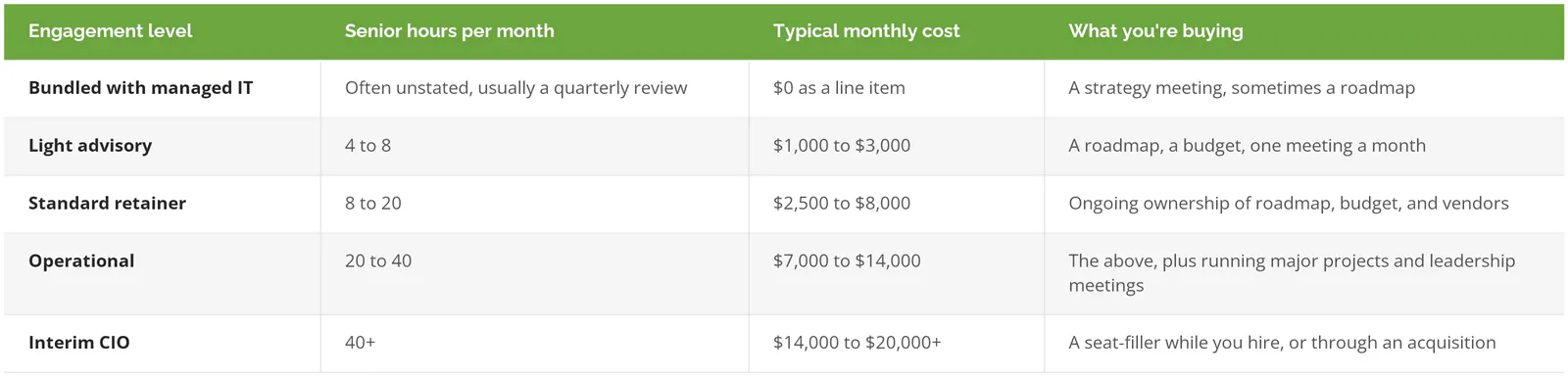
Watch the hours column. $200 to $350 an hour times the hours gets you the dollars, give or take a provider's minimum fee.
How do vCIOs charge?

Four models show up on real quotes. Hourly, monthly retainer, fixed project, and bundled into a managed IT contract. The retainer is where ongoing work lives, and it's the one worth comparing line by line.
Hourly
Good for a second opinion on a big purchase, a vendor contract review, or a one-time assessment. You'll pay $200 to $350 an hour, and MentorCruise notes that former enterprise CIOs with large transformation projects behind them charge $275 to $375. The catch? Nobody owns anything between calls. So the roadmap you paid for in January has no one checking it in June.
Monthly retainer
Flat fee. A set block of hours and named deliverables. It's how a roadmap actually gets maintained, revised every quarter as the business changes, instead of being written once during onboarding and left to collect dust in a shared drive nobody opens. Most ongoing vCIO work sits here.
Fixed project
One deliverable. A start date and an end date. Think an IT strategy assessment, a three-year roadmap, or an M&A technology review. Projects are a smart way to test a vCIO before committing to a retainer. If you want the roadmap piece on its own, that's what technology roadmap consulting is for.
Bundled into managed IT
Here the vCIO shows up as a feature of your managed IT agreement instead of a separate invoice. Some providers include it in every plan. Others sell it as an add-on, and an MSP coaching guide from Humanize IT has suggested since 2017 that providers price the vCIO add-on at about 20% of the managed services bill. On a $5,000-a-month IT contract, that's $1,000 a month, which their own math pegs at about 5 hours.
Five hours. That's a QBR with some prep.
QBR stands for quarterly business review, the meeting where your provider walks leadership through what broke last quarter, what it cost to fix, which renewals are coming up, and what they think you should spend money on next. Useful. But a QBR alone isn't a vCIO.
What should a vCIO retainer include?

Every retainer should name the deliverables, the hours, and the meeting cadence in writing. At minimum that means a multi-year roadmap, an annual IT budget, quarterly reviews, and vendor oversight. If the proposal lists only "strategic guidance," ask what you'll actually receive.
Here's the floor for a standard retainer:
- A written IT roadmap covering the next 1 to 3 years, refreshed at least once a year. If you've never seen one, what an IT roadmap is walks through the format.
- An annual technology budget with hardware replacement dates and software renewal dates on it, so a 60-laptop refresh isn't a surprise in March.
- Quarterly reviews with leadership, not just with your IT person.
- Vendor and contract oversight. Who renews what, when, and whether the price went up.
- A risk view that connects IT decisions to business exposure, which is the same lens behind looking at your infrastructure like a vCIO.
- Monthly check-ins? Depends on the tier. At 8+ hours, you should get them.
What it shouldn't include matters just as much. Engineers' hours, project labor, and help desk tickets are billed separately, and a quote that blurs that line will usually burn your senior hours on work a technician at a third of the rate should be doing. Compliance is billed separately too. NIST, CMMC, PCI, and SOC 2 readiness is its own service with its own scope and price, and a vCIO coordinates with it rather than replacing it. A vCIO who quietly absorbs all of that isn't a bargain. They're a project manager you're overpaying, or an executive you're underusing.
How do you compare two vCIO quotes?
Divide each monthly fee by the senior hours it commits to in writing. That's your real rate. A cheap quote with no stated hours often costs more per hour of actual executive time than a pricier one with hours spelled out.
Take an illustrative pair. These aren't real proposals, just the two shapes that land on a CFO's desk.
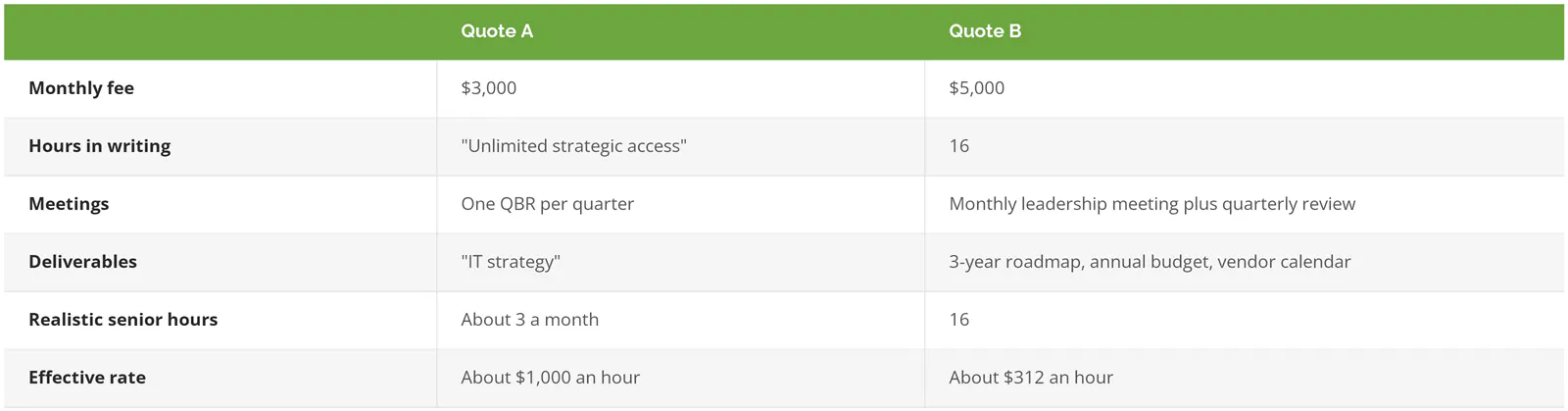
Quote A looks cheaper. It isn't. It's three times the price per hour. And "unlimited" usually means unlimited email replies, which is a different thing from someone senior sitting down to rework your three-year plan because you just bought a second facility.
Three questions sort it out fast:
- How many hours a month are committed, and what happens to the unused ones?
- Who exactly is the vCIO, and how many other clients are they carrying?
- What will I have in hand after 90 days?
That third question separates a vCIO from a salesperson with a nice title. Push on it. A real answer sounds like a current-state assessment in the first month, a draft roadmap and budget by the second, and a leadership review on the calendar by the third, with names attached to each.
One more risk comes with any bundled vCIO. When the person setting your strategy works for the company that sells you the tools, every recommendation to consolidate onto their stack deserves a second look. Ask for the reasoning in writing, and ask what the alternative would cost. A good vCIO answers that without flinching.
What does a full-time CIO cost by comparison?
The Bureau of Labor Statistics puts the median pay for computer and information systems managers at $175,140, and $218,290 in California. Add benefits and payroll costs, and that's about $250,000 to $312,000 a year before a CIO-level premium.
That BLS category, computer and information systems managers, lumps IT directors in with CIOs. So treat it as a floor. The May 2025 figures from the BLS occupational wage tables run $175,140 nationally, $204,370 in the Los Angeles metro, and $218,290 statewide in California. Wages and salaries made up 70.0% of private-industry compensation in June 2026, per BLS. Divide by 0.70 and a $175,140 salary costs an employer roughly $250,200 a year, or about $20,850 a month. In California, closer to $312,000.

Look at the bottom row and the top row together. An interim vCIO at $20,000 a month costs almost exactly what a full-time hire does. That's the crossover. If you genuinely need 40-plus senior hours every month with no end date, hire the person. The fractional model wins when the need is real but partial. For a growing business that sells something other than software and runs its day on Microsoft 365, an ERP, and a handful of line-of-business apps, the need almost always looks like that.
And recruiting isn't free. Executive search fees and the months the seat sits empty don't show up in the BLS numbers at all.
What pushes vCIO pricing up?
Complexity, not headcount. Multiple locations, acquisitions, a cloud migration in flight, heavy vendor sprawl, or an AI rollout nobody owns will push you into the operational tier faster than adding employees will.
Budgets are under pressure from outside too. Gartner's July 2026 forecast has worldwide IT spending up 14.2% to $6.37 trillion this year, with Gartner pointing at rising hardware and memory costs. Somebody has to decide which of those increases you actually absorb. That's the vCIO's job. More moving parts, more hours.
Picture two companies. A distributor with two warehouses on the same ERP system (the software that runs orders, inventory, and accounting) needs far less vCIO time than a manufacturer folding in a newly acquired plant that arrives with its own email system, its own ERP, and a different backup vendor nobody has a login for. Same size on paper. Very different month.
Industry matters a bit too. Manufacturers carry shop-floor systems that office-only firms don't, which is why there's a separate page for vCIO services for manufacturing.
Is a vCIO the same as a vCISO?
No. A vCIO owns technology direction and spend. A vCISO, or virtual chief information security officer, owns the security program. vCISO retainers usually run higher, from $3,000 to $20,000 a month.
The roles overlap on risk, and in a small company one advisor sometimes covers both, but a vCISO spends their hours on policies, audit evidence, incident plans, and customer security questionnaires that a vCIO would never touch in a normal month. Different work. Different price. The vCISO cost and pricing guide has the full breakdown for the security side. If your real problem is audit pressure or a customer security questionnaire, start there, not here.
When a vCIO isn't worth the money
Skip it if the company is very small and informal, if leadership won't commit to a plan and then follow it, or if you just need someone to fix things. Strategy without follow-through is an expensive document.
Three situations where I'd tell you to spend the money elsewhere.
You have a CIO or a strong IT director already. A good one doesn't need a part-time version of themselves. They may need project help, which is a different kind of IT consulting engagement.
You want tickets closed. That's managed IT or help desk support, and a vCIO won't make your printer work.
Leadership won't show up to the quarterly meeting. I mean this literally. If the CEO and CFO won't spend 90 minutes four times a year on the roadmap, the vCIO ends up writing careful plans for an empty room, and you end up paying a senior rate for documents that never change a single purchasing decision. Save the money.
What Consilien's vCIO work looks like
Consilien is a security-first managed IT and IT advisory firm that works with businesses nationwide. vCIO leadership is part of how Consilien runs managed IT, and it's designed to work alongside security and compliance rather than as standalone consulting. The model follows four steps. Assess the current environment and risk, plan a prioritized roadmap, execute alongside your team and vendors, then govern through regular executive reviews.
If you've got a vCIO proposal on your desk and can't tell what the hours look like, send it over. Speak to a vCIO expert and we'll walk through what it actually commits to.