How a vCISO Accelerates Compliance Programs (and What It Can't Speed Up)
A vCISO speeds up a compliance program by settling scope early, putting a named owner on every control, and ordering the work so nothing gets redone. It can't shorten a SOC 2 observation window or an auditor's calendar. Those clocks are fixed. Most of what comes before them isn't.
Table of Contents
One federal rule says the quiet part out loud. The FTC Safeguards Rule, which covers a wide band of non-bank financial businesses from mortgage brokers to tax preparers, lets the person running your information security program work for a service provider. You still keep responsibility for compliance. And you have to name a senior person inside the company to oversee them.
That's a vCISO compliance program in one regulation. The leadership can come from outside. The accountability stays home.
A vCISO, or virtual chief information security officer, is a part-time security executive on contract. Consilien's virtual CISO services put one at the head of a company's security and compliance work for a monthly fee instead of a full-time executive salary.
Speed is usually why executives ask. A customer wants a SOC 2 report by the second quarter. A prime contractor wants your NIST score current before it renews a purchase order. Does a part-time executive shorten that path, or just add a standing meeting?
It depends on where your time is going. Usually it isn't the auditor.
Where does compliance time actually go?
Compliance time goes to delays the auditor never sees. Scope nobody has decided. Controls with no owner. And work done in the wrong order, then done again once someone notices.
A vCISO compliance program is a compliance effort led by a contract security executive who sets scope, assigns an owner to every control, orders the remediation, and manages the auditor relationship, while the company's own leadership keeps the accountability. Vanta's 2024 State of Trust survey of 2,500 business and IT leaders put the load at 11 working weeks a year on compliance tasks. That's about a fifth of somebody's year.
Very little of it is spent with the auditor.
The people who would normally untangle this are hard to find. In ISC2's 2025 study of 16,029 security professionals, 59% reported critical or significant skills gaps on their teams, up from 44% the year before, and 88% said a skills shortage had already caused at least one significant security consequence. So the work lands on whoever's closest. Usually IT. Specifically, an IT manager with a full ticket queue and no authority to tell the sales VP that the CRM is in scope.

Delay 1: nobody decides the scope
Scope sits underneath every other decision, and it's the one that stalls longest because it isn't anyone's job.
For SOC 2, scope is the system description, meaning which product, which infrastructure, and which of the 5 Trust Services Criteria the report covers. Security is mandatory. The other 4 are choices, and every one you add is more testing. For CMMC Level 2, scope is about where CUI lives. CUI, or controlled unclassified information, is the government's label for sensitive data that isn't classified, like the drawings and specs a defense prime shares with its suppliers.
Picture an 80-person machine shop that handles CUI on 2 engineering workstations and a single file share. Scoped loosely, all 80 laptops, the ERP, and every PC on the shop floor sit inside the assessment, and each of the 110 requirements in NIST SP 800-171 Rev 2 applies to all of them. Scoped as an enclave, a walled-off set of systems that are the only ones allowed to touch CUI, it might be a dozen machines.
Same company. Very different project.
Nobody inside is wrong to hesitate. IT doesn't want to own a business decision, and the business doesn't know what the technical options cost, so the question bounces between them in email for weeks. A vCISO's first real deliverable is often a 1-page scope statement the CEO signs. Dull document. It ends the bouncing.
Framework order? Also a scope decision. If you touch CUI, start with 800-171, because it's the most prescriptive and a lot of SOC 2 falls out of it. If a SaaS customer is the one asking, SOC 2 usually goes first.
Delay 2: who actually owns each control?
Every major framework requires named ownership, and the gap surfaces in audits as evidence nobody can produce. A vCISO builds and runs the owner list. Your leadership still holds the accountability, and the frameworks are explicit about that.
Read the frameworks side by side and they agree on this one point more than on almost anything else:
- SOC 2's Trust Services Criteria include CC1.3, where management, with board oversight, sets structures, reporting lines, and authorities.
- ISO 27001 clause 5.3. Top management assigns responsibility for the ISMS, the information security management system, which is the policies, risk process, and controls run as one program, and for reporting on how it performs.
- In NIST CSF 2.0, the Govern function opens its roles category with leadership being responsible and accountable for cybersecurity risk (GV.RR-01).
- PCI DSS 4.0.1 requirement 12.4.1 applies to service providers and wants an executive named as accountable, plus a written charter.
Not one of them cares who does the work. They care that a specific person was told to do it, knew it, and can show it happened.
The stall looks like this in practice. A user access review is due every quarter. It's "IT's job." IT is a 2-person team, the review slips behind a laptop rollout, and in month 9 the auditor asks for 3 quarters of review evidence that doesn't exist. Not a security failure, really. The accounts might be fine. It's an ownership failure, and it costs you an exception in the report.
The owner list fixes the slip, not the person. Each control gets a name, a cadence, and a folder where the evidence lands, and the vCISO walks the list every month and chases what's late. I described assigning ownership as step 3 of building an information security compliance program. The vCISO is the one who keeps that list alive after the kickoff meeting ends and everyone goes back to their day jobs.
One thing a vCISO shouldn't be is the signer. Under SOC 2, management makes the assertion. Under CMMC, a senior official at your company affirms the score. Your vCISO prepares both and should tell you, without softening it, when you aren't ready to sign.
Delay 3: work done in the wrong order
Rework is the expensive delay. It looks like progress while it's happening.
Policies first is the classic version. A 40-page policy set pulled from a template describes controls the company doesn't run, and auditors test what you do against what you wrote. Write the policy before the practice and you've put the gap into the record yourself.
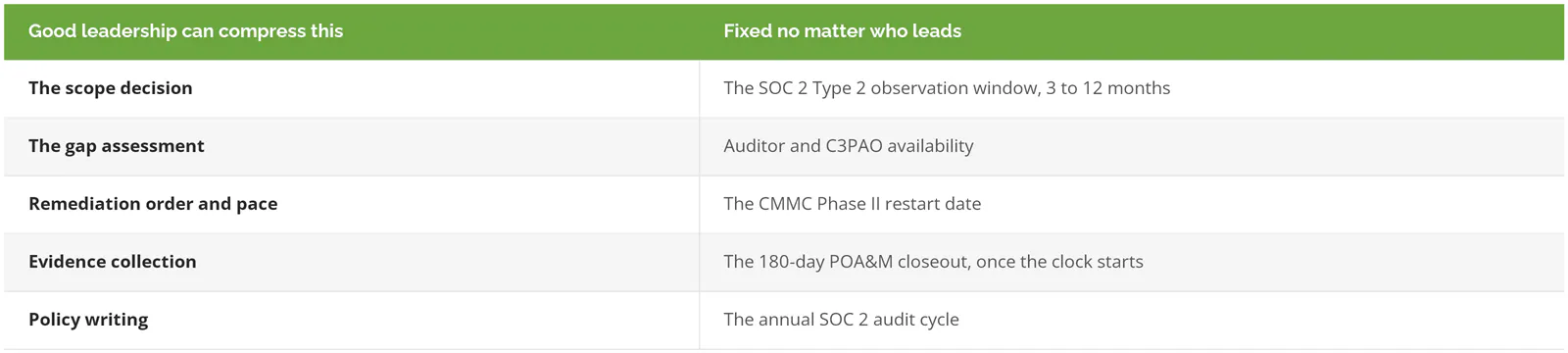
The SOC 2 Type 2 window is the second. A Type 2 report covers an observation period that typically runs 3 to 12 months, and the auditor samples evidence across all of it. Open the window in January and switch on multi-factor authentication in March, and January and February become the part of the report your customers ask about.
Then there's CMMC. Its version is stricter than people expect. A Level 2 assessment can end in Conditional status with open items listed on a POA&M, short for plan of action and milestones, which is the formal list of gaps you've committed to close. But 32 CFR 170.21 caps it hard, requiring a score of at least 0.8 of the maximum, allowing nothing worth more than 1 point on the list except encryption on CUI that isn't FIPS-validated (certified under the federal encryption standard), barring 6 named requirements outright, and expiring the conditional status if the items don't close within 180 days.
Plans to "just POA&M it" fall apart here. Any requirement worth 3 or 5 points, MFA included, can't go on the list at all. Expensive surprise. A vCISO sorts the list on day 1, eligible from ineligible, and moves the ineligible items to the front of the queue. Our breakdown of the 110 CMMC Level 2 controls covers the point values if you want to check your own list against it.
How does one program cover SOC 2, CMMC, and NIST at once?
Build each control once and map it to every framework you answer to. SOC 2, ISO 27001, NIST CSF, and NIST 800-171 overlap heavily on access control, logging, change management, backup, and incident response, so one tested control can supply evidence to several audits.
The overlap isn't a sales claim. The AICPA publishes its own mappings of the Trust Services Criteria to NIST CSF and to ISO 27001. A vCISO keeps one control list with a column per framework, so the MFA control and its evidence folder get cited in 3 places instead of rebuilt 3 times.
Mapping has limits, though. It saves the build. It doesn't save the separate audit, the separate fee, or the paperwork each framework wants for itself.
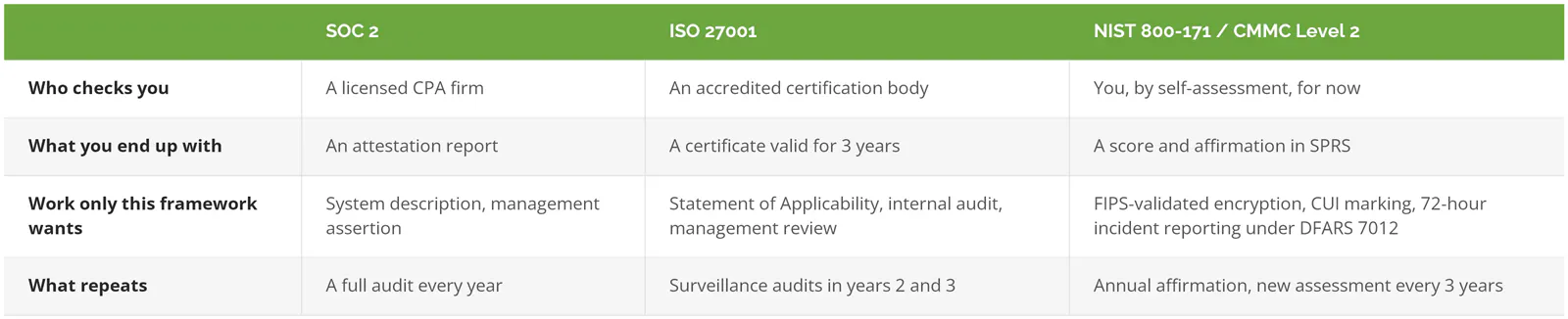
SPRS is the Department of War database where your self-assessment score lives, and contracting officers check it before award. Consilien runs compliance as its own service, separate from managed IT, and for a company facing SOC 2 and CMMC at the same time, a single mapped control list is where that work starts.
What a vCISO's first 90 days on a compliance program look like
Days 1-30. Scope statement signed. A gap assessment against the framework, done by interviewing people and looking at real settings in Microsoft 365, the firewall, and the backup console, not by sending a questionnaire. An owner list with a name on every control. If CMMC is in play, the POA&M sort.
Days 31-60. Remediation in the order the evidence needs it. Identity usually comes first, because MFA and access reviews feed a large share of the controls in every framework. Then logging, backups somebody has test-restored, and change tracking. Policies get written now, against controls that exist.
Days 61-90. Evidence collection runs on a schedule instead of in a panic. A readiness review with your auditor, or a mock assessment, goes on the calendar. For a SOC 2 Type 2, the observation window opens only after the controls have run cleanly for a few weeks.
That's a planning shape, not a promise. A company starting with no MFA and an undocumented network will take longer, sometimes a lot longer. One that already answers customer security questionnaires honestly might get through the first 30 days in 10. Both are normal.
What can't a vCISO speed up?
A vCISO can't shorten the SOC 2 Type 2 observation window or move an auditor's booking calendar. What a vCISO can do is make sure those clocks start on the first day they're allowed to, with nothing left to redo once they're running.
CMMC has a third clock right now, and it's a policy clock. The Department of War suspended CMMC Phase II on July 13, 2026, the phase that would have required C3PAO certification (a C3PAO is an outside firm authorized to assess CMMC) for CUI contracts starting November 10, according to CSIS's analysis of the pause. The reform task force's report went to the DoW CIO in September and, as Covington's September update noted, hadn't been made public.
None of that pauses the underlying obligation. Self-assessments against 800-171 Rev 2, a current score and affirmation in SPRS, and DFARS 252.204-7012 incident reporting all still apply, and DoW has said it intends to keep enforcing them. A supplier who reads "suspended" as "optional" is setting up a bad conversation with a contracting officer. Don't be that supplier.
The vCISO move here? Unglamorous. Keep the self-assessment honest and the affirmation current, and be ready to book a C3PAO the week the rule comes back.
vCISO, compliance platform, or consultant?
These get compared as if they were substitutes. They aren't. They work at different layers.
A compliance platform like Vanta or Drata connects to your cloud accounts, HR system, and identity provider and collects evidence on its own. It's very good at telling you a laptop is missing disk encryption. It won't tell you whether that laptop should be in scope at all. Different job.
A compliance consultant usually comes in for a defined project, a gap assessment or audit prep, and then leaves.
The vCISO stays. Month to month. The value shows up in decisions between audits, like a new customer asking for ISO 27001, a new SaaS tool that touches customer data, or an acquisition that brings in a network nobody documented. Plenty of companies end up with a platform and a vCISO together, the vCISO deciding and the platform proving. We compared building evidence collection yourself against buying it in compliance automation, build vs. buy.
A rough guide to which one fits:
- A platform on its own works for a single framework and a technical team that can fix whatever it flags.
- A consultant fits a one-time readiness push before a known audit date.
- A vCISO makes sense with 2 or more frameworks, no internal security lead, or a board or customer that wants a named security executive on the hook.
Skip the vCISO if any of these are true
You already have a security lead with time. A full-time CISO, or a senior security engineer who owns compliance, makes a vCISO overlap.
It's one framework and you have real hours to give it. A SaaS company with engineers who can fix what the platform flags can run a first SOC 2 without outside leadership. That's doable.
Nobody is asking. If no customer, prime, regulator, or insurer wants proof, spend the year on the controls themselves. Compliance doesn't equal security, and an audit nobody required is a cost with a report attached.
If you're still working out where the role starts and stops, Fred Romero's guide to what a vCISO does covers the job itself, and our vCISO pricing breakdown covers what it costs.
Consilien is a managed IT and cybersecurity company headquartered in Torrance, California, working with businesses nationwide. Its vCISO service gives a company a contract security executive who sets scope, owns the control list, and sits between leadership and the auditor. Compliance readiness for SOC 2, CMMC, ISO 27001, NIST, and PCI DSS is a separate service from managed IT and is scoped on its own.
If a customer or a prime has handed you a deadline and you can't tell which of these delays is eating your calendar, speak to a vCISO expert.