What Is a Zero-Day Vulnerability? A Business Guide for 2026
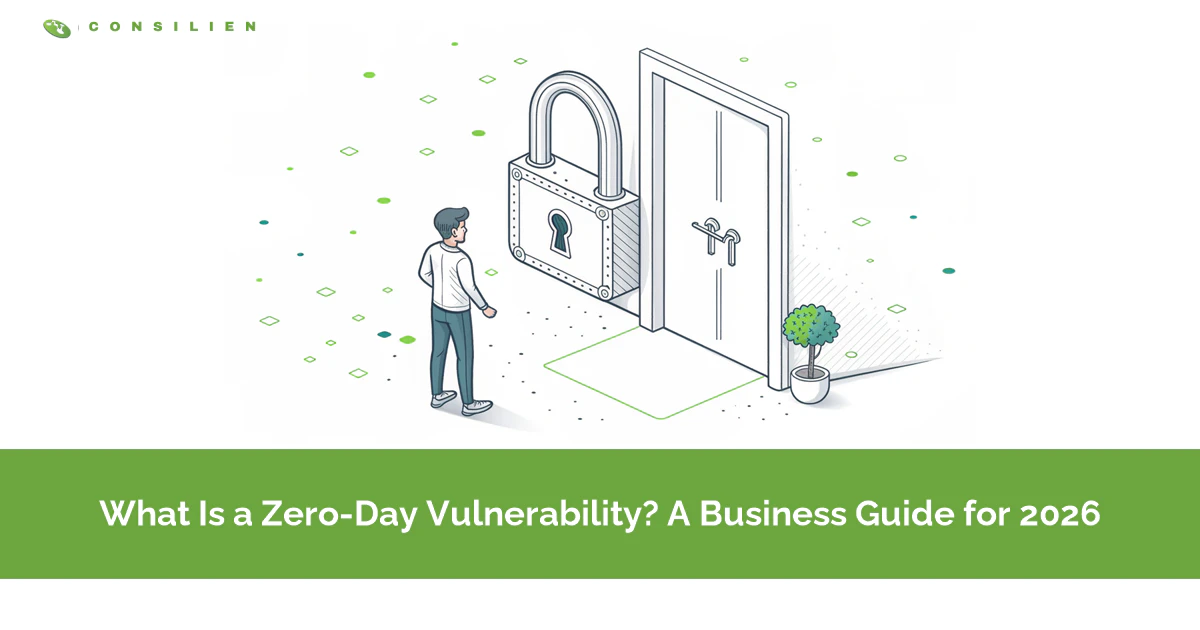
Zero-days get the headlines. They aren't what breaks most companies. Google tracked 90 of them exploited in the wild during 2025, while the median company took 43 days to fix flaws that were already public, already patched, and already being used against them. The gap between those two numbers is the thing worth managing, and it's the one almost nobody puts on a dashboard.
Table of Contents
A zero-day vulnerability is a software flaw the vendor doesn't know about yet, so no patch exists. Attackers who find it first can exploit it while every affected company sits fully exposed. The name refers to the vendor having zero days of warning. Ask a CEO what keeps them up at night and zero-day vulnerability lands near the top of the list. It sounds unstoppable. A flaw nobody knew about, no patch, no warning.
That reputation is half earned. They're real, and they're showing up more often in the software businesses actually run. Google Threat Intelligence Group counted 90 exploited in the wild during 2025, and nearly half of those hit enterprise software and appliances. The number that should worry you sits somewhere else entirely. Verizon's 2026 breach report found that companies now take a median of 43 days to fix flaws that are publicly known, already patched by the vendor, and confirmed by the U.S. government to be under active attack right now. Not secret ones. Known ones.
So the honest version of this topic isn't how you stop a zero-day. It's how long your company stays exposed after the world already knows. A managed cybersecurity program answers the second question. Nothing answers the first.
What Is a Zero-Day Vulnerability, Exactly?
A zero-day vulnerability is a flaw in software, firmware, or hardware that the vendor hasn't discovered yet. No patch exists. The name comes from the vendor having zero days of warning before the flaw gets used against real targets.
Three terms get used interchangeably and they shouldn't be. The vulnerability is the flaw. The exploit is the working code somebody wrote to abuse it. The attack is that code being pointed at your network on a Tuesday afternoon. You can have a zero-day vulnerability sitting quietly in your firewall for two years, never spotted by anyone outside the vendor's own codebase, with nobody ever bothering to write an exploit for it. You can also have one weaponized within hours. Same flaw. Wildly different outcome.
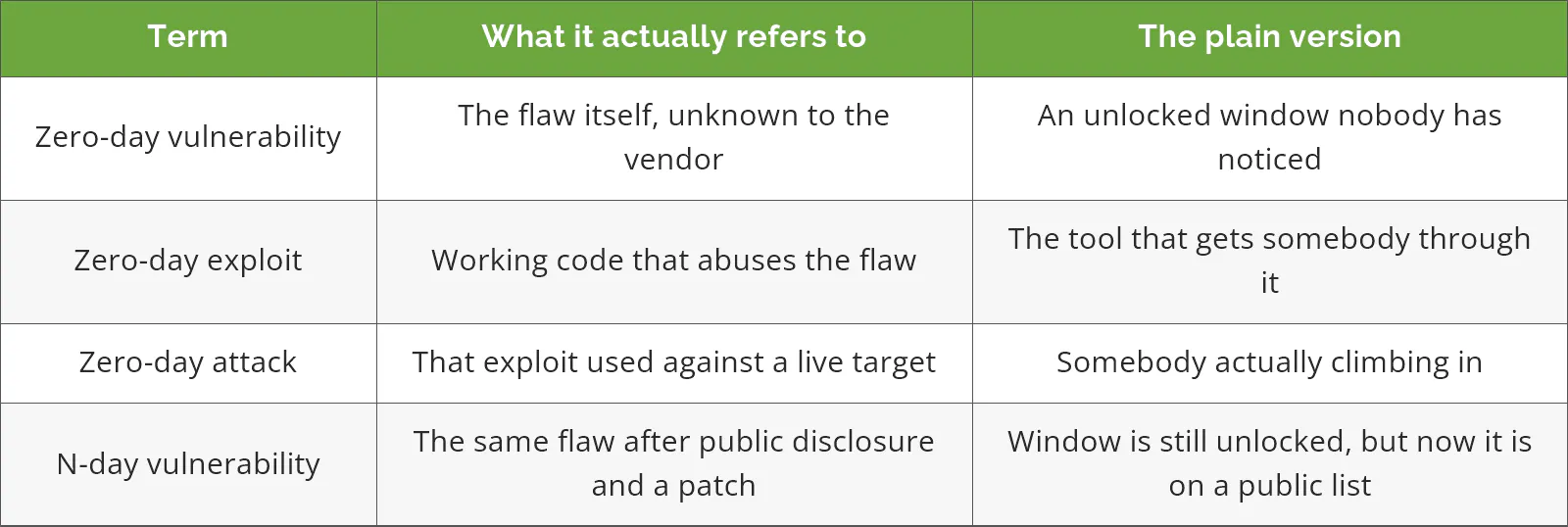
That last row is the one that costs money. More on it shortly.
Why the Term Zero-Day Doesn't Mean What It Used To
For years the mental model was a race. Vendor discovers a flaw, ships a patch, and you install it before attackers reverse-engineer the fix. Defenders had a head start. That head start is gone.
Mandiant has been tracking the gap between public disclosure and first observed exploitation for years. In 2018 the average was 63 days. Attackers needed two months to turn an advisory into a working attack. By 2024 the number crossed zero. In M-Trends 2026, the mean time to exploit is negative seven days.
Read that again. On average, exploitation campaigns begin a full week before the flaw is publicly disclosed and before any patch exists. Roughly 32% of exploited vulnerabilities are hit on or before their disclosure date. Another 28% get weaponized inside 24 hours of the advisory going live.
Which means the distinction between a zero-day and a regular vulnerability has quietly collapsed from where you sit. For a 90-person distributor running a Fortinet firewall and a Microsoft 365 tenant, a flaw disclosed Monday and exploited Tuesday is operationally identical to one nobody knew about, because in both cases the attack arrived before the patch did and nobody in the building had a chance to act. Either way you were exposed. Either way it wasn't your fault, and either way it was still your problem.
How a Zero-Day Actually Reaches Your Business
Most explanations of this walk through the vendor's timeline. Flaw introduced, flaw discovered, patch written, patch shipped. Useful for the vendor. Not useful for you.
Here's your timeline instead.
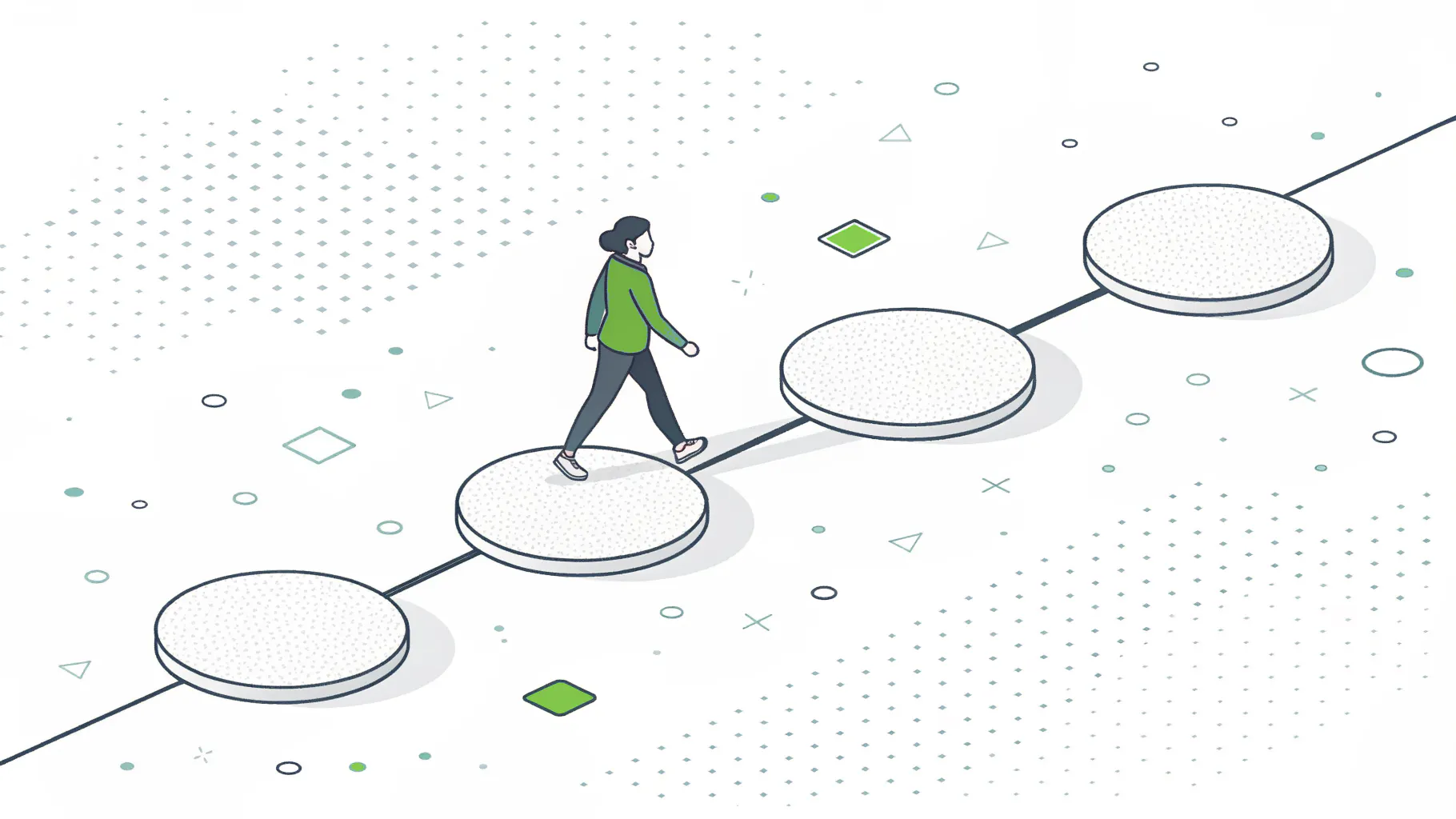
Someone finds the flaw. Could be a researcher who reports it responsibly. Could be a commercial surveillance vendor selling access to governments, a category that in 2025 accounted for more zero-day exploitation than traditional state-sponsored espionage groups for the first time since Google started tracking it. Could be a ransomware crew. You never find out which until later, and often not at all.
Then it gets used quietly. A working exploit against a VPN appliance is expensive to build, so early on it gets pointed at a handful of high-value targets. Nothing hits the news. Your logs look normal, because the traffic is authenticated and the account it's using is legitimate.
Eventually it goes loud. Once the exploit leaks, gets sold down-market, or shows up as a public proof of concept on GitHub, the target list expands overnight to include every company on earth running that appliance with a public IP. Scanning is automated and cheap. Nobody decided your company was interesting. A script found your IP.
Only then does the vendor ship a fix, and the clock you actually control starts running. Everything up to that point was out of your hands entirely, decided by researchers you'll never meet, criminals you'll never identify, and a vendor engineering team you have no visibility into. Everything after is a management decision. Yours.
The Exposure Gap Is Your Real Number
Your real risk isn't the zero-day. It's the distance between when attacks start and when your environment stops being vulnerable. Two published 2026 figures define that distance, and they're more useful side by side than either is alone.
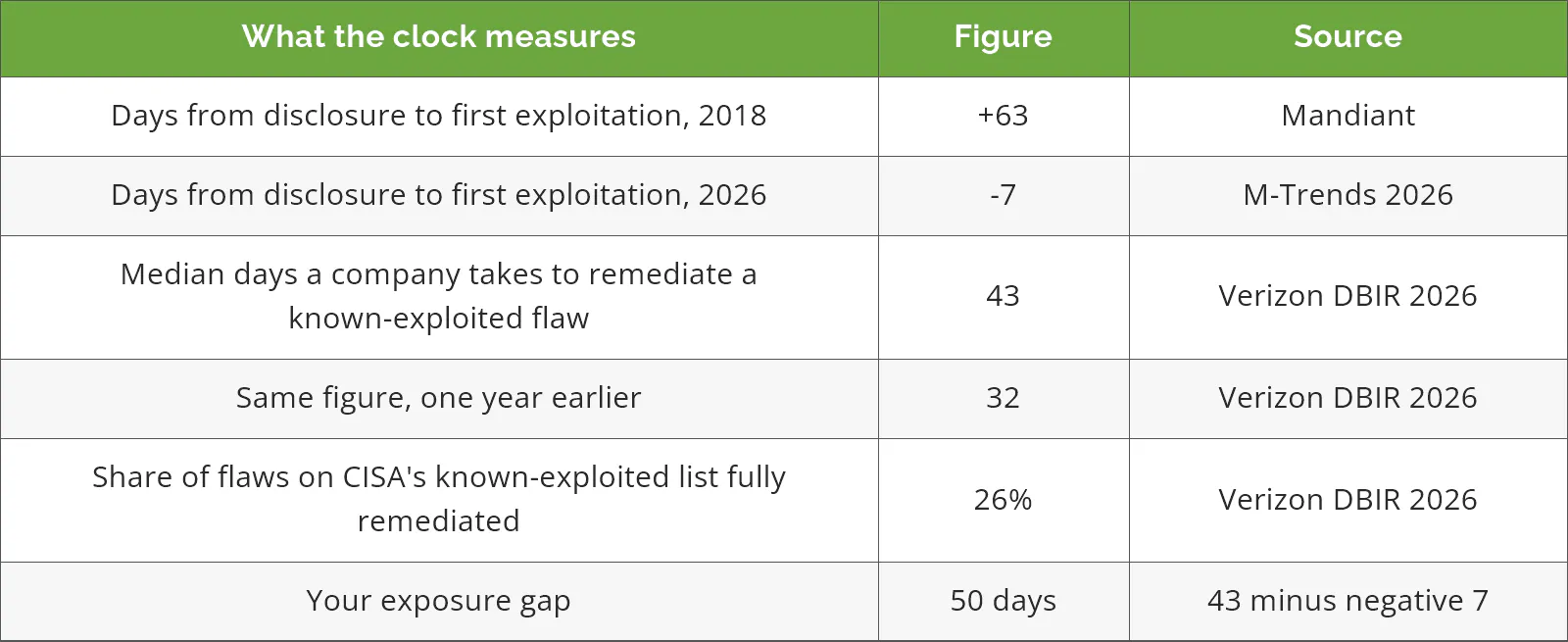
Fifty days. That's the window where a flaw is being actively exploited somewhere in the world and your systems still have it, sitting open, with a vendor patch available and nobody in the organization assigned to install it. Attackers got 70 days faster since 2018. Defenders got 11 days slower in a single year, according to the 2026 Data Breach Investigations Report.
Both lines are moving the wrong way at once. That's the whole problem, and it has nothing to do with how clever the original zero-day was.
Your Zero-Day Problem Is Mostly an N-Day Problem
Every vulnerability stops being a zero-day the moment it goes public. It becomes an n-day, meaning n days have passed since disclosure. The flaw is identical. The patch now exists. What changed is that attackers no longer need original research to use it. Neither does anyone else.
Verizon's 2026 report found that only 26% of vulnerabilities in CISA's Known Exploited Vulnerabilities catalog were fully remediated by the organizations it studied. Down from 38% the year before. These are flaws the U.S. government has publicly confirmed are being used in real attacks right now. Three quarters of them stay open.
Vulnerability exploitation became the single most common way breaches start in 2026, at 31% of initial access, up from 20%. Not phishing. Not stolen passwords. Unpatched software.
So the useful answer to how do you defend against zero-days usually starts somewhere else. How fast does your patch management process actually move? Do you have an inventory of what's internet-facing? Does anyone own the decision to take a production system down on a Thursday? A serious vulnerability management program answers all three of those questions on paper with names attached, and it will do more for your actual risk position than any product marketed specifically at zero-day protection.
Worth knowing what these programs don't catch. Scanning finds known flaws by matching your systems against a database of published CVEs, the public catalog of known software flaws. A true zero-day isn't in that database. It can't be. So the scan comes back clean and the flaw is still there, which is exactly why the controls in the next section matter.
Why Your Security Appliance Became the Target
What attackers go after has shifted, and the direction is counterintuitive enough to be worth stating plainly.
Of the 43 enterprise zero-days Google tracked in 2025, 21 were in security and networking products. Firewalls. VPN concentrators. Mobile device management platforms. The equipment you bought specifically to protect the business is now the most attractive door into it.
Makes sense once you see it. A VPN appliance sits at the edge, faces the internet by design, holds a set of working credentials, and usually runs a locked-down operating system that nobody on your team can inspect, patch independently, or install monitoring software on. Compromise it and you skip every other control. Verizon measured the result. Edge devices and VPNs went from 3% of exploitation-driven breaches to 22% in one year.
2026 has kept the pattern going. Ivanti disclosed two critical Endpoint Manager Mobile flaws on January 29, and within a day attacks tied to them hit the European Commission along with Dutch and Finnish government agencies. Two months later, security researchers observed exploitation of a FortiClient EMS flaw days before Fortinet published its advisory. Customers were compromised before they were told there was a problem. That's the pattern now.
None of that means your next-generation firewall is a liability. It means the firewall needs patching with the same urgency as your servers, and it usually doesn't get it, because taking down the appliance that connects the plant to headquarters requires a conversation nobody wants to have.
What to Do When There Is No Patch
You can't patch what the vendor hasn't fixed. So the goal shifts from prevention to containment. Assume something will get through and make sure it doesn't reach anything worth taking.
The controls that actually work against an unknown flaw share one trait. They watch behavior instead of matching signatures.

- Behavioral endpoint detection. Signature-based antivirus is useless here by definition, since there's no signature for a flaw nobody has published. Endpoint detection and response tools flag the behavior instead, things like a PDF reader spawning PowerShell, or a service account suddenly touching the file server at 2 a.m.
- Shrink what's reachable from the internet. Every appliance with a public IP is a candidate for the next Ivanti. Most companies find at least one they'd forgotten about.
- Segmentation. If the VPN box gets owned, does the attacker land in a flat network with the accounting server three hops away? Segmenting the network does more for your blast radius than anything else on this list, and it's the least fun to retrofit.
- Least privilege on service accounts, which is boring and unglamorous and stops more lateral movement than any product you can buy.
- A rehearsed response plan. When the advisory lands at 4 p.m. on a Friday, the question is whether someone has authority to act before Monday. The NIST incident response lifecycle gives you the structure. Rehearsing it gives you the speed.
- Vendor advisory monitoring, so you learn about the flaw in your firewall from the vendor rather than from your bank.
Now, when you can skip most of this. If you're running fewer than 20 users, everything is in Microsoft 365, and you own no physical appliance beyond an ISP-provided router, your zero-day exposure is genuinely small and your money is better spent on account security and backups. That advice is free and it's correct. The calculus changes the moment you put a firewall, a VPN, or an on-premise server on a public IP.
The Patch SLA Worth Stealing From CISA
The most useful thing to come out of 2026 on this topic wasn't a product. It was a policy document.
For more than four years the federal standard was BOD 22-01, which required agencies to patch anything in the KEV catalog on a flat timeline regardless of context. That directive was revoked on June 10, 2026 and replaced by BOD 26-04. The replacement scores every vulnerability against four questions. Is the asset publicly exposed? Is the flaw sitting in the KEV catalog? Then the two that separate a bad week from a bad quarter, meaning whether the exploit can be automated at scale by an adversary who has never heard of your company, and whether success hands the attacker total control of the system or only a piece of it.
Those four answers produce a 16-tier remediation matrix. Federal agencies have to follow it. You don't. But it's a published, defensible patch SLA built by people with access to actual exploitation data, and it costs nothing to adopt.
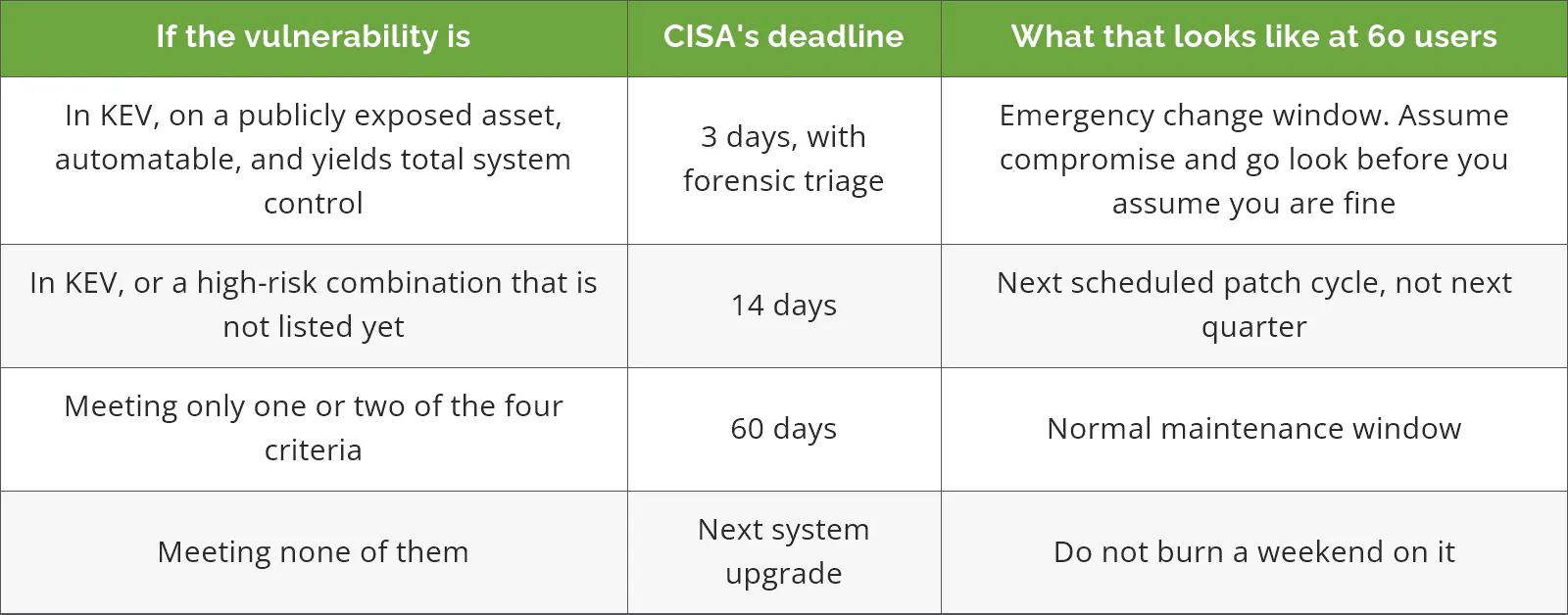
Write those four tiers into your IT policy and you've replaced patch everything urgently, which nobody actually does and everyone writes down anyway, with a graduated rule that survives contact with an ordinary Tuesday. It also gives your team air cover. When someone asks why a production system is going down on short notice, the answer is a federal risk standard rather than a hunch.
Cyber insurance underwriters have started asking about patch timelines too, so having a documented one is worth more than the security benefit alone.
What This Means for Your Business
Zero-days aren't going away. Google's count went from 78 in 2024 to 90 in 2025, and nearly half now target the enterprise software and appliances that mid-market companies run every day. You will not out-patch a flaw the vendor hasn't found. Nobody can.
What you can control is the 50 days after the world finds out. That number is a management problem, not a technical one. It comes down to whether someone owns the patch decision, whether you know what's facing the internet, and whether a compromised appliance lands the attacker in a segmented network or an open one.
Consilien is a managed IT and cybersecurity firm working with companies of 20 to 500 users in manufacturing, distribution, professional services, and real estate nationwide. We handle the unglamorous side of this, the asset inventory, the patch SLA, the managed detection and response coverage that catches behavior no signature would flag. Our approach is to translate technical risk into a business decision you can actually make, rather than handing you a dashboard and calling it a program.
If you don't know your current exposure gap, that's the first number to go find. Speak to a cybersecurity expert about what's facing the internet in your environment and how fast you can actually close it.